Best Off Grid Inverter 10kW: Top 5 Choices for Reliable Autonomous Power
Looking for an off-grid inverter around 10 kW that can power a cabin, shed, RV, or backup home system? This guide highlights five solid options designed for 48V battery banks, parallel expansion, and mixed AC outputs. Each choice suits different needs—whether you want integrated battery storage, built‑in WiFi/BMS, or flexible PV input. Use this comparison to decide which system best fits your energy goals, climate, and planned expansion. The table below summarizes the key specs and ideal buyers for quick reference.
| Product | Best For | Key Benefit | Limitations |
|---|---|---|---|
| ECO-WORTHY 10000W DC 48V UL1741 | Off-grid cabins and RVs needing parallel units | Dual MPPT, built‑in charger, 200A charging | Off-grid only, complex setup |
| ECO-WORTHY Powermega 48V 314Ah | Home backup with built‑in storage | Integrated storage, Bluetooth/WiFi monitoring | Requires compatible inverter/charger framework |
| SUNGOLDPOWER 10000W DC 48V | Large off-grid systems with WiFi | Parallel up to 6 units, 2 MPPT | Indoor IP rating not specified |
| Y&H 10KW 48V Solar Inverter | Flexible expansion and battery-less operation | CAN/USB/RS485, parallel and split/ single phase | Indoor use only, IP20 |
| Aninerel 12000W Solar Hybrid Inverter | Rugged, scalable off-grid setups | 12kW output, up to 6x in parallel | High power setup, data not fully standardized |
ECO-WORTHY 10000W DC 48V UL1741 Solar Inverter

Best for large off-grid installations where two MPPT controllers and strong charging capacity are required. This ECO-WORTHY model combines a 10,000-watt pure sine wave inverter, dual MPPT solar controllers, and a built-in inverter charger in a single 48V system. It supports parallel operation up to six units to scale power as needs grow. Output is split-phase 120V/240V or 120V single-phase, suitable for homes, cabins, and remote workshops. The unit is designed for off-grid use and cannot feed back to the utility grid.
Who it’s for: buyers seeking robust solar harvesting with clear expansion paths and integrated charging for high-capacity 48V battery banks. Why selected: the two MPPT inputs and high max charging (up to 200A total) offer flexible energy capture from larger PV arrays, making it better for sunny, expansion-ready layouts. Caution: ensure proper ventilation and electrical installation to manage heat in high-output scenarios.
ECO-WORTHY Powermega 48V 314Ah LiFePO4 System
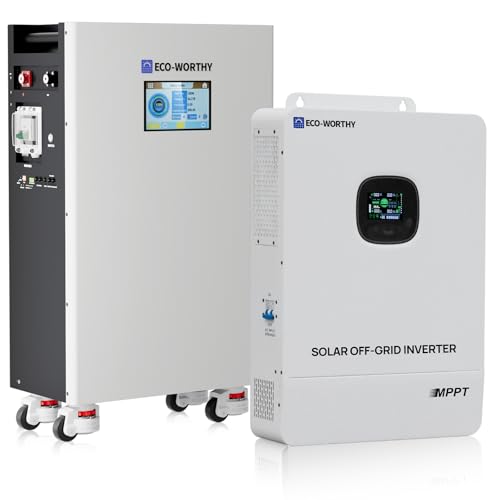
This 10kW hybrid storage solution pairs a high‑capacity LiFePO4 battery with a hybrid inverter. It includes smart monitoring via built-in WiFi/Bluetooth and an RS485/CAN/RS232 interface for broad inverter compatibility. The system is ideal for home backup, cabins, and off-grid storage where real-time battery data and app control improve reliability. The onboard Active Balancing BMS and safety features support stable long-term operation.
Best for: homeowners who want integrated storage with easy mobile access and robust safety protections. Why: the balanced combination of an oversized battery bank and hybrid inverter helps provide reliable power during outages. Limitation: real-world performance depends on battery chemistry and temperature management; ensure proper cooling and safety clearances.
SUNGOLDPOWER 10000W DC 48V UL1741

Best for builders who want robust parallel capabilities with built-in MPPT and WiFi. This SUNGOLDPOWER model delivers 10kW of continuous DC-48V input with a built-in 2 MPPT charge controller, and supports parallel expansion up to six units. It outputs 120V/240V split-phase or single-phase, and includes a WiFi module for remote monitoring. It’s designed for off-grid systems with high PV input flexibility (up to 500VDC open-circuit).
Who it’s for: customers planning scalable, grid-independent power with advanced protection features. Why: the four charging/output modes—hybrid, utility priority, solar priority, and only solar—cover diverse daily energy routines. Caution: ensure parallel configuration follows safety guidelines to prevent miswiring or overloading the system.
Y&H 10KW 48V Solar Inverter

Best for flexible installation with battery-free options and CAN-BMS support. The Y&H 10KW inverter delivers 48V DC input with 120V/240V split-phase or 120V single-phase output. It supports parallel operation up to six units and includes CAN‑BMS and Wi‑Fi connectivity for status monitoring. It accepts a wide PV input range and provides robust protection features for home or RV applications.
Who it’s for: buyers who want modular, expandable off-grid power with battery-diversity compatibility be it AGM, GEL, Li‑ion, or LiFePO4. Why selected: the system’s battery-free operation and BI of CAN-BMS enable versatile, battery-first strategies. Limitation: IP rating indicates indoor use; plan for a protected installation area.
Aninerel 12000W Solar Hybrid Inverter

Best for high-demand off-grid sites needing maximum PV input and strong parallel scalability. The Aninerel 12kW inverter provides 48V DC to 120/240V AC, with two MPPT controllers and a high 220A charging capability. It supports up to six units in parallel for large power needs and works with a wide range of battery chemistries, including Li‑ion and lead-acid variants. It supports no-battery operation for direct solar-to-load use in some configurations.
Why chosen: the expanded parallel capacity and high peak output make it suitable for workshops or tiny industrial setups off-grid. Caution: data emphasizes compatibility with multiple batteries; verify the exact battery chemistry and temperatures before long-term use.
Buying Guide: Key Considerations for 10 kW Off-Grid Inverters
- System type: Decide between inverter-only, hybrid (inverter + charger with battery storage), or all-in-one solutions. All-in-one units simplify wiring but may limit expansion.
- Battery compatibility: Check voltage (48V), chemistry (LiFePO4, Li-ion, lead-acid), and maximum charging/discharging currents. Higher A ratings support larger battery banks.
- PV input and MPPTs: Dual MPPTs improve energy harvest from different solar arrays. Consider maximum open-circuit voltage (VOC) and total PV input rating to match your panels.
- Parallel capability: If you plan to scale, ensure the model supports multiple units in parallel and understand the required linking procedure and safety requirements.
- Output configuration: Split-phase (120/240V) is common for U.S. homes. Confirm compatibility with your loads and any sensitive electronics.
- Monitoring and controls: WiFi/Bluetooth, LCD displays, and RS485/CAN interfaces help with remote monitoring and integration into home automation.
- Safety and installation: Observe enclosure, ventilation, and IP/rating recommendations. Ensure proper protective devices, grounding, and professional wiring when needed.
FAQ
- What does UL1741 imply for these inverters? It indicates compliance with safety and interconnection standards for inverter-based systems used in off-grid or backup applications.
- Can these inverters operate without batteries? Some models support no-battery operation, directly powering loads from PV when conditions allow. Verify model specifics.
- Is parallel operation safe for residential use? When installed per manufacturer instructions and by a qualified technician, parallel units can safely increase total output and surge capacity.
- What should I consider for PV array sizing? Ensure total PV input matches or remains below the inverter’s MPPT capacity and VOC limits to optimize charging.
- How important is monitoring access? Remote monitoring via WiFi or CAN/RS485 provides visibility into battery health, PV input, and load usage, aiding maintenance and optimization.
- Do these systems backfeed to the grid? Most off-grid inverters described here are off-grid only and cannot feed energy back to the utility, which suits remote locations without grid access.