Best 6-Circuit Sub Panel for Home Electrical Wiring
Looking for a reliable 6-circuit sub panel to distribute power safely in a home or small shop? This guide highlights five suitable 125A/120V-240V sub panels, focusing on compact, indoor and outdoor-ready options. Each choice is explained for who it’s best for, plus practical trade-offs to help you compare quickly.
| Product | Best For | Key Point |
|---|---|---|
| Lovnewmax 8-Space 125A Main Lug | Smaller home setups needing organized distribution | |
| JINDOUZI THQL 8-Space 125A | Indoor residential or light commercial | |
| Lovnewmax 12-Space 125A | Mid-size homes or workshops needing more circuits | |
| Square D QO612L100FCP 6-Space 12-Circuit | Budget-friendly indoor main lug option | |
| ABB TM1212RCU1K 125A Outdoor | Outdoor installations or sub panels in garages |
Note: This article focuses on 6-circuit sub panels or panels that can be configured to 6 circuits while offering practical expansion paths. Each entry uses the listed features to explain suitability, along with a caution where data suggests a limitation.
Lovnewmax 8-Space 125A Main Lug Panel

Best for compact home setups that need organized distribution across up to eight circuits. The 125A rating comfortably handles common household loads while protecting each circuit independently. Ideal for garages, basements, or light commercial spaces where a small, sturdy enclosure is required. Caution: 8 spaces means you may need one or two tandem breakers if expanding beyond eight circuits.
JINDOUZI THQL 8-Space 125A Main Lug
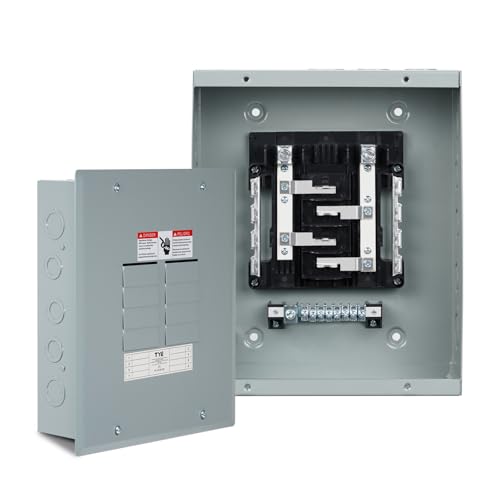
Best for indoor residential or light commercial use requiring a rugged NEMA 1 steel enclosure. With 8 spaces and a 125A rating, this box supports 120/240V single-phase systems. It provides solid safety and a straightforward setup, making it a solid choice where indoor protection is needed. Limitation: Only 8 spaces, so future expansion to more than eight circuits isn’t possible without replacement.
Lovnewmax 12-Space 125A Main Lug Panel

Best for mid-size homes or workshops needing more circuits, while still remaining in a compact footprint. The 12-space main lug design provides flexibility to install up to 12 single-pole breakers, enabling more granular circuit protection. Caution: Larger enclosure than the 8-space models, requiring more installation space and wiring planning.
Square D QO612L100FCP QO 100 Amp 6-Space 12-Circuit

Best for budget-conscious buyers seeking a familiar QO series experience, with 6 spaces that can host up to 12 circuits depending on breaker type. The unit is designed for indoor use with a surface-mount option and accepts a top-entry feeder. Caution: Returns policy noted for closeouts; confirm availability and compatibility before purchase.
ABB TM1212RCU1K Outdoor 125A

Best for outdoor installations and sub panels in garages or exterior applications. The 125A main breaker and 12-space configuration support up to 24 circuits with the right breakers, all housed in a weather-resistant NEMA 3R enclosure. Caution: Outdoor setup requires proper weatherproofing and sealants to protect connections from environmental exposure.
Eaton Main Lug Load Center 125A

Best for when you need a versatile 12-circuit capacity in a compact indoor panel. With 12 maximum circuits and compatibility with tandems/quadplex breakers, this Eaton panel supports flexible configurations. Caution: Requires careful planning to ensure compatible breaker types and load distribution for safe operation.
Buying Guide
What should you consider when choosing a 6-circuit sub panel?
Key factors include enclosure type (indoor vs outdoor), number of usable spaces, main lug vs main breaker design, and compatibility with your existing panel’s wire size and breaker types. Outdoor panels require weather resistance (NEMA ratings) and proper sealing, while indoor panels prioritize compact size and ease of access.
How does space affect future expansion?
6-space panels limit expansion compared with 8- or 12-space options. If you anticipate adding circuits later, choose a model with 8 or more spaces or a design that accommodates tandem breakers where permitted by code.
What are main lug vs main breaker distinctions?
Main lug panels distribute power without a main disconnect, while main breaker panels include a built-in main disconnect. For sub panels, main lug designs are common, but a main breaker can offer a clear service disconnect for safety and code compliance in some installations.
Which features improve installation efficiency?
Look for full-length neutral bars, easily accessible terminals, and clear labeling. Panels with pre-installed breakers or included ground bars can reduce setup time, though ensure the included breakers match your wiring plan and local code requirements.
Safety and code notes
Electrical work should comply with the National Electrical Code and any local amendments. If you’re unsure about wire sizes, conductor runs, or panel rating, consult a licensed electrician to confirm suitability for your specific home or workspace needs.
Quick reference comparison
- Most compact: Lovnewmax 8-Space 125A Main Lug
- Best indoor rugged protection: JINDOUZI THQL 8-Space 125A
- More circuits, mid-size space: Lovnewmax 12-Space 125A
- Budget-friendly indoor option: Square D QO612L100FCP
- Outdoor-ready: ABB TM1212RCU1K 125A
FAQ
- What is the difference between a sub panel and a main panel?
Sub panels extend power from a main service panel and require a feeder from the main panel; they do not replace the primary service disconnect. - Can I install a 6-circuit sub panel myself?
Installation requirements vary by local code; a licensed electrician is recommended to ensure proper grounding, wiring, and safety. - Is 125A enough for typical homes?
125A supports common households with typical loads, but consider future expansions, HVAC, and electric vehicle charging when sizing. - Should I choose indoor or outdoor panels?
Outdoor panels require weather resistance and proper enclosure, while indoor panels can be easier to install in walls or utility spaces. - Why choose main lug vs main breaker in a sub panel?
Main lug panels are common for sub panels to simplify distribution; main breakers provide an obvious service disconnect for safety. - Do these panels support tandem breakers for more circuits?
Some models support tandem or quadplex breakers; check the product data for compatibility and code compliance.