Best Optical Fiber Ethernet Switches for Fast, Reliable Networking
Answering your search for robust fiber-enabled network gear, this guide highlights five top Amazon picks that suit different buyers. Whether you’re building a small office backbone, a data center edge, or a home lab, you’ll find options for fiber-to-Ethernet conversion, multi-port switching, and high-speed SFP support. The list includes devices best for IT professionals needing scalable fiber distance, installers seeking DIN-rail options, and enthusiasts wanting plug-and-play, tool-free setups. Below is a quick comparison table of the chosen products to help you decide at a glance.
| Product | Best For | Key Advantage |
|---|---|---|
| Estink SFP Ethernet Fiber Optic Switch | Medium-sized networks needing long fiber reach | Up to 120 km fiber range with 9k jumbo frames |
| Industrial 8-Port Ethernet Optical Switch (Lcantve) | Industrial environments with reliable power | Redundant 12–57V DC input, 20 Gbps backplane |
| TP-Link MC220L Gigabit SFP to RJ45 Media Converter | Fiber-to-Ethernet conversion in mixed networks | Plug-and-play, versatile compatibility |
| MokerLink 8-Port 10Gbps SFP+ Switch | High-speed data centers or labs | 8x 10G SFP+ with 160 Gbps bandwidth |
| 4-Port Gigabit Fiber Switch (10Gtek) | Simple dual-SFP fiber switching | Two SFP slots, compact form |
Estink SFP Ethernet Fiber Optic Switch

Best for networking teams that need long-haul fiber capability in a compact unit. This device includes multiple Gigabit SFP ports and RJ45 interfaces, with plug-and-play operation and auto MDI/MDI-X. Its standout feature is the option to extend fiber distances up to 120 km, making it suitable for campus interconnects or remote-building links. It supports QoS, multicast, and flow control for efficient data delivery. A caution: real-world performance depends on the SFP modules used, so ensure compatibility with your installed optic modules.
Industrial 8-Port Ethernet Optical Switch (Lcantve)

Best for industrial deployments requiring robust power redundancy and non-blocking performance. The 8-port model combines 10/100/1000 Mbps Gbps Ethernet with SFP flexibility in a compact DIN-rail or desktop form. The unit offers redundant DC input (12–57V), aiding uptime in harsh environments. Its 20 Gbps backplane bandwidth and 9K jumbo frame support help maintain throughput in dense traffic scenarios. Choose this if you need reliable operation in factories or remote sites; avoid if you require ultra-high-speed 10G Ethernet across all ports.
TP-Link MC220L Gigabit SFP to RJ45 Media Converter
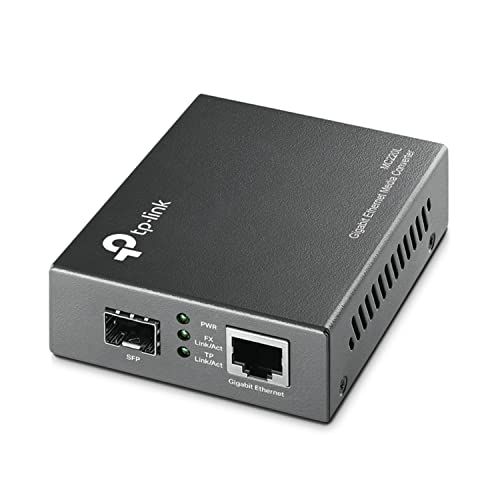
Best for bridging fiber to copper in mixed architectures. The MC220L converts 1000BASE-SX/LX fiber to 1000Base-T copper and supports both single-mode and multi-mode SFPs with broad compatibility. It’s a plug-and-play solution—no software or configuration needed—making it ideal for quick deployments, maintenance windows, or rack-mounted edge devices. Consider this if you need simple fiber-to-Ethernet conversion; if you require multi-port switching, this device is a converter, not a switch.
MokerLink 8 Port 10Gbps SFP+ Switch

Best for high-bandwidth environments needing non-blocking 10G paths. This switch provides 8x 10G SFP+ slots with a 160 Gbps switching capacity, and it supports non-blocking line speeds across all ports. It accepts standard SFP modules (no SFPs included), which offers flexibility to choose single-mode, multi-mode, or copper options. Use this for data-heavy tasks like server-to-storage links, virtualized workloads, or clustering. A limitation: you must supply your own SFP modules.
4-Port Gigabit Ethernet Fiber Switch (10Gtek)

Best for small setups needing a two-SFP, two-Ethernet port solution. This unit offers 2 SFP fiber slots plus 2 RJ-45 ports, supporting 10/100/1000 Mbps and auto-MDI/MDIX. It’s a compact option for home labs or small offices where fiber is used for a couple of links. A caveat: with only two fiber ports, this switch is less suitable for larger fiber-heavy environments; ensure your topology fits its port count.
Buying Guide
What should you consider when buying an optical fiber Ethernet switch?
- Port mix and speed: Choose the number of SFP ports vs RJ45 ports and the supported speeds (1G vs 10G). A balanced mix reduces bottlenecks.
- Fiber distance and modules: Long-haul links require appropriate SFP modules (multi-mode vs single-mode). Verify compatibility with your fiber type and distance needs.
- Power and mount: DIN-rail or desktop mounting matters for deployment. Redundant power helps uptime in critical environments.
- Jumbo frames and QoS: For storage networks or virtualization, 9K+ jumbo frames and QoS support improve performance and reliability.
- Ease of use vs configurability: Plug-and-play devices are fast to deploy; managed switches offer feature control but require setup.
FAQ
- What is an optical fiber Ethernet switch? A device that forwards Ethernet traffic over fiber links, often including SFP ports for fiber connectivity.
- Do I need SFP modules for these devices? Yes, most models require you to supply compatible SFP modules for fiber links.
- Is a converter different from a switch? Yes, a converter translates fiber to copper; a switch routes traffic between multiple Ethernet ports.
- What is jumbo frame support? Larger than standard Ethernet frames, improving performance for storage and virtualization workloads.
- Can these devices be used in a home network? Some models are suitable for home labs; check port counts and power requirements first.
- Do these switches require configuration? Many are plug-and-play, but higher-end models offer management features for advanced networks.