Best 2 Channel Function Generator for Precise Dual-Channel Testing and Prototyping
Looking for a reliable 2-channel function generator to cover dual-signal testing, lab prototyping, or hobby projects? This guide highlights five top options, each offering distinct strengths for different needs. Whether you need higher frequency capability, stable DDS output, or rich waveform storage, these picks help you choose the right dual-channel device for your workflow. The list includes a mix of entry-to-mid range models suited for electronics hobbyists, students, and professional labs seeking dependable performance.
Buyer snapshot: the following table provides a quick comparison of the selected models. It focuses on core capabilities like maximum frequency, two-channel operation, and notable features to help you decide quickly which device matches your use case.
| Product | Max Frequency | Channels | Key Feature | Best For |
|---|---|---|---|---|
| Rigol DG1022Z | 25 MHz | 2 | Sifi waveform replication, long arbitrary waveform length | Precise dual-channel testing with faithful waveform replication |
| Koolertron 15 MHz | 15 MHz | 2 | Dual-channel DDS with independent channel settings | Budget-friendly dual-channel with stable outputs |
| UNI-T UTG962E | 60 MHz | 2 | High-resolution 14-bit DAC, built-in frequency counter | High-resolution dual-channel generation |
| Seesii 60 MHz | 60 MHz | 2 | 99 saved waveforms, comprehensive software suite | Extensive waveform storage and reuse |
| Siglent 120 MHz | 120 MHz | 2 | High-frequency capability, two-channel operation | High-frequency lab testing |
Rigol DG1022Z 25 MHz Dual-Channel Arbitrary Function Generator

The Rigol DG1022Z is built for precise dual-channel work at modest frequencies. It uses SiFi (Signal Fidelity) to reproduce waveforms with high accuracy, and offers either 2Mpts or 8Mpts per channel (standard), with 16Mpts/CH available as an option. This makes it a strong fit for bench testing where waveform integrity matters. Best for: electronics technicians and students who need faithful waveform replication at a practical price. Limitation: maximum frequency is 25 MHz, which may not satisfy higher-frequency RF test scenarios.
Koolertron Upgraded 15MHz DDS Dual-Channel Generator

The Koolertron model uses a dual-channel DDS architecture with independent parameter settings per channel. It supports sine, square, triangle, sawtooth, pulse, and white noise, plus user-defined waveforms. It also includes frequency sweeps and a basic frequency/period measurement feature. Best for: hobbyists and educators seeking a low-cost, flexible dual-channel generator. Caution: 15 MHz ceiling may limit RF or high-speed applications.
UNI-T UTG962E 60 MHz Dual-Channel Arbitrary Waveform Generator

The UNI-T UTG962E offers higher frequency reach with 60 MHz per channel and 200 MSa/s sampling. It features 14-bit vertical resolution, built-in frequency counting (1 μHz to 60 MHz), and supports multiple modulation types, making it a strong choice for advanced lab setups. Best for: users needing higher frequency performance and precise frequency measurement on two channels. Limitation: more complex menu navigation may require a steeper learning curve.
Seesii 60 MHz Dual-Channel DDS Arbitrary Waveform Generator

The Seesii DDS generator stands out with 60 MHz capability, 200 MSa/s sampling, and a robust storage feature that allows 99 user-defined states and 60 saved waveforms. It supports independent channel control and offers a rich software package for waveform creation. Best for: projects requiring extensive waveform libraries and easy reuse. Caution: firmware quality and software stability can vary between units; test compatibility with your setup.
Siglent Technologies 120 MHz Dual-Channel Generator
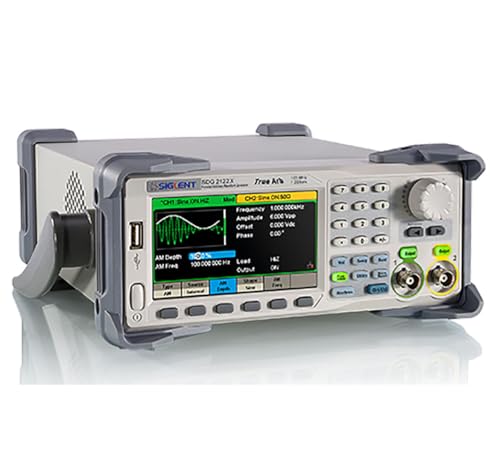
Siglent’s 120 MHz two-channel model delivers higher-frequency performance suitable for more demanding lab and development tasks. While details focus on the composite specification, the key takeaway is the capability to generate faster waveforms on two synchronized outputs. Best for: labs needing higher-bandwidth dual-channel generation. Limitation: higher cost relative to entry-level models may be a consideration for hobbyists.
Buying Guide
- What frequency range do you need? If your work involves RF or high-speed signals, prioritize higher max frequency like 60–120 MHz (UNI-T UTG962E or Siglent models). For basic bench work, 15–25 MHz units may be sufficient (Koolertron or Rigol).
- How much waveform storage is required? If you reuse many waveforms, look for devices with built-in memory (Seesii models offer extensive storage). If you primarily generate live signals, storage may be less critical.
- How important is frequency accuracy and stability? DDS-based dual-channel generators with stable oscillators provide repeatable results, making them ideal for calibration and test setups.
- Do you need advanced modulation options? Units with AM, FM, PM, FSK, and other modulation types help in simulating real-world signals; consider models like UNI-T UTG962E for broader modulation support.
- Budget versus performance: balance the need for higher bandwidth and features with price. For entry-level dual-channel testing, a Koolertron or Rigol DG1022Z often provides the best value; for higher-end lab use, Siglent or Seesii options may be preferable.
Frequently Asked Questions
- What is the advantage of a two-channel function generator? It enables simultaneous generation of two signals, allowing testing of interactions, synchronization, and more complex signal setups.
- What does DDS stand for and why does it matter? Direct Digital Synthesis; it provides precise waveform control and stable, repeatable outputs across a wide frequency range.
- Can these devices generate arbitrary waveforms? Yes, most models support user-defined waveforms or a library of built-in shapes for versatile testing.
- Is higher maximum frequency always better? Not necessarily. Choose a frequency range that matches your application; higher bandwidth increases cost and may be unnecessary for simple bench work.
- Do these units include modulation options? Many do, including AM, FM, PM, and FSK, which are useful for simulating communications signals and testing demodulation hardware.
- What should I consider besides frequency and channels? Look at sampling rate, vertical resolution, memory depth, ease of software control, and the availability of a stable user interface for repetitive tasks.