Best Window Mounted Solar Panel Solutions for Off-Grid Needs
Looking for an effective way to harvest sunlight on curved or uneven surfaces like RV roofs, boat cabins, or camper vans? Window mounted solar panels offer flexible, lightweight options that adapt to irregular shapes. This article highlights five top choices that balance portability, durability, and efficiency. Each pick is best for different setups—from stealthy, ultra-thin installs to higher power output on curved surfaces. Read on to match your vehicle, surface, and daily energy needs with clear, practical guidance.
Buyer’s quick summary:
| Product | Best For | Key Benefit | Limitations |
|---|---|---|---|
| Renogy Flexible Solar Panel 100W | Low-profile installations on curved roofs | Extremely flexible; very light | Lower wattage may require more panels for large needs |
| Renogy 100W Flexible Solar Panel (22% efficiency) | Compact, curved surfaces with stealth look | High efficiency; very bendable | All-black glare-free appearance; may require mounting hardware |
| SOLPERK 20W Kit | Starter kits for boats, RVs, or bikes | Includes MPPT controller and mounting hardware | Lower wattage; for trickle charging and maintenance |
| Renogy 200W Flexible Panel | Higher power on curved surfaces | High power output in a flexible form | Heavier than 100W options; may require stronger mounting |
Renogy Flexible Solar Panel 100 Watt 12 Volt

Brand: Renogy. This ultra-thin, bendable 100W panel is designed for off-grid charging on irregular surfaces like RV curved roofs, boats, vans, and cabins. Its defining features are extreme flexibility, ultra-light weight, and a lamination that sits roughly a tenth of an inch tall. Best for buyers who need a stealthy, unobtrusive install that still delivers solid output on moderate sun.
Who it’s best for: stealthed or space-constrained installations where a rigid panel won’t fit. Why selected: offers maximum flexibility with minimal thickness and weight. Caution: flexible panels can be more susceptible to micro-cracks if bent beyond recommended angles; ensure mounting keeps within spec.
Renogy 100W Flexible Solar Panel 22% High-Efficiency
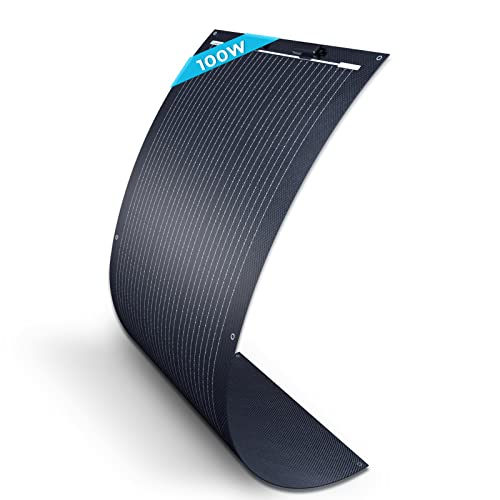
Brand: Renogy. This 100W panel excels on curved surfaces with 240° bend capability and a sleek all-black look. It uses half-cut PERC cell technology to capture more light and improve output efficiency. Best for: compact, high-efficiency setups where appearance matters and mounting space is limited. Caution: higher efficiency panels can still need clear sun exposure; performance drops in shade or oblique angles.
Who it’s best for: installers prioritizing efficiency per area and a low-profile appearance. Why selected: combines substantial wattage with flexibility and a modern finish. Limitation: heavier reliance on sun trajectory for peak performance compared to larger rigid arrays.
SOLPERK Solar Panel Kit 20W
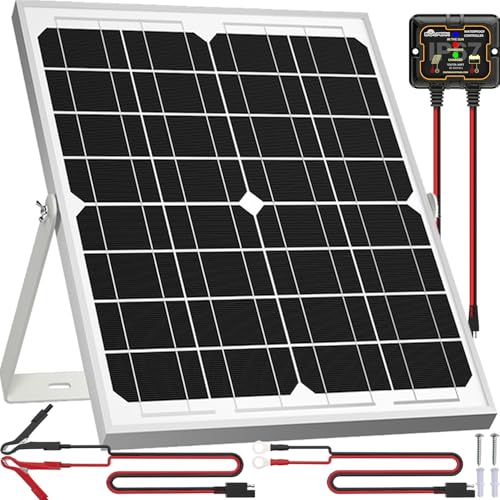
Brand: SOLPERK. A complete 20W kit with monocrystalline A+ cells, an MPPT controller, and mounting hardware. Best for beginners or as a dedicated trickle charger for trailers, boats, RVs, or motorcycles. It supports 12V batteries and has a robust waterproof build for all-weather use. Caution: lower wattage means slower charging under cloud cover or higher energy demand scenarios.
Who it’s best for: users starting small-scale off-grid charging or maintaining batteries. Why selected: value-packed with controller and hardware, facilitating straightforward installation on uneven surfaces. Limitation: not ideal for high daily energy needs or large battery banks.
Renogy Solar Panels 200W Flexible Panel

Brand: Renogy. This 200W flexible panel provides a higher daily output ideal for larger mobile setups on curved surfaces. It is engineered to be bendable up to 240 degrees and weighs about half as much as a rigid 200W panel, with an all-black, glare-free appearance. Best for: van or boat configurations needing stronger daytime energy with space constraints. Caution: handling and mounting should respect bend radius to avoid damage, and larger panels may require sturdier mounting hardware.
Who it’s best for: users with bigger energy needs on curved roofs who still want a low-profile look. Why selected: highest wattage among the options, while retaining flexibility. Limitation: heavier and potentially more challenging to install on very small surfaces.
Buying Guide: Window Mounted Solar Panels
- Surface compatibility: Check the maximum bend radius and whether the mounting area is flat or curved. Flexible panels shine on uneven surfaces but require proper mounting hardware to avoid micro-cracking or wind uplift.
- Power needs: Determine daily energy consumption and sun exposure. Higher wattage panels pair well with larger battery banks or longer camping periods.
- Weight and thickness: Ultra-thin panels minimize wind resistance and weight, aiding in stealth installs on campers and boats.
- Durability and weather resistance: Look for weatherproof seals, tempered glass or robust polymer laminates, and corrosion-resistant frames for marine or outdoor use.
- System integration: An MPPT charge controller improves efficiency, especially in variable sunlight. Ensure compatibility with 12V or 24V battery systems you plan to charge.
- Aesthetics and stealth: All-black finishes and slim profiles reduce visibility on small vehicles you want to keep discreet.
- Installation considerations: Consider mounting hardware, sealing against moisture, and vibration resistance for mobile applications.
FAQ
- Q: Are flexible solar panels as durable as rigid panels? A: Flexible panels are durable for mobile and curved surfaces, but they may be more susceptible to physical damage if bent beyond recommended angles and can be more sensitive to abrasion.
- Q: Do I need a charge controller with window mounted panels? A: Yes. A charge controller regulates charging to prevent battery overcharge and improves efficiency, especially in variable sunlight.
- Q: Can these panels power a full RV or boat camping setup? A: They can power many essential devices and help maintain batteries, but for full-time, high-demand use you may need higher wattage or a larger array combined with a robust battery bank.
- Q: How do I choose between 100W and 200W panels? A: Pick 100W for smaller threads, vented or tight spaces; choose 200W if you have higher daily energy needs or more sun exposure and a larger mounting area.
- Q: Do these panels require maintenance? A: Routine checks for loose connections and clean surfaces help sustain performance, but most modern panels are low-maintenance.
- Q: Are all-weather panels suitable for marine use? A: Look for waterproof construction and corrosion resistance; marine use benefits from additional sealing and mounting hardware designed for salt exposure.