Best MPPT DC-DC Converters for Solar Power Systems
MPPT DC-DC converters optimize solar charging by adjusting input voltage to harvest maximum power from panels. This guide highlights five reliable options, suitable for different setups—from battery-based hybrids to battery-less configurations. Whether you’re building a small off-grid cabin, a mobile RV system, or a home backup, these picks help you choose based on power needs, battery compatibility, and installation simplicity. The table below compares key attributes to help you compare at a glance.
| Product | Battery Type | Max Output | Best For |
|---|---|---|---|
| SUMRY Hybrid Solar Inverter (4000W) | Battery-Less or AGM/Lithium | 4000W nominal | High-power hybrid setups with MPPT |
| SUMRY Solar Inverter Charger (3600W) | AGM/Lithium capable | 3600W nominal | Inverter charger with integrated MPPT |
| 585W Adjustable DC-DC Buck Converter | Any 12-72V source | 585W | Compact, adjustable output for small loads |
| XY-SK120 CNC DC Converter | Various 24V systems | 120W | Lab/DIY and compact projects with MPPT |
| Powerwerx MPPT-150-14.6 | Bioenno 12V LiFePO4 | 150W | Battery-specific LiFePO4 charging |
What to expect: MPPT DC-DC converters provide efficient voltage conversion with maximum power tracking. They’re ideal when you must match panel output to a particular battery voltage or charging profile. Use the product notes to confirm compatibility with your battery chemistry and system voltage. Below, each option is explained with practical buyer guidance.
SUMRY Hybrid Solar Inverter With MPPT

Best for high-power off-grid systems where battery-less operation or AGM/Lithium battery support is needed. This unit combines a pure sine wave inverter with a built-in 140A MPPT charge controller and a 4000W rated output (8000W peak). The glass-top design includes a large LCD for real-time data. It’s suited for users who want a single, consolidated solution for solar charging, DC-AC conversion, and monitoring. The MPPT capability supports up to 5600W PV input at 350VDC and up to 98% conversion efficiency. Caution: ensure total load remains within the continuous power rating to avoid overloading during peak surges.
- Best for: high-demand appliances, off-grid living, or battery-less operation scenarios.
- Why chosen: integrated MPPT simplifies wiring and monitoring in one unit.
- Limitation: higher power unit may require more space and robust installation.
SUMRY Solar Inverter Charger (3600W)

This all-in-one solution blends inverter power, MPPT charging, and AC battery charging into a compact unit. With 3600W nominal and 7200W peak capabilities, it supports 24V battery systems and can work with various battery chemistries, including AGM and LiFePO4. It can operate with or without a battery; PV input supports up to 4200W, and the system can run loads directly from PV when conditions allow, helping reduce grid or shore power use. Best for: households seeking a flexible, battery-assisted or battery-free solar setup. Caution: battery absence requires PV voltage to exceed a higher threshold; grid conditions affect operation.
- Best for: mixed-use homes and off-grid hybrids needing reliable AC output.
- Why chosen: integrated MPPT simplifies configuration and reduces separate components.
- Limitation: battery-less mode relies on PV being sufficient to cover load during daylight.
585W Adjustable DC-DC Buck Converter
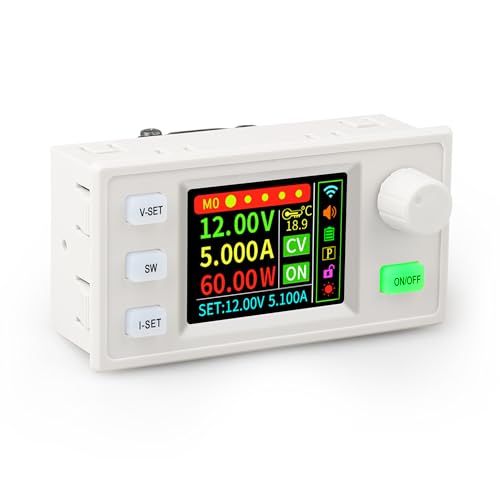
Best for compact, versatile voltage conversion tasks. This converter handles an input range of 12-72V and provides an adjustable 0-65V output at up to 9A, delivering up to 585W. The 1.8″ TFT LCD displays real-time voltage, current, and power, enabling precise tuning. It includes comprehensive protections such as reverse polarity, backflow, undervoltage/overvoltage, overcurrent, overheating, and overpower safeguards. Choose this if you need adjustable regulation for small electronics or charging devices in a limited space. Limitation: not designed for high-current, long-duration heavy loads.
- Best for: hobby projects, small RV or boat auxiliary systems, or bench experiments.
- Why chosen: clear display and robust protections improve reliability in tight spaces.
- Limitation: limited overall power compared to larger MPPT-type controllers.
XY-SK120 CNC DC Converter With MPPT

Best for lab, industrial, and DIY projects needing precise MPPT-based voltage regulation in a compact package. The XY-SK120 offers 120W output with a full-color VA display showing voltage, current, and power. It includes 10 data storage groups, making it suitable for experiments or repeated testing. It emphasizes easy readouts, which helps troubleshoot MPPT behavior during experimentation. Caution: lower power ceiling means it’s not suitable for high-demand loads, but it’s excellent for educational or small-scale applications.
- Best for: educational labs, electronics hobbyists, and small-scale projects.
- Why chosen: clear display and data storage facilitate testing and tuning.
- Limitation: modest power rating; not ideal for appliances or heavy loads.
Powerwerx MPPT-150-14.6, 12V LiFePO4 Charging

Best for charging Bioenno 12V LiFePO4 batteries with a dedicated MPPT solar charger controller. The MPPT-150-14.6 is rated for 150W, with a 16-25V input range and a fixed 14.6V output. It’s designed for smart charging without user adjustment, making it convenient for LiFePO4 setups. Choose this if your focus is LiFePO4 battery charging from solar panels in a compact package. Caution: matches a specific battery type; verify compatibility with your battery chemistry and panel voltage.
- Best for: LiFePO4 battery systems needing efficient, fixed-voltage charging.
- Why chosen: dedicated to a common 12V LiFePO4 charging profile with automatic optimization.
- Limitation: limited to 150W and a fixed 14.6V output.
Buying Guide
What should you consider when choosing an MPPT DC-DC converter?
Power rating matters. Match the converter’s continuous and peak output to your expected load. For larger off-grid builds, a unit with higher wattage is preferable to prevent overload during peak demand.
Which battery type will you use?
Some MPPT DC-DC solutions are universal, while others are optimized for specific chemistries (LiFePO4, AGM, Gel). Confirm battery compatibility before purchase to ensure proper charging voltage and protection features.
Do you need an all-in-one or modular approach?
All-in-one hybrids simplify wiring and monitoring but can be bulkier and costlier. Modular MPPT controllers offer flexibility to expand or customize a system as needs grow, though they require more setup work.
Is monitoring and display important to you?
Clear displays help monitor real-time voltage, current, and power. If you plan frequent adjustments or testing, a unit with a readable TFT/LCD display is advantageous.
What about protection features?
Look for safeguards such as reverse polarity, overcurrent, overvoltage, overheating, and short-circuit protection. These features improve reliability in variable outdoor conditions and during peak loads.
Installation environment
Consider enclosure requirements and mounting space. Higher-power units may need proper ventilation and secure mounting to handle heat generation and vibrations in mobile setups.
FAQ
- How do MPPT DC-DC converters improve solar charging?
- Can I run household appliances directly from an MPPT DC-DC converter?
- Should I choose a battery-less or battery-based system?
- What is MPPT’s typical efficiency range?
- Is LiFePO4 charging supported by these products?
- Do these units require specialized installation?
They maximize power extraction by adjusting input voltage to track the optimal point for solar panels, improving charging efficiency compared to simple buck converters.
Most MPPT DC-DC converters are designed for charging batteries or powering low-voltage DC loads. High-power inverters are typically separate devices; choose a unit that matches your system design.
Battery-less systems rely on solar to meet load during daylight, which can be limiting for nighttime use. Battery-based systems provide energy storage and more consistent power.
Modern MPPT controllers commonly achieve efficiencies around 95% to 98%, depending on input/output conditions and cooling.
Several options support LiFePO4 (e.g., dedicated LiFePO4 charging units). Check each product’s compatibility and voltage requirements for your battery bank.
Basic electrical knowledge is recommended. Many units include protective features, but proper grounding, wiring gauge, and enclosure are important for safety and performance.