Best Clip-on Power Meter Options for Home and DIY Projects
Discover reliable clip-on and plug-in power meters for household and light professional use. These devices help you monitor voltage, current, power, and energy consumption with clarity. The best pick varies by need: true-RMS clamp meters excel for live electrical troubleshooting, while plug-in watt meters suit ongoing monitoring of appliances. The top picks below span clamp meters for electrical work and watt meters for energy tracking, making them suitable for DIYers, electricians, and homeowners. Summary table follows to help you compare at a glance.
- AstroAI Digital Clamp Meter Multimeter 2000 Counts – Best for basic electrical troubleshooting on a budget
- KAIWEETS Digital Clamp Meter with D-Shaped Jaw – Best for secure clamping on diverse cables
- AstroAI Digital Clamp Meter 4000 Counts – Best for higher precision and advanced testing
- Hioki CM3286-50 AC Clamp Power Meter – Best for professional use with built-in power analysis
- TANKOOL Digital Clamp Meter T-RMS 4000 Counts – Best value with true RMS and NCV features
Notes
| Product | Type | Best For | |
|---|---|---|---|
| AstroAI 2000 Counts | Clamp Meter | Budget DIY troubleshooting | AC/DC voltage, AC current; NCV; data hold |
| KAIWEETS D-Shaped Jaw | Clamp Meter | Secure clamp on various cables | TRUE-RMS; NCV; backlight |
| AstroAI 4000 Counts | Clamp Meter | Higher precision, broader testing | Voltage, current, frequency, duty cycle; NCV |
| Hioki CM3286-50 | AC Clamp Power Meter | Industrial/commercial energy analysis | Power, frequency, power factor, harmonics |
| TANKOOL T-RMS 4000 | Clamp Meter | Value with NCV and backlight | AC current up to 600A; NCV; backlight |
AstroAI Digital Clamp Meter 2000 Counts

Best for: budget-conscious DIYers and basic electrical troubleshooting. This model measures AC/DC voltage (though the DC current test is not supported) and AC current by clamping around a single conductor. It also tests resistance, capacitance, and continuity, with live wire and NCV indicators. The device offers a backlit LCD and alarms for easy use in dim work areas. It does not test DC current, so choose this if your tasks revolve around AC systems and general diagnostics rather than high-precision DC work.
Key reasons for selection: affordable entry point, essential measurement capabilities for home electrical tasks, and practical features like data hold and auto shut-off. Limitation: cannot test DC current, and clamping around a whole power cord can give incorrect readings; ensure the conductor is centered and tested individually.
KAIWEETS Digital Clamp Meter With D-Shaped Jaw

Best for: professionals and serious DIYers who need a secure clamp on a variety of cables. The distinctive D-shaped jaw opens up to 1.1 inches and supports true-RMS measurements for AC/DC current and voltage, plus temperature, NCV, capacitance, frequency, resistance, and diode testing. It includes non-contact voltage detection with audible/visual alerts. Choose this if you frequently clamp around different cable types and want reliable, safe operation.
Key reasons for selection: robust D-shaped jaw design, wide measurement range, and built-in NCV detection. Limitation: the feature set is broad, which may overwhelm casual users seeking only basic voltage checks.
AstroAI Digital Clamp Meter 4000 Counts
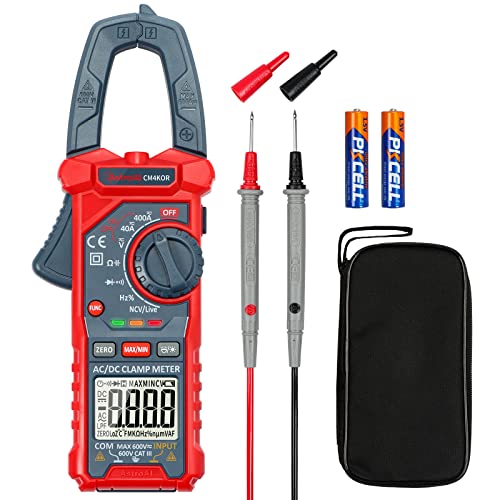
Best for: users needing higher precision and a broader set of measurements. It can measure AC/DC voltage and current, resistance, capacitance, frequency, and duty cycle, with NCV and live wire testing. Features like data hold, Max/Min, auto power-off, and a backlit LCD screen improve usability in varied environments. It’s well-suited for more demanding electrical work compared to entry-level meters. Caution: as with many clamp meters, correct positioning around a single conductor is essential for accurate AC current readings.
Hioki CM3286-50 AC Clamp Power Meter

Best for: professional environments that require integrated power analysis. This all-in-one clamp meter measures AC/DC voltage and current, power, frequency, and power factor in a single device. It supports single and three-phase testing up to 600 A and 1000 V and includes a built-in power analyzer for harmonics, phase sequence, and energy usage. Selection is ideal for industrial settings and energy audits. Caution: Hioki devices are often premium-priced and may be overkill for simple home tasks.
TANKOOL Digital Clamp Meter T-RMS 4000 Counts

Best for: users needing true RMS readings with NCV and a practical backlit display. It measures AC current up to 600A (not for DC), AC/DC voltage up to 600V, resistance, diode, continuity, and NCV detection with audible/visual alerts. The backlight and flashlight aid visibility in dim spaces. This model is a strong all-around option for home electrical work and automotive tasks. Limitation: it cannot measure DC current, so plan accordingly for DC circuits.
Buying Guide
What should you consider when choosing a clip-on or plug-in power meter?
- Measurement needs: Decide if you primarily need AC current and voltage readings, or if you require power, energy cost, and harmonic analysis. Clamp meters excel for on-the-spot current checks, while plug-in meters simplify ongoing energy tracking of appliances.
- True RMS vs. average-responding: True RMS meters provide more accurate readings on non-sinusoidal or varying loads. This is important for motor loads and power supplies.
- Conductor access: For clamp meters, ensure the device can clamp a single conductor (not the whole cable) and that the jaw opening accommodates your wire size.
- Display and readability: Backlit screens, large digits, and data hold features help in dim work areas or when comparing readings side by side.
- Safety ratings: Look for CAT ratings (e.g., CAT III or CAT IV) appropriate to your environment. Higher ratings support higher voltage environments and safety.
- NCV and alarms: Non-contact voltage detection is useful for quick checks, while audible/visual alarms aid in low-light conditions.
FAQ
- What is a clip-on power meter best used for?
Clip-on meters (clamp meters) are best for measuring AC current on live circuits without breaking the circuit, and for on-the-go troubleshooting.
- Do these meters measure DC current?
Some models do, but not all. Check the product features; several listed models measure DC voltage and DC resistance, but some clamp meters do not test DC current.
- Is true RMS important for home use?
Yes, true RMS provides more accurate readings with non-sinusoidal loads, common in modern electronic devices and motors.
- Can I use these for three-phase systems?
High-end models like Hioki CM3286-50 support single and three-phase testing, which is suitable for commercial and industrial setups.
- Should I worry about safety ratings?
Yes. Choose a meter with appropriate CAT ratings for your voltage environment to ensure safe operation.