Best Emergency Backup Power Stations for Home and Outdoors
Answering the need for reliable, portable power during outages, camping trips, or remote work, these emergency backup power stations cover a range of capacities and features. The top picks are ideal for different buyers: compact daily carry for travel, mid-capacity units for home backup, and higher-output platforms for CPAPs, laptops, or small appliances. This guide highlights five strong options, explaining who they’re best for, why they stand out, and any notable limitations to consider before buying. A quick comparison table is included to help you scan differences at a glance.
| Product | Best For | Key Benefit |
|---|---|---|
| EnginStar Portable Power Station 300W | Outdoor enthusiasts, CPAP users | Two 110V pure sine wave outlets and multiple ports in a compact 6.5 lb unit |
| MARBERO Portable Power Station 88Wh | Lightweight travelers and quick-charge needs | Ultra-portable with multiple outputs and fast charging for on-the-go use |
| BLUETTI Elite 30 V2 600W | Storm prep and home backup | Slender yet capable with 288Wh and Power Lifting mode up to 1500W |
| Anker SOLIX C1000 Gen 2 | Home backup and remote work | Ultra-fast recharge and high-output 2,000W with 1,024Wh |
| EF ECOFLOW Delta 2 | Homes and RVs needing scalable capacity | Expandable up to 3kWh with rapid charging and many outlets |
EnginStar Portable Power Station 300W

Best for: campers, travelers, and CPAP users who need reliable AC power in compact form. The EnginStar unit weighs 6.5 pounds and fits in small spaces while delivering 296Wh capacity and a 300W AC output. It includes eight output ports, including two 110V pure sine wave AC outlets, two regulated DC outputs (12V/24V), USB, and USB-C charging. The battery management system emphasizes voltage and temperature control, supporting safe operation through multiple charges and discharges. A potential limitation is the absence of a solar panel in the package, meaning solar charging requires separate equipment.
- Best for: CPAP users needing overnight reliability and general outdoor use.
- Better for: Small electronics and laptops when AC power is essential.
- Choose this if: You want robust pure sine wave output for sensitive devices and multiple ports in a compact form.
MARBERO Portable Power Station 88Wh
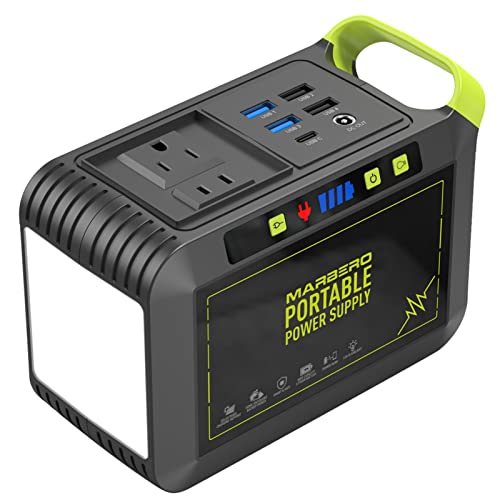
Best for: users who need lightweight, quick-charging backup for light devices or road trips. At about 3.2 pounds and 6.5 x 4.6 x 3.1 inches, MARBERO’s compact design is ideal for backpacks or glove compartments. It features eight outputs and a car DC charger, making it practical for charging phones and small appliances on the go. The included solar panel option enhances outdoor versatility. A limitation is its smaller 88Wh capacity, which may require recharging more often during extended outages or high-demand scenarios.
- Best for: Weekend trips, small-device charging, and contingency power in a backpack-friendly form.
- Better for: Quick recharges and travel-friendly power needs with multiple outputs.
- Choose this if: You prioritize ultralight design and ease of transport over massive energy storage.
BLUETTI Elite 30 V2 Portable Power Station 600W

Best for: storm-prepared homes and users needing higher output in a compact chassis. The BLUETTI Elite 30 V2 weighs 9.4 pounds and provides 288Wh capacity, with Power Lifting Mode delivering up to 1500W for power-hungry devices. Its UltraCell technology reduces consumption by up to 50%, contributing to efficiency during frequent outages. A caution: while it offers significant output, longer power needs may require frequent recharging, and expansion options are part of more advanced models in the BLUETTI lineup.
- Best for: Off-grid or storm-season readiness where moderate energy demand is expected.
- Better for: Running small appliances, TVs, and CPAP machines during outages.
- Choose this if: You want a balance of portability and higher powered output with efficient operation.
Anker SOLIX C1000 Gen 2 Portable Power Station

Best for: homes and remote work setups that require fast recharge and substantial power. The Anker SOLIX C1000 Gen 2 delivers 2,000W continuous output (3,000W peak) and a 1,024Wh battery, with HyperFlash fast charging achieving full recharge in about 49 minutes. It supports multiple ports across AC, USB-C, and USB-A, making it suitable for powering a broad range of devices during outages. A caveat: higher power output can mean shorter run times if large loads are used for extended periods, and solar panel usage is optional rather than standard.
- Best for: Quick refill during outages and powering multiple devices at once.
- Better for: Remote workstations, laptops, and small appliances requiring reliable current.
- Choose this if: Fast charging and high output are top priorities for your backup needs.
EF ECOFLOW Delta 2

Best for: homeowners and RV users who want scalable storage and robust output. The Delta 2 features a 1024Wh LiFePO4 battery with up to 1800W AC output and 100W USB-C, plus the option to expand capacity to up to 3kWh with additional batteries. It supports rapid charging and is designed for home backup, camping, and RV use. A potential limitation is listed capacity expansion relies on adding compatible modules, which may increase overall system cost and complexity.
- Best for: Full home backup or extended off-grid trips where larger energy capacity is needed.
- Better for: Running multiple essential appliances during outages or off-grid living.
- Choose this if: You anticipate long outages and want scalable energy capacity with fast charging.
Buying Guide: Key Purchase Considerations
- Capacity vs. weight: Higher capacity means longer runtimes but heavier units. Align capacity with your typical outage duration and device load.
- Output types and ports: Confirm the number and type of outputs (AC, USB-C, USB-A, DC) to match your devices, such as CPAP machines or laptops.
- Charging speed: Look for fast recharge options (HD/HyperFlash-like tech) if you need to regain power quickly after an outage.
- Recharging sources: Consider whether you want solar compatibility, and whether solar panels are included or sold separately.
- Safety and lifespan: Battery management systems, protection against short circuits, and long cycle life (1000+ cycles) improve reliability.
- Expandability: If you foresee growing energy needs, evaluate modular or expandable systems (additional battery packs) for future-proofing.
- Portability: If you’ll move the unit often, weight and footprint matter for ease of transport and storage.
Frequently Asked Questions
- What is an emergency backup power station? A portable device that stores electrical energy and provides power to appliances during outages or off-grid scenarios.
- Do I need solar panels to use these devices? Not always. Some models include solar charging compatibility as an option; panels are often sold separately.
- What devices can these units power? Common devices include smartphones, laptops, CPAP machines, small TVs, lights, cameras, and portable fridges, depending on capacity and outlets.
- How do I know which capacity I need? Consider your essential devices and how long you expect to power them during an outage. Higher-capacity models support longer runtimes but are heavier.
- Are LiFePO4 batteries better? LiFePO4 chemistry offers longer lifespan and stability in many models, often preferred for home backup and extended use.
- Can these units be charged while operating? Many support pass-through charging, but it’s best to verify per model if you plan to run devices while charging.