Best All-in-One Multimeters for Home, DIY, and Pro Use
If you’re shopping for an all-in-one multimeter, you want a tool that covers voltage, current, resistance, continuity, and more, in a single compact unit. This guide highlights five versatile models that balance accuracy, safety features, and user-friendly design for common electrical tasks. Best for DIYers, electricians, automotive technicians, and preventive-maintenance pros alike, these meters simplify troubleshooting and testing with built-in protections and clear displays. See the quick comparison table below to plan your purchase at a glance.
| Product | Best For | Key Benefit |
|---|---|---|
| Klein Tools MM325 Multimeter | Home and field technicians | Lead-alert protection and backlit display |
| AstroAI Digital Multimeter and Analyzer TRMS | Automotive and general troubleshooting | True RMS, auto-ranging, backlit LCD |
| KAIWEETS KIT01 Digital Multimeter Set | All-in-one set for pros and DIYers | Includes non-contact tester and GFCI tester |
| FNIRSI DMT-99 Digital Multimeter | Field work and extended testing | 9999 counts, rechargeable, waveform view |
| Klein Tools MM420 Digital Multimeter | Premium testing with multiple functions | Auto-ranging TRMS, wide feature set |
Klein Tools MM325 Multimeter
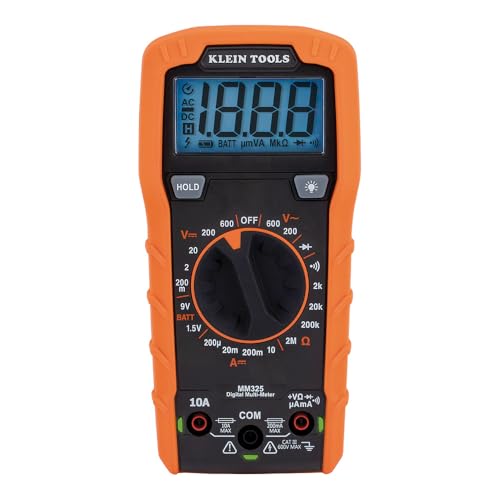
The Klein MM325 offers AC/DC voltage up to 600V, 10A DC current, and 2 MΩ resistance, with added continuity, diode test, and battery test. It features LED test-lead indicators to confirm proper placement, enhancing accuracy and safety. A backlit LCD display helps readings in low-light conditions. Best for field technicians and DIYers who need reliable measurements with straightforward protections. Caution: if you rely on specialty measurements beyond its range, consider a higher-end model.
AstroAI Digital Multimeter and Analyzer TRMS 6000 Counts

This meter delivers auto-ranging and True RMS for AC current and voltage, plus data hold, a large backlit display, and a built-in kickstand. It measures voltage, current, resistance, diodes, continuity, duty cycle, capacitance, and temperature. It’s well-suited for automotive diagnostics and household electrical troubleshooting. Choose this if you need a robust, feature-rich meter for varied environments; best for professionals who value TRMS accuracy. Limitation: Auto-ranging features may feel slow in very rapid signal changes.
KAIWEETS KIT01 Digital Multimeter Set

This complete kit combines a digital multimeter, a smart non-contact voltage tester, and a GFCI outlet tester in a single carrying case. It measures AC/DC voltage up to 600V, DC current up to 10A, resistance, continuity, and diode tests, with a backlit LCD and CAT III 600V safety. Best for electricians, HVAC pros, and serious DIYers who want quick, all-in-one diagnostics. Caution: always follow safety protocols when using the non-contact tester around live circuits.
FNIRSI DMT-99 Digital Multimeter

The FNIRSI DMT-99 provides 9999 counts and aTrue RMS, with a rechargeable 1500mAh battery and Type-C charging. It supports voltage, resistance, current, continuity, diode testing, and more, plus graphic waveform monitoring for transient analysis. Best for field technicians needing long use between charges and waveform visualization. Limitation: newer users may require time to learn Auto-Mode and waveform features.
Klein Tools MM420 Digital Multimeter

The MM420 emphasizes auto-ranging TRMS measurement of 600V AC/DC voltage, 10A AC/DC current, and 50 MΩ resistance, with additional features like continuity, temperature, capacitance, and frequency/duty cycle. Lead-alert protection and a backlit display aid visibility and accuracy. Best for professionals who need a broader feature set in a durable, safety-focused meter. Caution: more advanced features may be unnecessary for simple home tests.
Buying Guide
What should you consider when choosing an all-in-one multimeter?
- Measurement range and capabilities — Ensure it covers voltage, current, resistance, and diode/continuity tests you’ll perform. If you work with automotive systems, look for true RMS and higher voltage ratings.
- Accuracy and display — True RMS ratings improve accuracy with non-sinusoidal signals. A backlit LCD helps in dim environments.
- Safety category and construction — CAT III or CAT IV ratings and lead protection reduce shock risk. Consider meters with durable housings for field use.
- Extras and accessories — Kits that include non-contact voltage testers, GFCI testers, and carrying cases save trips to the toolbox and improve efficiency.
- Power and battery life — Rechargeable options offer longer use between charges, especially for field technicians.
- Ease of use — Auto-ranging, data hold, auto shut-off, and a clear waveform view simplify diagnostics for both novices and pros.
Which features drive the most value?
- True RMS for accurate readings on non-sinusoidal signals.
- Auto-ranging to reduce manual range selection and speed up testing.
- Safety features like CAT ratings and lead-alert indicators to prevent misreads and shocks.
- Included accessories that expand testing scenarios, such as non-contact voltage testers and GFCI testers.
Usage scenarios
- Home electrical projects and circuit troubleshooting — A standard 600V meter with backlit display is typically sufficient.
- Automotive diagnostics — Look for True RMS, wide range, and robust resistance and continuity testing.
- HVAC and electrical contractor work — Kits with comprehensive accessories and CAT safety are ideal.
- Field service and troubleshooting — Rechargeable power and long battery life provide practical convenience.
FAQ
- What is an all-in-one multimeter? — A single tool that measures voltage, current, resistance, continuity, diode tests, and often additional parameters like capacitance and frequency.
- Do I need True RMS? — True RMS improves accuracy when dealing with non-sinusoidal signals common in modern electronics and some automotive systems.
- Is auto-ranging necessary? — It speeds up testing and reduces user error, especially for beginners.
- Are these meters safe for DIY home use? — Yes, when used with appropriate caution and following manufacturer safety guidelines.
- Should I buy a kit or a single meter? — Kits offer convenience with complementary accessories, while single meters are lighter and simpler for basic tasks.
- How long do rechargeable meters last between charges? — Battery life varies by model and usage; rechargeable meters are designed for extended field use.