Best High-Watt ATX Power Supplies for 2000W and Beyond
Answering the most common buyer question: which 2000W-class or near-2000W ATX power supply is best for high-end builds and multi-GPU rigs? This guide highlights top options suited for 2000W-capacity needs, including multi-GPU servers, mining rigs, and power-hungry workstations. The picks are evaluated for reliability, efficiency, and compatibility with ATX 3.0/3.1 standards. Best for enthusiasts building advanced rigs, professionals running dense GPU setups, and gamers pushing high frame rates with multiple GPUs.
Summary table:
Product | Brand | Wattage | Key Strength | Best For
BestParts Upgraded 2000W | BestParts | 2000W | Cables included, solid case fit | Multi-GPU servers, high-draw workstations
Pstaroth 2000W Mining Power Supply | Pstaroth | 2000W | Wide GPU support, active PFC | Crypto-mining rigs, 8-GPU ETH rigs
ASRock PG 1600G ATX 3.1 | ASRock | 1600W | Low-noise, Cybenetics Platinum | ATX 3.1 builds needing quiet operation
be quiet! Dark Power Pro 13 1600W | be quiet! | 1600W | Titanium efficiency, digital regulation | Silent high-load gaming rigs, PCIe 5.0 GPUs
Corsair HX1500i (2026) | Corsair | 1500W | ATX 3.1, Platinum efficiency | High-end builds with PCIe 5.1 devices
BestParts Upgraded 2000W Power Supply PSU
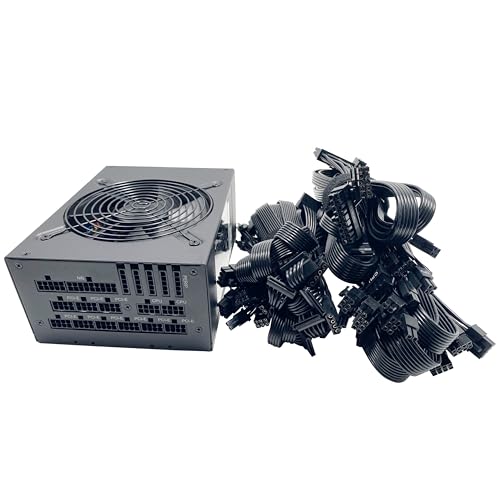
BestParts offers a 2000W PSU unit replacement suitable for multi-GPU servers. Best for users upgrading existing high-draw servers or building new dense GPU rigs that require ample 12V rails. The included cables and wide input range (100-240V~, 15-12A, 60-50Hz) support diverse regional power conditions. Consider this option when system clearance and PSU size align with your chassis.
Who this is best for: system integrators and data-center-style builds needing a 2000W supply with included cables. Why selected: direct 2000W capacity and compatibility with multi-GPU setups. Caution: ensure your chassis has adequate clearance for a 20 x 15 x 9 cm unit and verify connector needs match your motherboard and GPUs.
Pstaroth 2000W Mining Power Supply

Pstaroth’s 2000W model targets mining rigs and high-GPU-density builds. It offers multiple 6+2 and 8-Pin PCIe-style connectors and 24PIN/4+4PIN for motherboard power. Best for mining operators and 8-GPU Ethereum rigs requiring broad connector availability and a stable 110V-240V input range. It features high-temperature protection to guard against overheating during long runs.
Who this is best for: crypto miners and heavy GPU rigs needing extensive GPU power rails. Why selected: strong 2000W output with many GPU connectors. Caution: high-temperature protection engages around 50°C, which may impact performance if cooling is insufficient; verify case airflow.
ASRock PG 1600G ATX 3.1 1600W

ASRock PG-1600G is a 1600W unit designed for ATX 3.1 systems with a focus on efficiency and quiet operation. It carries a Cybenetics Platinum rating and 90%+ efficiency in typical loads, with noise reduction features for low-noise builds. The large 180mm depth requires chassis clearance checks before installation. Best for power-hungry gaming PCs or workstations that require robust yet quiet operation.
Who this is best for: builders needing ATX 3.1 compatibility and quiet performance. Why selected: high efficiency with Platinum/ Lambda ratings and solid compatibility profile. Caution: may not fit all cases due to depth; measure PSU clearance before purchase.
CORSAIR RM1000x ATX 3.1 1000W

Corsair RM1000x provides a modular 1000W solution with ATX 3.1 compliance. It emphasizes clean cabling, low noise, and reliable power delivery for systems that require PCIe 5.1 support. Best for mid-to-high-end builds that do not require the extreme wattage of 1500W–2000W but still demand efficiency and cable management.
Who this is best for: builders seeking modularity and ATX 3.1 compatibility with solid efficiency. Why selected: strong modular design and quiet operation. Caution: not a high-wattage option for multi-GPU rigs that truly exceed 1200W–1400W combined draw.
Corsair HX1500i (2026)

Corsair HX1500i represents a high-performance 1500W unit with ATX 3.1 and PCIe 5.1 readiness. It features fully modular cabling and a 140mm Fluid Dynamic Bearing fan for quiet operation. Best for enthusiasts building power-hungry workstations or gaming PCs that require near-2000W headroom with sophisticated efficiency and control.
Who this is best for: power users needing reliable headroom for GPU-heavy tasks and future-proof PCIe 5.1. Why selected: strong ATX 3.1 support, Platinum-level efficiency, and modular design. Caution: not a true 2000W unit; ensure your system’s peak draw stays within 1500W to avoid over-provisioning.
Buying Guide: Key Purchase Considerations
What matters most when selecting a high-wattage ATX power supply? Consider efficiency, modularity, physical dimensions, and ATX/PCIe compatibility. A higher efficiency rating can reduce heat and electricity use in long runtimes. Fully modular cabling helps with clean builds and airflow. Check the case clearance for depth and the number of PCIe power connectors to support multiple GPUs. For extreme builds, confirm ATX 3.0/3.1 compatibility and 12V rail structure to ensure stable delivery under peak loads.
Do I need a 2000W PSU or is 1500W enough?
Use a 2000W unit when a system draws close to or exceeds 1500W under load, such as multi-GPU rigs or serious mining setups. For fewer GPUs or mid-range configurations, a 1500W or 1600W unit with efficient rails may be sufficient.
What about noise and heat?
Look for units with low-noise fans and high efficiency. Titanium or Platinum ratings typically indicate better efficiency, cooler operation, and quieter performance under load.
Does ATX 3.1 matter for future GPUs?
ATX 3.1 compatibility supports newer PCIe 5.x GPUs and helps manage transient power spikes. If you plan future GPU upgrades, prioritize ATX 3.1-certified models.
How important is cable management?
Fully modular designs simplify cable routing and improve airflow. They are especially beneficial in dense builds where cable clutter can restrict airflow and increase temperatures.
What should I verify before buying?
Measure chassis depth, confirm clearance for long PSUs, confirm the number and type of PCIe connectors, and ensure the unit’s wattage aligns with your planned hardware draw.
What’s a reliable way to compare these options?
Compare wattage headroom, efficiency rating, ATX standard compliance, modularity, and the number of PCIe/CPU connectors. Consider practical needs like future GPU upgrades and planned overclocking.
Quick reference: 5 picks at a glance
- BestParts Upgraded 2000W: Best for multi-GPU servers and high-draw workloads.
- Pstaroth 2000W Mining: Best for mining rigs with wide GPU support.
- ASRock PG 1600G: Best for ATX 3.1 builds requiring quiet operation.
- be quiet! Dark Power Pro 13 1600W: Best for silent, high-load gaming and workstations.
- Corsair HX1500i (2026): Best for near-2000W headroom with PCIe 5.1 readiness.
Frequently Asked Questions
- What is the main difference between 1500W and 2000W PSUs?
- Is ATX 3.1 required for modern builds?
- Are modular PSUs worth it for small cases?
- What is Cybenetics Platinum or Lambda rating?
- Should I choose a titanium-rated PSU?
- Can a 2000W PSU cause overkill in a typical gaming PC?
Wattage indicates maximum sustained power; higher-watt models support more GPUs and components simultaneously, especially under peak loads.
ATX 3.1 compatibility helps with newer GPUs and transient spikes. It is recommended for future-proof builds.
Yes, modular cabling reduces clutter and improves airflow, which is valuable in compact builds.
These are third-party efficiency and noise metrics indicating high efficiency and low noise, useful for comparing premium PSUs.
Titanium offers the highest efficiency across loads, reducing heat and electricity use, though it often comes at a premium.
Yes, for most single-GPU gaming rigs, a lower-wattage, efficiently rated unit is more cost-effective and sufficient. Reserve 2000W units for very high-performance, multi-GPU, or mining setups.