Best Hardwired Interconnected Smoke Detectors for Safer Homes
Direct answer: hardwired interconnected smoke detectors provide continuous, networked fire coverage across your home with battery backup, helping you detect and escape faster. This guide highlights top options and who they’re best for, with clear, practical comparisons to help you decide. Ideal buyers include homeowners seeking whole-home coverage, renters with power reliability concerns, and families prioritizing early warning in common living spaces.
Summary table of selected products
| Product | Best For | Key Benefit | Battery Backup | Interconnect |
|---|---|---|---|---|
| SITERWELL 6-Pack | Medium to large homes | Broad coverage with 12-unit interconnect | 9V backup | Yes |
| First Alert SMI100-AC 6-Pack | Homes with cooking zones | Precision Detection to reduce nuisance alarms | Battery backup | Yes |
| First Alert BRK SMI100-AC 6-Pack | New installs needing reliability | UL-compliant with interconnect and backup | 9V battery backup | Yes |
| Kidde 20SAR 3-Pack | Smaller homes or apartments | Fast 25% faster detection and clear alert visuals | AA backup | Yes |
| Kidde 4-Pack CO/Smoke | Homes needing dual detection | Smoke and CO in one device | 10-year life internal backup | Yes |
Note: When selecting hardwired interconnected detectors, verify compatibility with your home’s electrical system and ensure you follow local building codes for installation. The products listed below are chosen for broad coverage, reliable interconnect, and clear audible/visual alerts.
SITERWELL 6-Pack Hardwired Interconnected Smoke Detectors

Product overview: This hardwired model connects up to 12 alarms to maximize home coverage. It delivers more than 85 decibels of alarm sound, ensuring early fire warnings across multiple rooms. A built-in DC 9V battery provides protection during power outages, and the unit features fast alerts via enhanced sensing technology to reduce false alarms from cooking and other benign triggers.
Best for: Homes needing flexible, wide-area coverage with strong backup power. It’s suitable for larger layouts where early detection across multiple zones matters most.
Caution: Battery life is tied to the included 9V backup; periodic battery checks are advised to ensure continuous operation during outages.
First Alert SMI100-AC Hardwire Interconnect Smoke Alarm (6-Pack)

Product overview: This model emphasizes precision detection to minimize nuisance alarms while maintaining early warning capabilities. Interconnect ensures that when one unit sounds, all compatible alarms activate. Battery backup maintains protection during power outages.
Best for: Homes with varied cooking patterns or open-plan layouts where reducing false alarms is important, but reliable interconnect remains critical.
Limitation: Some installations may require professional wiring assessment to ensure full interconnect behavior across all units.
First Alert SMI100-AC 3-Pack Hardwire Interconnect Smoke Alarm

Product overview: This 3-pack offers the same Precision Detection and interconnect advantages as larger sets, with battery backup for outages. It’s designed for smaller installs or zone-specific coverage in multi-story homes.
Best for: Buyers needing reliable interconnection in a smaller setup or when expanding a current system in stages.
Limitation: Fewer units may require future expansion to achieve full home coverage.
Kidde Hardwired Smoke & Carbon Monoxide Detector (4 Pack)
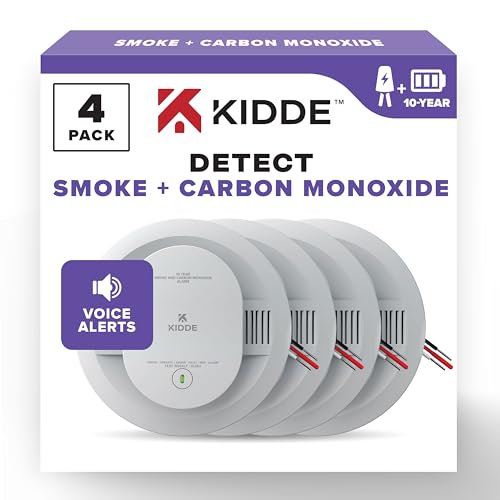
Product overview: A 2-in-1 device that detects both smoke and carbon monoxide, with interconnectability for whole-home alert integration. It operates on 120V AC with a 10-year battery backup, and includes LED warning indicators and an 85 dB alarm for clear notification.
Best for: Homes seeking combined smoke and CO detection with a long-battery-life solution. It’s ideal where CO monitoring adds critical safety alongside fire detection.
Limitation: Dual-detection devices may require careful placement to optimize the balance between smoke and CO sensing across rooms.
First Alert BRK SMI100-AC Hardwired Smoke Detector with Battery Backup

Product overview: This model emphasizes early warning with a precise interconnect system and battery backup for outages. It supports a network of interconnected alarms—great for consistent protection across multiple rooms.
Best for: Households prioritizing rapid shared alerts and straightforward wiring in established layouts.
Limitation: Implementation across an existing ceiling grid may require compatibility checks with other detectors in the network.
Buying Guide
Key considerations when choosing hardwired interconnected smoke detectors:
- Number of alarms and home layout: Larger homes benefit from higher-capacity interconnect networks. Plan placements to maximize coverage in bedrooms, hallways, and living areas.
- Battery backup type and life: Look for devices with long-lasting backup options and clear signaling when replacement is needed. Battery maintenance is essential for power outages.
- Detection technology: Photoelectric sensors excel at smoldering fires and reduce nuisance alarms, while ionization sensors respond quickly to flaming fires. Many modern units blend technologies for balanced performance.
- Interconnect compatibility: Ensure the detectors are compatible with existing or planned alarms to trigger all units when one detects smoke.
- Compliance and certifications: UL217 and relevant standards ensure reliability and safety across installations.
- Installation considerations: Check ceiling height, wiring accessibility, and the presence of tamper-resistant features if children or pets are nearby.
FAQ
- What does “hardwired interconnected” mean for a home alarm system? Answer: It means detectors connect to a building’s electrical system and to each other so a smoke event triggers all units simultaneously for faster warning.
- Do these detectors work during a power outage? Answer: Yes, most include a battery backup that maintains operation when AC power is interrupted.
- How many detectors should I install? Answer: Install in every bedroom, outside sleeping areas, and common spaces on each floor, with additional units for large rooms or open-plan layouts.
- Can I mix brands? Answer: Some interconnect systems are cross-compatible, but it’s best to confirm compatibility with your chosen brand and model to ensure network reliability.
- How often should I test detectors? Answer: Test weekly and perform a full system check during routine maintenance, while replacing batteries per manufacturer recommendations.
- Is it necessary to replace old detectors? Answer: If a detector is more than 10 years old or shows reduced sensitivity, replacement is advised to maintain safety standards.