Best Shipping Container Solar Panels and Vent Kits: Top Picks for Fresh Air
The buyer intent is clear: find reliable solar vent solutions for shipping containers that reduce heat, moisture, and condensation without relying on grid electricity. This guide highlights five of the most relevant options, explaining who each product is best for and why it stands out. It’s useful for container owners, workshop managers, and remote-site operators seeking durable, low-maintenance solar ventilation. A quick summary table follows to compare key points at a glance.
| Product | Best For | Highlights |
|---|---|---|
| EXODIOS Shipping Container Solar Vent Kit | Containers needing robust dual-fan ventilation | Two high-speed fans, adjustable panel, rain/hail proof |
| Krysolad Shipping Container Solar Vent Kit (15W) | Balanced ventilation with adjustable panel | Two fans, adjustable panel, energy-efficient |
| Shipping Container Solar Vents Kit with Battery (25W) | Ventilation with off-grid battery backup | 25W panel, 8800mAh battery, USB charging |
| Krysolad 25W Foldable Panel Vent Kit | Portable or shifting containers | Foldable panel, battery-ready design |
| PROPART Solar Roof Vent Kit (600 CFM) | High airflow for large containers | Dual 2688 RPM fans, 600 CFM, weatherproof |
Note: Each option below includes a concise view of who benefits most, along with practical considerations. Where relevant, a caution or limitation is noted to help avoid common pitfalls.
EXODIOS Shipping Container Solar Vent Kit

Best for high-demand airflow in medium to large containers. Features two high-speed fans (2688 r/min) with a foldable 15W solar panel. The integrated design reduces installation steps and uses clean energy to minimize condensation in winter and overheating in summer. The system is rain and hail proof, suitable for outdoor deployment in varying climates. This kit is ideal for container owners who want robust performance with straightforward setup. A potential limitation is sun position sensitivity; optimal operation requires direct sunlight on the panel for steady energy supply.
Krysolad Shipping Container Solar Vent Kit (15W)

Best for balanced, cost-conscious ventilation with adjustable panels. The kit uses a 15W solar panel to power two high-speed fans, actively circulating air to minimize interior-exterior temperature differences. It aims to prevent condensation in winter and overheating in summer. The design emphasizes easier installation and reliable shade-to-sun alignment. A caveat is that performance may dip on heavily overcast days or with suboptimal sun angles, requiring occasional repositioning for best results.
Solar Blaster Mega RoofBlaster for 3.5″ Ribbed Conex

Best for large roofs and roof-rib configurations. Solar-powered venting uses sunlight to move air with no grid electricity required, and hot air rises so ventilation continues as weather permits. The product is designed to fit 3.5″ roof ribs and pairs well with proper intake vents for uniform airflow. Best when placed with adequate intake on the shaded side. Caution: Verify rib dimensions to ensure compatibility with your container’s roof profile before purchase.
Krysolad Shipping Containers Solar Vents Kit with Battery Run Day/Night

Best for continuous ventilation with battery backup. A 25W foldable solar panel powers two high-speed fans, expelling hot air and maintaining a smaller interior temperature difference. The 8800mAh battery supports up to 12 hours of operation after a full charge, and USB charging adds versatility. Built for rain and hail, the kit suits container houses and office containers. A limitation is battery capacity limits several hours of night-time operation without sun.
PROPART Solar Roof Vent Kit For Shipping Containers
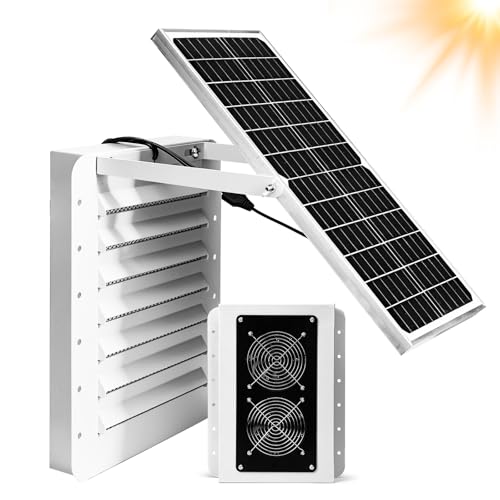
Best for high airflow and robust performance. The kit uses dual 2688 RPM fans delivering up to 600 CFM for rapid heat and moisture removal. It is designed with weatherproof, heavy-duty metal construction and UV-resistant coating for long-term use. Suitable for larger containers or heavy-duty storage environments. A potential drawback is the heavier setup that may require a more involved installation.
Buying Guide
What should I look for in a container solar vent kit?
Key factors include solar panel wattage and efficiency, fan speed (CFM), battery backup (if any), weatherproofing, and ease of installation. Higher wattage panels can deliver more consistent airflow on sunny days, while larger CFM helps ventilate bigger containers quickly.
Do I need dual fans or a single fan setup?
Dual fans generally move more air and create cross-ventilation paths, which improves moisture control. A single strong fan may suffice for smaller containers or tight spaces but may struggle in hot climates.
How important is sun orientation?
Sun orientation directly affects energy production. Choose products with adjustable panels or flexible mounting to maximize sun exposure throughout the day.
What about rain, hail, or dusty environments?
Look for weatherproof enclosures, protective grilles, and waterproof panels. Durable coatings reduce corrosion in hot, dusty, or coastal areas and extend component life.
Is a battery backup necessary?
Battery backups provide nighttime ventilation and cloudy-day operation, which can be important for stored goods or remote sites without reliable power. However, consider maintenance and replacement costs.
Installation considerations
Many kits are designed for simple mounting with minimal tools. Ensure the roof rib measurements are compatible, seal penetrations properly, and plan panel orientation to prevent shading during peak sun hours.
Maintenance and durability
Regular inspections of seals, wiring, and fan blades extend system life. Select products with corrosion-resistant materials and UV coatings for durability in harsh environments.
FAQ
- Q: Can these vent kits completely replace electrical cooling in a large container?
- A: They provide substantial airflow, but in extreme climates, supplementary cooling or passive ventilation may still be needed.
- Q: Do these kits require professional installation?
- A: Most kits are designed for DIY installation with basic tools; follow manufacturer instructions for best results.
- Q: Will the panel work in winter or on cloudy days?
- A: Battery-powered backups and higher-efficiency panels help, but performance can vary with sunlight conditions.
- Q: How do I choose between 15W, 25W, or 10W panels?
- A: For larger containers or higher heat, higher wattage panels yield more airflow; smaller or portable setups can use lower wattage.