Best Sun Tracking Solar Array: Top Dual- And Single-Axis Trackers for Maximum Output
Looking to boost solar energy production with a tracking system? The best options below use dual- or single-axis tracking to follow the sun, increasing output and efficiency for various solar panel setups. These picks are suited for yards, farms, RVs, off-grid apps, and DIY projects. The top products below are chosen for clear setup, real-world applicability, and compatibility with common panel sizes.
| Product | Best For | Key Benefit |
|---|---|---|
| ECO-WORTHY Dual Axis Tracking System (B00JYAIS9W) | Yards, Farms, Multi-panel arrays | Up to 40% power increase |
| ECO-WORTHY Expanded Version (B0DJLNBP6Q) | Large configurations, flexible mounting | Smart light tracking, 270° coverage |
| ECO-WORTHY Single Axis Tracking (B0D94DC93H) | Smaller installations, garden to yard | Up to 30% power gain |
| BINGOX Dual-Axis Tracker (B0DC18FQH6) | Off-grid, DIY systems | Wind protection and easy setup |
| WQV Dual Axis Controller Kit (B0D9LB6963) | Custom builds, hemispheric flexibility | Real-time sun tracking with LCD and remote |
ECO-WORTHY Dual Axis Tracking System (Increase 40% Power)

The ECO-WORTHY Dual Axis Tracking System is designed for solar arrays that need constant sun exposure. This tracker uses two axes to rotate the panels up to 270° and features a sensitive sunshine sensor to align with the sun throughout the day. It is suitable for yard, farm, or field installations and aims to increase energy capture by about 40% versus fixed mounts. A wind sensor helps protect the frame by auto-resetting angles during strong winds, and a sturdy ground base is included for stable installation.
Who it’s best for: large outdoor setups that require sustained sun tracking and wind resilience. Choose this if you need strong daily tracking with automated wind responses for moderate to high wind areas. Caution: installation requires secure anchoring; improper ground setup can reduce wind stability.
ECO-WORTHY Expanded Version Dual Axis Tracking System

This expanded version targets larger panel configurations, including multi-panel layouts. It features intelligent light detection to adjust orientation in real time, increasing efficiency by about 40% relative to standard brackets. The 270° tracking range captures sun from all directions, and the system includes automatic leveling to handle high winds. It’s especially suitable for yard, farm, or field deployments where multiple panels must stay aligned for maximal beam capture.
Who it’s best for: users with 10-panel or more arrangements or those requiring precise, real-time sun optimization. Better for: colder or windier climates with a need for wind-leveled operation. Caution: more complex setup may require careful alignment and calibration during initial install.
ECO-WORTHY Single Axis Tracking System

The single-axis option provides a streamlined approach to tracking by rotating along one axis, offering at least a 30% boost in power generation compared with fixed mounts. It accommodates different panel sizes and can support configurations with up to four panels of certain widths. The kit emphasizes robust after-sales support and diagnostic options, making it a practical choice for DIY installers who value service accessibility.
Who it’s best for: smaller installations or budget-conscious projects that still want noticeable efficiency gains. Better for: simple, quick setups with fewer moving parts. Caution: fewer degrees of freedom than dual-axis trackers, so performance may be slightly lower in diffused light or shading conditions.
BINGOX Dual-Axis Solar Tracker Controller Kit
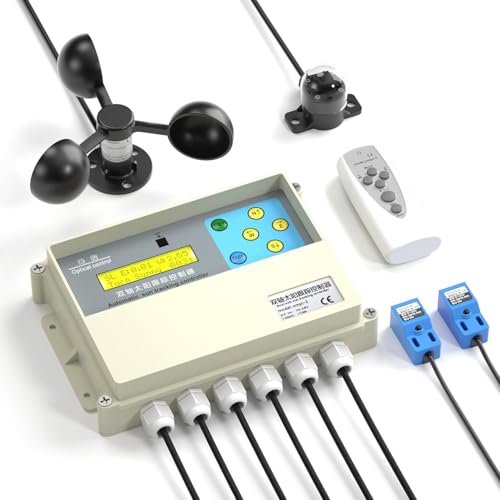
The BINGOX kit offers dual-axis sun tracking with an LCD display, wind sensor, and a remote for straightforward operation. It tracks the sun east–west and north–south to maximize daily energy capture and includes wind protection features to safeguard against harsh conditions. This is a fit for off-grid projects, RVs, and DIY solar builds requiring reliable automated tracking with user-friendly controls.
Who it’s best for: off-grid enthusiasts and DIY builders who want a complete, easy-to-use tracking solution with remote control. Caution: assembly and wiring clarity are important; miswiring could affect tracking accuracy.
Dual Axis Solar Tracker Controller Kit (WQV)

The WQV controller kit provides dual-axis tracking with a bright LCD, wind leveling, and a remote control for parameter adjustments. It’s designed for use in both northern and southern hemispheres, enabling flexible placement and operation worldwide. The controller manages a 12V/24V DC brushless motor to drive the dual-axis platform, making it suitable for experimental builds or custom installations where precise sun tracking is desired.
Who it’s best for: builders who want a flexible, controllable tracking system with clear parameter visibility. Caution: as a controller-focused kit, it may require additional hardware to mount specific panel configurations.
SolarX V2: Sun-Tracking Kit (Robotistan)

The SolarX V2 kit is a DIY option that uses an Arduino Nano to provide a sun-tracking system. It’s designed for educational purposes and hobbyists who want to learn how tracking works while assembling and coding their own tracker. The kit includes sensors, servos, and the moving components necessary for a functioning tracker.
Who it’s best for: students or hobbyists seeking a hands-on learning project. Caution: not a plug-and-play commercial solution; performance depends on user assembly and programming skill.
Solar Tracker Controller with Light Sensor (LorFain)

The LorFain controller emphasizes dual-axis tracking to maximize exposure across daytime hours. It supports universal compatibility with standard solar mounting systems and includes weatherproof housing to protect internal components. Real-time sun tracking and weather resistance make it a versatile option for residential or commercial installations where durability matters.
Who it’s best for: installers needing broad compatibility and enhanced weather resilience. Caution: universal designs may require careful mounting alignment to ensure optimal performance.
Buying Guide: How to Choose a Sun Tracking Solar Array
- Tracking type: Dual-axis trackers offer the most precise sun following and generally deliver higher gains than single-axis models. If you have space and want maximum efficiency, a dual-axis option is preferable. For smaller setups, single-axis trackers can still provide meaningful gains with simpler installation.
- Panel compatibility: Check the maximum panel size and number of panels supported by the tracker. Some kits are suited to up to four panels of specific widths; others support larger arrays. Ensure your panels fit within the mounting footprint.
- Wind handling: Look for trackers with wind sensors or automatic leveling to protect against gusts. Strong wind tolerance helps avoid damage and downtime in stormy climates.
- Ease of installation: Some products include complete controller kits with LCD, remote, and sensors, making setup straightforward. Others require more custom wiring or programming, especially DIY kits.
- Control options: Decide between automatic tracking with sensors and manual override options. Remote control and display readouts can simplify tuning and maintenance.
- Maintenance and service: Favor products with clear after-sales support, diagnostic options, and accessible customer service. This reduces downtime if issues arise.
- Physical footprint and foundation: Ensure the ground base or mounting framework can be securely installed in your location, especially in wind-prone areas where stakes, anchors, or poured foundations may be needed.
- Cost vs. gain: Dual-axis trackers typically offer higher gains but at greater cost and complexity. Consider your daily sun exposure, climate, and energy goals to estimate payback time.
Frequently Asked Questions
- What is the typical power gain from a sun-tracking system? Answer: Gains vary by location and system, but dual-axis trackers commonly deliver around 20% to 40% more energy than fixed mounts in optimal conditions.
- Do trackers require maintenance? Answer: Yes, regular inspections of moving parts, sensors, and wiring help prevent performance drops due to wear, dust, or corrosion.
- Can DIY sun trackers work with all panels? Answer: Most trackers support common panel sizes, but always confirm mounting compatibility and weight limits with your specific panels.
- Are wind sensors essential? Answer: Wind sensors reduce risk by reorienting or locking positions during high winds, which protects the system and prolongs life.
- Is single-axis tracking enough for my yard? Answer: If space is limited or you mainly receive sun for a portion of the day, single-axis tracking can still offer meaningful gains, though not as high as dual-axis systems.
- What should I consider before buying? Answer: Panel size and count, climate (wind and snow), installation space, wiring complexity, and after-sales support.