Best 110 Volt Battery Chargers for Cars, Boats, and More
Answer: If you need a 110-volt battery charger that can safely maintain, trickle, or boost 12V batteries across vehicles and equipment, these five models offer a mix of fast charging, automatic safety features, and compatibility with common lead-acid and lithium batteries. The best pick depends on your use-case: daily vehicle maintenance, emergency engine starts, or deep-cycle battery recovery. The top options below are suited for car lovers, boaters, RV travelers, and workshop technicians seeking reliable, plug-in charging without constant monitoring.
| Product | Best For |
|---|---|
| TowerTop 2/10/25 Amp 12V Smart Charger | All-around maintenance and fast charging for cars, boats, and deep-cycle batteries |
| Schumacher Electric Wheeled 10A Charger | Garage use with engine start capability for fleets and high-demand power sports |
| NOCO GENIUS1 1A 6V/12V | Small spaces, maintenance, and desulfation for various lead-acid and lithium batteries |
| AZZUNOX 12V/24V Charger | Deep-cycle recovery and dual-voltage versatility for 12V/24V systems |
| NOCO GENIUS10 10A 6V/12V | Mid-range power maintainer with robust desulfation and temperature compensation |
TowerTop 12V Smart Charger with Auto Desulfator

The TowerTop charger supports 2A, 10A, 25A, and AUTO modes. It is designed for sealed lead-acid batteries in cars, boats, RVs, and deep-cycle configurations, including AGM, GEL, and CALCIUM varieties. Features include automatic start within 30 seconds if left idle, a pulse repair mode after full charge, energy-saving display shutdown, and memory of last settings after outages. Best for users who want quick charging with automatic safety and a regain power when voltage drops. Limitation: the 25A setting is recommended for larger 100Ah batteries and may be too aggressive for smaller packs without monitoring.
Who it’s best for: Vehicle owners who need a versatile charger that can act as a powerful maintenance tool and occasional starting aid, plus a smart desulfator for longer battery life.
Why selected: It combines multiple current options with automatic features and compatibility across common 12V battery chemistries, delivering efficient charging and long-term storage protection.
Caution: Always verify battery type before selecting AUTO or high-current modes to avoid undue heat on sensitive batteries.
Schumacher Electric Wheeled 10A Charger & 250A Engine Starter

This model delivers a 250-amp engine start alongside a precise 135-minute manual charging timer. It is built for durability with a steel case, heavy-duty wheels, and a retractable handle, intended for garages and service bays. Best for fleets or DIY enthusiasts who need a reliable jump-start capability in addition to charging control. Limitation: Being a wheeled unit with substantial power, it’s heavier and less portable than compact chargers.
Who it’s best for: Professionals or hobbyists who require a one-stop solution for reviving dead batteries and performing controlled charging in larger vehicles or power sports.
Why selected: The dual capability—strong engine-start power and configurable charging control—addresses both emergency starts and regular maintenance needs.
Caution: Use the engine-start function only for appropriate battery types and follow safety guidelines for high-current starts.
NOCO GENIUS1: 1A 6V/12V Smart Charger

The GENIUS1 provides an all-in-one charging solution: a charger, maintainer, trickle charger, and desulfator for 6V and 12V lead-acid (AGM, Gel, SLA, VRLA) and lithium batteries. It uses a thermal sensor to adjust charging based on ambient temperature, reducing overcharging and undercharging. Best for compact spaces and routine maintenance that benefits from temperature-compensated charging. Limitation: Smallest of NOCO’s line, may not deliver rapid charging for large or deeply discharged packs.
Who it’s best for: Homeowners with limited space or garages who need a simple, automatic charger that also protects against overcharge and supports multiple battery chemistries.
Why selected: Its compact size, broad compatibility, and smart temperature compensation provide reliable, safe charging for everyday use.
Caution: For very large 12V deep-cycle or heavy-duty automotive batteries, consider a higher-current unit to reduce charge time.
AZZUNOX 12V/24V Charger and Engine Starter
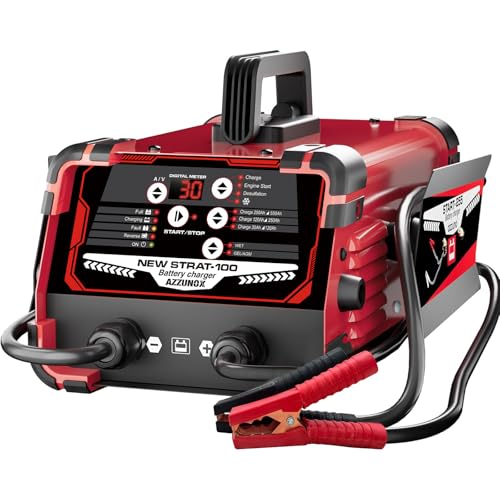
The AZZUNOX unit supports 12V and 24V systems with 0-30A charging and up to 130A engine starting current. It offers automatic charging with two voltage modes and a recovery/desulfation function designed to revive deeply discharged batteries. Best for users who work with mixed 12V/24V configurations and require a robust starting capability in a rugged, metal-chassis charger. Limitation: Battery voltage below 1V may be interpreted as damaged, preventing charging or starting.
Who it’s best for: Technicians or enthusiasts who handle diverse vehicle fleets, boats, or heavy equipment needing deep recovery and dual-voltage support.
Why selected: Its dual-voltage capability and substantial current range provide flexibility for various battery types and recovery scenarios.
Caution: Ensure the battery voltage is above 1V to avoid misclassification as damaged.
NOCO GENIUS10: 10A 6V/12V Smart Charger
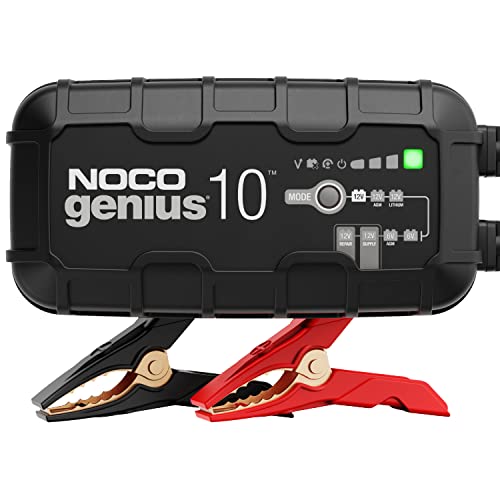
The GENIUS10 offers 10A charging with advanced desulfation and temperature-compensation features. It is designed for 6V and 12V lead-acid and lithium batteries, including maintenance-free and deep-cycle varieties. Best for mid-range charging performance with strong protection against overcharging and thermal variability. Limitation: Taller units may take more space than ultra-compact chargers, affecting portability in tight spaces.
Who it’s best for: Users seeking a higher-current, feature-rich charger for regular maintenance, battery recovery, and protection across multiple battery chemistries.
Why selected: Its higher current capacity and proactive temperature compensation balance speed, safety, and battery longevity.
Buying Guide: Key Considerations for 110V Battery Chargers
Voltage compatibility: Confirm the charger supports your battery system (12V is standard for cars, boats, and light trucks; 24V for larger vehicles or certain equipment). Some models also support 6V and lithium chemistries.
Charging rates: Higher amperage charges faster but can stress small batteries. Choose a charger with multiple settings to match battery capacity (Ah) and avoid overheating.
Automatic features: Look for automatic desulfation, deep-cycle recovery modes, temperature sensing, and auto shutoff. These features help maintain battery health and prevent overcharging.
Battery types: Ensure compatibility with AGM, GEL, flooded/wet, calcium, EFB, MF, and deep-cycle batteries. If you own lithium batteries, verify LiFePO4 support.
Portability and build: For frequent移 or workshop use, consider a model with a durable housing, wheels, and a compact footprint. Heavier units offer higher power but reduce portability.
Safety features: Short-circuit protection, reverse polarity alarms, overcurrent protection, and temperature compensation improve safety and equipment longevity.
Recovery and desulfation: If your battery sits unused, desulfation can help restore performance. Not all batteries respond similarly—for severely degraded packs, recovery may be limited.
FAQ
- What is the difference between a charger and a maintainer? A charger actively raises a dead or low battery to a usable voltage, while a maintainer keeps a fully charged battery at an optimal level to prevent discharge over time.
- Can I use a 110V charger on 24V batteries? Only if the charger explicitly supports 24V input or dual-voltage operation. Using a 12V-only charger on a 24V system can damage the charger and the battery.
- Is temperature compensation important? Yes, it helps prevent overcharging in hot conditions and undercharging in cold conditions, protecting battery life and performance.
- Do these chargers require professional installation? Most consumer chargers are plug-and-play, but some heavy-duty units with engine-start capabilities should be used by informed users following safety guidelines.
- How long does it take to charge a typical car battery? It depends on battery capacity and charger amperage. A 25A charger can top up a typical 100Ah battery in approximately 3–4 hours under optimal conditions.
- Can desulfation extend battery life? Desulfation can improve performance for some lead-acid batteries, but results vary and it cannot restore severely damaged cells.