Best 24 Volt 100Ah Lithium Battery for RVs, Solar and Off-Grid Living
Choosing the right 24V 100Ah lithium battery depends on how you plan to use it. This guide highlights five top options, each built for off-grid power, RVs, solar storage, or Marine applications. The batteries vary in protection features, cycle life, cold-weather behavior, and expandability. This overview helps buyers identify which model best suits their system size, climate, and space constraints.
Summary table of selected products:
| Product | Best For | ||
|---|---|---|---|
| Dumfume 24V 100Ah LiFePO4 | High-output off-grid and RV setups | 2560W continuous output, 100A BMS, up to 15000+ cycles | RV, Solar, Home Backup |
| Dyness 24V 100Ah | Cold climates and expandable systems | Smart 100A BMS with low-temperature protection, expandable to 20.48kWh | Solar, RV, Marine |
| Rvpozwer 24V 100Ah | Lightweight, space-constrained installations | Compact, 2560Wh, 20k+ cycles, automatic recovery | RV, Trolling motors, Off-grid |
| XZNY Compact 24V 100Ah | Space-saving installations | 30% smaller than standard 24V packs, built-in 100A BMS | RV, Camper, Marine |
| HAYAEnergy 24V 100Ah | Budget-friendly, general off-grid storage | High safety with CE/SGS, 100A BMS, broad operating range | RV, Van, Marine |
Dumfume 24V 100Ah LiFePO4 Battery

The Dumfume model delivers 2.56kWh of usable energy and uses a built-in 100A BMS to guard against overcharge, over-discharge, and short circuits. It supports series and parallel expansion up to 2S4P, making it suitable for larger solar storage or multi-battery configurations. Best for buyers who want high output and long cycle life in an off-grid or RV setup. A caution: low-temperature performance requires temperatures of 5°C or higher for optimal operation, and return shipments for cold-weather issues may not be covered.
Who it’s best for: Off-grid homeowners, RV users, and solar enthusiasts who prioritize long cycle life and higher voltage stability. Why chosen: strong continuous output, scalable architecture, and robust protection features.
Dyness 24V 100Ah LiFePO4 Battery

Dyness emphasizes extreme cold protection with a smart 100A BMS and A+ grade cells, ensuring safe operation in cool environments. It’s highly expandable with up to 4P2S, enabling larger banks up to 20.48kWh. Best for users in regions with cold winters or those building expandable solar storage. Limitation: like other LiFePO4 packs, performance can vary with temperature, so verify operating conditions for your climate.
Who it’s best for: Solar owners in cold climates and anyone planning a scalable battery bank. Why chosen: excellent cold-weather features and clear expansion path.
Rvpozwer 24V 100Ah LiFePO4 Battery
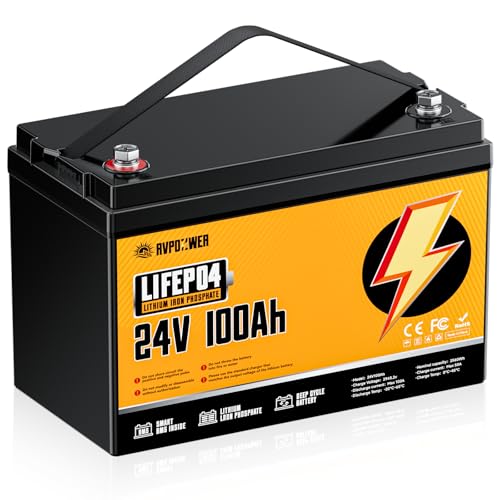
Rvpozwer offers a compact, lightweight design at about 41.9 lbs with 2560Wh energy and a robust 100A BMS. This model suits RVs, boats, and off-grid systems where space and weight matter. It shows strong cycle durability with 20,000+ cycles in description, and automatic recovery helps keep systems stable after disturbances. Caution: ensure your system wiring accommodates a 24V setup and check for compatibility with existing charge controllers.
Who it’s best for: Lightweight RV or marine installations and small solar arrays. Why chosen: best balance of weight, size, and deep-cycle performance.
XZNY Compact 24V 100Ah Battery

XZNY emphasizes compactness without sacrificing capacity. The pack is 30% smaller than standard 24V 100Ah batteries and includes a built-in 100A BMS with low-temperature protection. Best for users needing a space-saving solution while maintaining performance. A limitation to note: compact designs can be more sensitive to heat; ensure adequate ventilation and spacing in tight compartments.
Who it’s best for: Tiny to mid-size off-grid setups, boats, or RVs with tight spaces. Why chosen: strongest space-saving advantage and solid protection.
HAYAEnergy 24V 100Ah LiFePO4 Battery

HAYAEnergy presents a practical option with a built-in 100A BMS and broad operating range. It notes safety features backed by CE/ SGS and UN38.3 compliance indicators, aiming for reliable power in RVs, vans, or off-grid storage. Best for buyers who want a budget-friendly but dependable LiFePO4 battery with strong protection. Caution: verify environmental and warranty terms since data emphasizes safety certifications rather than performance benchmarks.
Buying Guide: Key Purchase Considerations
What matters most when choosing a 24V 100Ah LiFePO4 battery?
- Protection and safety: Look for a 100A BMS with overcharge, over-discharge, short-circuit, and temperature protection. Low-temperature cut-off is a plus for cold climates.
- Expandability: If you plan bigger storage later, choose batteries that allow series/parallel expansion (e.g., 2S4P or 4P2S configurations).
- Weight and size: Space and weight affect installation in RVs and boats. Compact designs save room and ease handling.
- Temperature performance: Cold-weather operation is crucial for off-grid, marine, or winter RV use. Verify operating temperature ranges.
- Cycle life: A higher cycle count indicates longer usable life and better long-term value.
- Applications: Confirm suitability for deep-cycle storage rather than engine starting or cranking, if specified by the manufacturer.
Practical Comparison Questions
- Which battery offers the best cold-weather protection?
- Which pack is the easiest to expand into a larger bank?
- Which option provides the lightest weight for tight spaces?
- Which model has the most comprehensive safety certifications?
- Which battery is best for RV or marine use in moderate climates?
Frequently Asked Questions
- What does a 100A BMS do? It protects the battery from overcharge, over-discharge, short circuits, and temperature extremes, helping extend life and ensure safe operation.
- Can these batteries power a trolling motor? Yes, most 24V 100Ah LiFePO4 packs are suitable for trolling motors within their continuous power rating.
- Are LiFePO4 batteries safe in marine environments? Generally yes, with proper protection and ventilation; confirm certifications and mounting guidelines.
- How many cycles can I expect? Many models advertise 4000–15000+ cycles under proper use; real-world results vary with temperature and depth of discharge.
- Do I need a battery management system? A built-in BMS is essential for safety and longevity in LiFePO4 packs.
- Can I mix different brands in one system? Mixing brands can complicate BMS compatibility and charging behavior; use matched batteries when possible.