Best Heat Exchange Water Heaters and Exchangers for Efficient Home and Marine Use
Answering the demand for reliable heat exchange solutions, this guide highlights five practical water-to-air and plate heat exchanger options. These products suit homeowners looking to integrate renewable energy, boaters needing efficient hot water, and professionals seeking robust heat transfer. Best for homeowners exploring outdoor wood-furnace compatibility, best for compact spaces on boats, and best for high-efficiency heating loops, these selections balance performance with durability.
Below is a quick buying snapshot. The table helps compare core attributes at a glance and identify which model best fits your setup.
| Product | Best For | Key Feature | Notes |
|---|---|---|---|
| AB Water to Air Heat Exchanger 15×20 (HTL15x20) | Outdoor wood-furnace setups requiring 110k-360k Btu/h | 12 fins per inch, 3 rows of 3/8″ copper tubes | Epoxy-coated fins; steel shell; energy efficient |
| VEVOR Water to Air Heat Exchanger 16×16 | Residential cooling/heating with durable copper brazed joints | Up to 160kBtu/h; corrosion-resistant epoxy fins | Wide operating temperature range |
| AB Water to Air Heat Exchanger 20×20 | Higher-capacity cooling/heating needs | Up to 360kBtu/h; 12 fins per inch; 3 rows of copper tubes | Premium materials; energy-efficient design |
| AB Water to Air Heat Exchanger 16×18 | Compact yet efficient heat exchange | 100kBtu/h to 360kBtu/h range; copper tubes with epoxy fins | Good balance of size and output |
| VEVOR Plate Heat Exchanger, 5×12 | Floor heating, water heating, and cooling in compact systems | 80 plates; high heat transfer with 99% efficiency potential | Stainless steel and copper brazing; broad temperature range |
AB Water to Air HTL15x20 Heat Exchanger

Best for outdoor wood-furnace installations that require robust performance. This unit ships with a steel shell and base-brazed contact points to withstand high pressure and temperature, while copper and aluminum materials support efficient heat transfer. The fins are epoxy-coated for extended wear resistance. This exchanger offers a capacity of up to 360kBtu/h in suitable configurations, with a listed base capacity of 110,000 Btu. Choose this if you need strong heating or cooling, particularly when integrating renewable energy sources like boilers or solar panels. A potential limitation is the substantial footprint and mounting considerations for smaller spaces.
Best for users who need a durable, high-capacity water-to-air exchange in outdoor or semi-exposed environments. Its design emphasizes longevity under demanding conditions and compatibility with a variety of heat sources.
Why it’s selected
- High heat transfer potential due to wavy fins and seamless copper tubes.
- Epoxy-coated fins to resist wear and corrosion.
- Solid steel shell with base brazed joints for structural integrity.
Caution: Ensure compatible connections and mounting space for the 15×20 footprint and copper port sizing.
VEVOR Heat Exchanger Water to Air 16×16

Best for compact residential systems seeking strong performance and corrosion resistance. This unit features copper brazed edges and contact points for a leak-resistant build, with epoxy-coated fins to reduce wear and mineral buildup. It handles a broad temperature window from -40 to 356 degrees Fahrenheit. It can deliver up to 160kBtu/h, making it well-suited for mid-sized homes or add-on heat-pump configurations. A notable limitation is the mid-range maximum output compared to larger, multi-pass units.
Best for homeowners prioritizing durability and corrosion resistance in a compact footprint. The brazed design and epoxy-coated fins provide durable operation in various climates.
Why it’s selected
- High-quality copper and aluminum combination for efficient heat transfer.
- Leak-resistant construction with strong thermal performance.
- Wide operating temperature tolerance enhances versatility.
Caution: For very large heat loads, a larger model may be preferable.
AB Water to Air 20×20 Heat Exchanger
Best for higher-capacity heating and cooling in larger homes or multi-zone setups. This model pushes up to 360kBtu/h with 12 fins per inch and three copper tube rows, yielding strong heat transfer with enhanced fin-contact areas. Premium materials and base brazed joints contribute to durability in demanding environments. Consider this option when you need substantial BTU output at a reasonable footprint. A limitation is that the larger size may require more space and more complex installation.
Best for scenarios where maximum heat transfer is needed from a water source to air. It balances power with a wider footprint than smaller units.
AB Water to Air 16×18 Heat Exchanger
Best for medium-sized spaces requiring a balance of output and footprint. This unit offers a 100kBtu/h to 360kBtu/h range with 12 fins per inch and three 3/8″ copper tube rows. The steel shell and epoxy-coated fins deliver reliable service life, while copper and aluminum contribute to effective heat transfer. Choose this if you want a mid-range option with robust construction. Caution: output variability depends on setup and heat source compatibility.
Best for applications where a moderate-to-high BTU load is needed without the largest footprint.
VEVOR Brazed Plate Heat Exchanger, 5×12
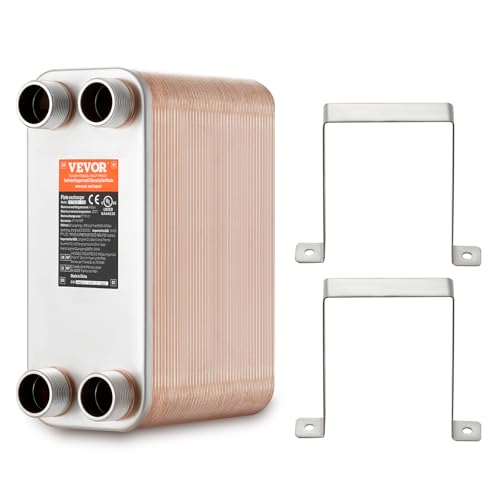
Best for floor heating, water heating, and cooling systems that benefit from high plate density. The 5×12 plate design with up to 80 plates delivers strong heat transfer, especially in constrained spaces. Stainless steel plates and copper brazing support robust performance across a broad temperature range, with up to 99% heat efficiency potential. This option is ideal for retrofit projects or compact installations where plate heat exchangers are preferred. Limitation: plate heat exchangers can require careful assembly and leak testing during installation.
Buying Guide
What size and capacity do I need?
Determine your BTU/h target based on the space to heat or cool and the heat source compatibility. Larger spaces or higher heat loads require bigger exchangers (e.g., 20×20 or higher), while smaller setups can run efficiently with mid-sized models (16×18 or 16×16).
Which materials guarantee durability?
Look for copper tubing with aluminum fins or stainless-steel plates, paired with epoxy coatings. Copper brazed joints reduce leakage risk, and steel shells with base brazing provide better resilience under pressure and temperature shifts.
What about energy efficiency?
Exchangers with higher contacts between fins and tubes typically deliver better heat transfer. Epoxy-coated fins reduce wear and mineral buildup, extending service life in challenging water conditions.
Where will it be installed?
Outdoor or exposed installations benefit from epoxy-coated fins and robust shells. Compact units fit tighter spaces, but ensure proper mounting clearance for airflow and connections.
What about compatibility with heat sources?
Verify whether the exchanger supports your heat sources—boilers, solar panels, or wood furnaces—and whether the connections match your piping. Some units excel in renewable-integrated systems, others in marine applications where space is limited.
Maintenance considerations
Regular inspection for leaks, mineral buildup, and corrosion is essential. Plate exchangers require proper seal checks, while finned tube designs benefit from anti-corrosion coatings and careful water chemistry management.
FAQ
- What is a heat exchange water heater? A device that transfers heat between water and air (or between two water streams) to provide heating or cooling, often used in HVAC and marine applications.
- Which is best for an outdoor wood furnace? A larger, robust water-to-air exchanger with a steel shell and copper tubes, such as the AB 20×20 or HTL15x20, is typically well suited for outdoor wood furnace systems requiring high heat output.
- Do plate heat exchangers work for home heating? Yes, plate exchangers are efficient for floor heating and radiant systems; they provide compact, high-efficiency heat transfer in tight spaces.
- Are epoxy-coated fins necessary? Epoxy-coated fins extend the life of fins by resisting wear and mineral buildup, especially in variable water chemistry.
- Can these units handle solar heating? Many units are compatible with solar or other renewable heat sources, enabling energy savings when paired with boilers or solar collectors.
- What maintenance is required? Regular inspection for leaks, corrosion, and mineral buildup; periodic flushing or cleaning as needed based on water quality.