Best Solar Panel With Storage Battery for Off-Grid Power and Backup
Answering the search intent directly: these solar panel and storage battery kits deliver portable or home-scale solar power with integrated or compatible battery storage. They’re ideal for campers, RVs, emergency backup, and off-grid living. The top picks below cover high-capacity home storage, compact portable kits, and starter setups for DIY solar. Each section explains who should choose it, why it stands out, and any practical limitations to consider.
| Product | Type | Best For |
|---|---|---|
| Jackery Solar Generator 1000 V2 with 200W Solar Panel | Portable power station + panel | Outdoor enthusiasts and emergencies |
| Dawnice 16kWh LiFePO4 Wall-Mounted Battery | Home battery storage | Home backup and expansion |
| ZeroKor Portable Solar Generator 300W | Compact power station with solar panel | Outdoor trips and small devices |
| ECO-WORTHY 10kW Off-Grid System | Whole-home solar kit | Whole-house backup and scalable power |
| SOLPERK 20W Solar Panel Kit | Trickle-charger kit | 12V battery maintenance and small loads |
Jackery Solar Generator 1000 V2 With 200W Panel

The Jackery Solar Generator 1000 V2 is a portable power station built around a 1,070Wh LiFePO4 battery and a 1,500W AC output with a 3,000W surge. It weighs 23.8 lbs and includes a foldable handle for easy transport. This unit is best for campers, RV travelers, and emergency prep where reliable wide-swing power is needed. A notable plan feature is one-hour fast charging activated via the Jackery App, with constraints that full charging can vary by charger input (600W alternator or 200W solar panel options). It’s designed for longevity, retaining over 70% capacity after thousands of cycles.
Best for: users who need strong AC output and portability with rapid charging on-site. Limitations: full outdoor charging depends on the right charger setup and solar input; battery lifespan varies with charging cycles.
Dawnice 16kWh LiFePO4 Wall-Mounted Battery

This 16kWh LiFePO4 storage unit delivers large-scale house-ready capacity with a 51.2V system and 314Ah rating. The product includes a 100A BMS for protection and is designed to connect with inverters and mainstream solar generators. With a claimed 6,000+ cycle life, it targets multi-year reliability for home backup, RV setups, or off-grid installs. It’s best for: homeowners or setups looking to scale storage with a robust, long-life LiFePO4 pack. Caution: compatibility with your inverter and system topology should be confirmed before pairing.
ZeroKor 300W Portable Solar Generator Kit

This kit pairs a 300W portable power station with a foldable 60W solar panel and multiple outlets, including two 300W AC outlets and several USB ports. It provides a compact, all-in-one solution for off-grid camping, RV use, or emergency charging for devices like phones and laptops. Best for: hikers, campers, and travelers seeking a rugged, plug-and-play power option. Limitation: higher-watt appliances (like hair dryers or coffee makers) may exceed its continuous output capacity and require careful management.
ECO-WORTHY 10kW Off-Grid Solar Panel Kit

This all-in-one system includes a 10kW inverter, five 590W solar panels (total PV around 2,950W), and a 48V 314Ah LiFePO4 battery storage with 16.1 kWh capacity. The design supports parallel expansion (up to six units) and includes a user-friendly display with Bluetooth/Wi‑Fi. It targets complete home backup and scalable power for extended outages. Best for: homeowners seeking substantial backup capacity and future scalability. Caution: system setup and electrical code compliance are essential for safe operation in a residential setting.
SOLPERK 20W Solar Panel Kit
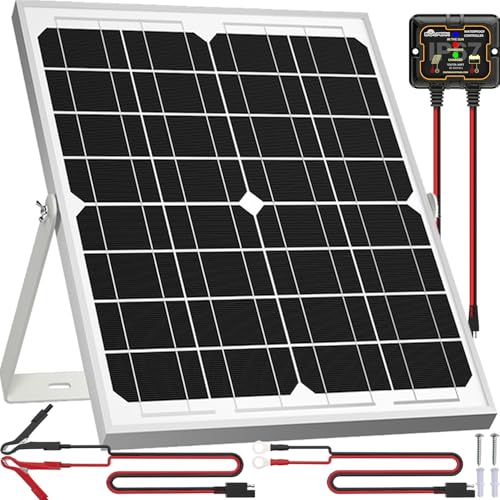
The SOLPERK 20W kit focuses on small-scale charging and battery maintenance. It uses a 20W monocrystalline panel with an MPPT controller to boost charging efficiency. It’s compatible with 12V batteries (LiFePO4, AGM, Gel, etc.) and includes condition indicators to monitor charge status. Best for: maintaining 12V batteries for trailers, boats, RVs, or vehicles when sun exposure is available. Limitation: small panel output may not suffice for high-power devices or continuous use without larger storage capacity.
Buying Guide: Key Considerations For Solar Panels With Storage
- What is your primary use case? Emergency backup, RV/camping, or home off-grid power require different storage capacities and port layouts.
- Storage capacity vs. power output: Higher Wh (or kWh) values provide longer runtime; higher continuous watts support more devices.
- Battery chemistry: LiFePO4 offers long life and stability; consider cycle life and safety features for home installations.
- Portability vs. home installation: Portable units prioritize weight and handle design; home kits emphasize scalability and integration with inverters.
- Expandability: Some systems support parallel battery or module expansion; check critical compatibility with inverters and control systems.
- Inverter and charging options: Look for pure sine wave outputs, peak surge ratings, and diverse charging inputs (AC, solar, vehicle).
- Weather and durability: Outdoor-friendly panels require protective frames and weatherproof enclosures; ensure IP ratings and mounting compatibility.
- Safety and protection features: BMS protections (overcharge, short circuit), thermal management, and automatic shutdown safeguards are essential for long-term reliability.
Frequently Asked Questions
- What is the difference between a solar panel kit and a portable solar generator?
– A solar panel kit provides solar panels with a controller and wires for charging a battery bank or an inverter; a portable solar generator combines a battery, inverter, and ports in one unit, sometimes with an integrated solar panel. - Can you expand a home solar storage system later?
– Yes, many systems are designed for parallel expansion, but verify inverter compatibility and BMS settings before adding more batteries or panels. - Is LiFePO4 safer for long-term storage?
– LiFePO4 cells typically offer longer cycle life, stable voltage curves, and better thermal stability than many other chemistries, making them common in long-term storage. - What wattage panel should I start with for home backup?
– For general home backup, larger PV arrays (2–5 kW or more) paired with substantial storage (multiple kWh) provide meaningful daily recovery, depending on sun exposure and loads. - Do these systems run on solar-only power?
– Some setups run primarily on solar, but most require grid or generator support during limited sun or high-load scenarios; always plan for peak usage and weather variability. - What maintenance is required for LiFePO4 storage?
– Periodic checks of voltage, temperature, and cell balance; ensure BMS stays within safe operating ranges and connections remain clean and tight.