Best Brushless DC Motor With Controller for Efficient Electric Drives
Answering common buyer questions: this guide highlights five reputable brushless DC motor controllers, each paired with compatible motors for E-bikes, scooters, DIY robotics, and small automation projects. The selections favor reliability, compatibility, and clear safety notes. Best for hobbyists, DIY engineers, and riders seeking steady speed control and responsive braking. The summary table below helps compare key details at a glance.
| Product | Brand | Voltage Range | Power | |
|---|---|---|---|---|
| yuandai Electric Bicycle Scooter E-Bike Brushless DC Motor Controller | yuandai | 48V-64V | 1500W (45A) | High-power e-bikes and scooters |
| Original 48V 21A Brushless DC Motor Controller for OUXI V8 | SPEDWHEL | 48V | 21A (approx. 1000W class) | Replacement parts for specific bikes |
| RioRand 350W 6-60V 3-Phase PWM Controller | RioRand | 6-60V | 200-300W continuous | DIY robotics and small tools |
| 36-48V 350W Brushless Dc Motor Speed Controller | munirater | 36-48V | 350W | E-bike/scooter replacements |
| DC 7-24V 200W BLDC Driver with Potentiometer | GODIYMODULES | 7-24V | 200W | Compact DIY projects |
yuandai Electric Bicycle Scooter E-Bike Controller

Best for high-power electric bicycles and scooters requiring robust control with stable speed and reliable braking/direction changes. The aluminium alloy construction emphasizes durability, and the controller is designed for 48V to 64V systems with up to 1500W output. This makes it suitable for riders seeking strong performance in urban commuting or light off-road use. A potential limitation is its higher power class, which may be unnecessary for smaller builds.
- Application: Suitable for electric bicycles and scooters
- Material: Aluminium alloy for durability
- Control: Emphasizes steady speed and responsive braking/direction
Best for: Riders building or upgrading a high-power e-bike or scooter who need reliable, durable control and straightforward braking response.
Original 48V 21A Brushless DC Motor Controller for OUXI V8

Best for owners of OUXI V8 bikes or similar setups requiring a direct fit replacement controller. It’s a straightforward option when compatibility matches your bike’s accessories. Note that buyers should verify accessory compatibility before purchase to avoid mismatches. A potential limitation is the lack of broader compatibility guidance beyond product notes.
- Compatibility: Specifically mentions matching bike accessories
- Note: Confirm compatibility before purchase
Best for: You own an OUXI V8 or a bike with similar controller specs and seek a direct replacement.
RioRand 350W 6-60V 3-Phase PWM Controller

Best for DIY robotics and small electric tools that require motor speed control with Hall sensor compatibility. It supports 6-60V input, up to 200-300W continuous output, and offers various speed control inputs (potentiometer, analog, PWM). A key caution: the main power circuit lacks an internal fuse; external fusing is recommended for protection, and improper polarity can damage on-board electronics.
- Speed control options: potentiometer, analog, PWM
- Safety: includes overcurrent protection, but no internal fuse for main circuit
Best for: Builders focusing on precise, multi-input speed control in DIY projects or small automation setups.
GODIYMODULES BLDC Controller With Forward/Reverse
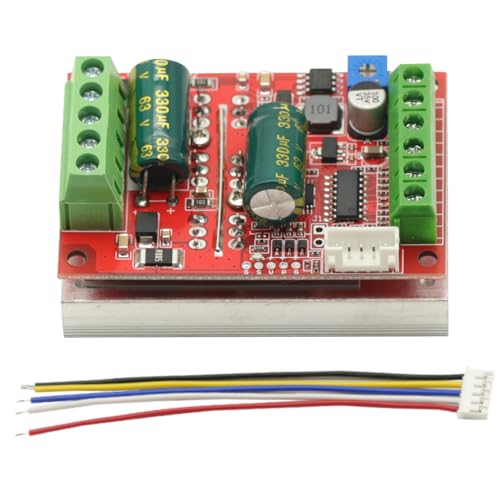
Best for straightforward installation in scooters and bicycles needing simple Hall sensor connections. The board supports full patch wiring with Hall signal and a VR speed control input if required. Choose this if you want a compact, modular controller with reliable forward/reverse and braking controls. Limitation: wiring specifics may require careful matching to your motor’s Hall outputs and sensor arrangement.
- Phase connections: Ha Hb Hc +5V GND
- Features: forward/reverse and braking functions
Best for: DIY riders seeking a compact, easy-to-wire controller for 3-phase BLDC motors with Hall sensing.
GODIYMODULES DC 6-24V 1000W Controller

Best for higher-power 6-24V BLDC systems requiring 0-5V analog control. It supports significant drive current (30A rated, up to 50A with cooling) and is suitable where a robust, analog-based speed regulation is needed. Limitation: the product mentions dual color options shipped randomly, which may affect aesthetic consistency in some builds.
- Voltage range: 6-24V (max 24V)
- Current: 30A typical, 50A with cooling
Best for: Projects needing higher current handling with 0-5V analog input for precise speed control.
Buying Guide
What to consider when choosing a brushless DC motor controller with a compatible motor system:
- Voltage and current compatibility: Match controller voltage range and continuous current to your motor and battery to avoid overheating or underperformance.
- Sensor compatibility: Hall sensor vs. Hallless drives influence wiring, troubleshooting, and compatibility with your motor.
- Control interfaces: Potentiometer, analog 0-5V, PWM input, or built-in braking/fwd-rev features affect how you integrate the controller into your system.
- Protection features: Look for overcurrent, short-circuit, and thermal protection, and plan for external fusing where noted.
- Wiring and connectors: Ensure phase and Hall wiring schemes align with your motor; check for required connectors and insulation ratings for your environment.
- Physical build and cooling: Higher-power controllers benefit from heat sinks and adequate ventilation to maintain performance.
- Compatibility notes: Some controllers specify compatibility with specific models or accessories. Verify these before purchasing to prevent mismatches.
FAQ
- What is a brushless DC motor controller used for?
– It regulates speed and direction for brushless DC motors in bikes, scooters, robotics, and small automation projects. - Do all BLDC controllers require Hall sensors?
– No. Some controllers work with Hallless motors, but wiring and control behavior differ; verify motor type before purchase. - Why is external fusing recommended for some controllers?
– To protect power components from damage due to unexpected short circuits or high inrush currents. - What should I check before buying a compatible controller?
– Voltage range, current rating, sensor type, input control method, and motor compatibility. - Can I mix controllers from different brands with my motor?
– Only if electrical specifications and wiring schemes match; otherwise, performance and safety issues may occur.