Best Dual Stage CO2 Regulator Aquarium: Stable, Precise Plant Growth
Answering the main buyer intent: when choosing a dual-stage CO2 regulator for an aquarium, prioritize stability, safety, and multi-tank compatibility. The top options below are best for planted tanks, multi-tank setups, and hobbyists seeking precise gas delivery. This guide highlights five regulators that balance reliability with ease of use for American hobbyists.
| Product | Best For | Key Benefit |
|---|---|---|
| FZONE Pro Series Aquarium Dual Stage CO2 Regulator | Single or two-tank setups; precise control | Independent dual blocks with two needle valves |
| Hygger CO2 Upgraded Regulator with Motorized Valve | Two tanks; automated scheduling | Motorized valve with timer for automatic control |
| FZONE Aquarium CO2 Regulator Mini Series V3.0 | Compact, reliable dual-stage regulator | 12V DC solenoid and high-precision needle valve |
| PRO-SE Series – Aquarium CO2 Dual Stage Regulator | Professional-grade dual-stage regulator | Redesigned construction with safety features |
| JARDLI Aquarium Dual Stage CO2 Regulator | Medium to large tanks; stability at varying cylinder pressures | Dual gauges and integrated relief valve |
Note: This article uses objective product details to help buyers compare reliability and suitability for planted tanks, multi-tank systems, and automated setups. Each section describes who benefits most from the product and a key caveat when relevant.
FZONE Pro Series Dual Stage CO2 Regulator
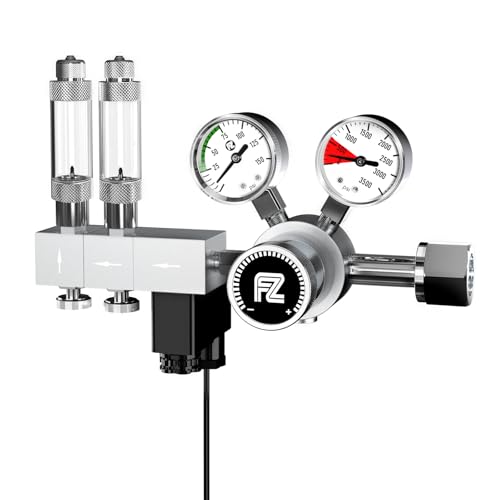
Best for: hobbyists who need independent regulation for two separate aquariums. Features two manifold blocks, each with its own high-precision needle valve, allowing separate pressure and flow control. The dual-stage design maintains stable output as cylinder pressure changes, reducing end-of-tank-dump risks. The built-in safety valve opens at 100 PSI to protect livestock. Caution: setup requires proper tubing and fittings to ensure leak-free operation.
Hygger CO2 Upgraded Regulator With Motorized Valve

Best for: aquariums needing automated CO2 scheduling and multi-tank expansion. This kit includes two bubble counters and a rapidly expandable manifold design, enabling two tanks from day one. The dual-stage regulator provides stability, while the motorized valve with a timer supports automatic CO2 dosing. Caution: motorized valve may be less effective for non-timed, continuous dosing without an appropriate timer system.
FZONE Aquarium CO2 Regulator Mini Series V3.0
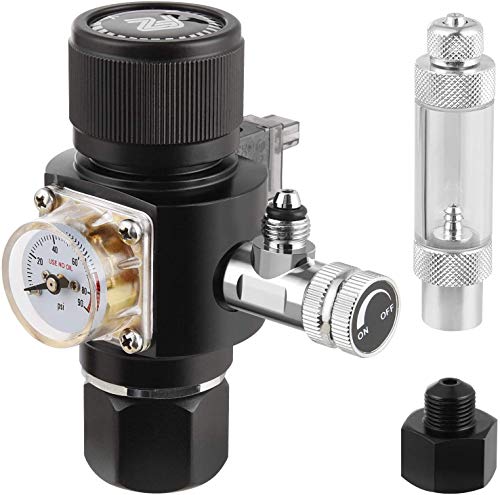
Best for: compact setups where space is at a premium but precise dosing is required. It features dual-stage regulation with a 0-60 psi working range, a 12V DC solenoid for quiet operation, and a high-precision needle valve. The included bubble counter aids in monitoring flow. Limitation: triple-stage design emphasizes stability over ultra-high flow, which may be unnecessary for very large systems.
PRO-SE Series – Aquarium CO2 Dual Stage Regulator
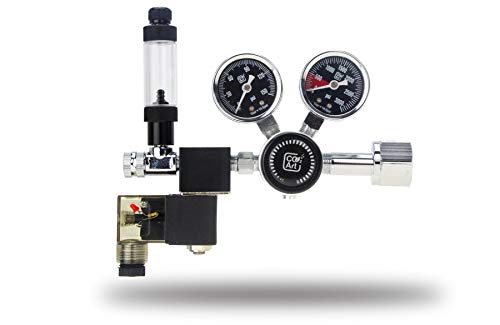
Best for: users seeking a robust, professional-grade regulator with integrated safety features. It ships with a DC solenoid valve and a universal power adapter, simplifying setup in diverse electrical environments. The redesign emphasizes safety and reliability for ongoing CO2 management. Caution: confirm compatibility with your specific tank size and diffuser system to avoid under- or over-pressurization.
JARDLI Aquarium Dual Stage CO2 Regulator

Best for: tanks where pressure stability matters as cylinder content changes. This regulator includes dual gauges showing both working pressure and tank gas pressure, plus a safety relief valve to vent if pressure exceeds 100 PSI. The 12V DC integrated solenoid minimizes noise and heat. Choose this if you want clear visual pressure readouts and a safety-first design. Limitation: some users prefer additional bubble counters or splitters for multi-tank setups, which may require upgrading components.
Buying Guide: Key Purchase Considerations
- Single vs. multi-tank support: If you run more than one tank, look for regulators with modular manifolds or dual outlets to simplify distribution.
- Regulation stability: Dual-stage regulators keep output pressure steady as the cylinder empties, reducing fluctuations that affect CO2 dosing.
- Valves and control: Needle valves aid precise dosing; motorized or DC solenoids enable automation but require power and timers.
- Safety features: Built-in relief valves and check valves prevent over-pressurization and backflow that could harm livestock and equipment.
- Ease of setup: Quick-connect fittings, included tools, and bubble counters help users deploy faster with fewer leaks.
- Compatibility: Confirm CGA320 compatibility with your cylinder, and ensure diffusers or reactors match your tank size and plant species.
- Noise and heat: DC solenoids tend to run cooler and quieter than AC alternatives; consider an automatic timer for automation without heat buildup.
FAQ
- What is a dual-stage CO2 regulator?
A dual-stage regulator maintains a consistent output pressure as the CO2 cylinder pressure drops, reducing fluctuations in CO2 delivery to the aquarium.
- Why choose a regulator with a timer or motorized valve?
Timers and motorized valves enable automatic dosing schedules, saving time and reducing manual adjustments.
- What should I consider for multi-tank setups?
Look for modular manifolds or splitters that allow independent control per tank and easy future expansion.
- Is a bubble counter necessary?
Bubble counters help you visually monitor flow rate and adjust dosing to maintain stable plant growth.
- What safety features are important?
Relief valves prevent dangerous pressure buildup; check valves prevent backflow into the CO2 cylinder.
- How do I know the right PSI range?
Most planted tanks do well with 1 bubble every 3–5 seconds at 0–60 PSI; adjust based on plant response and tank size.