Best Ways to Compare Commercial Solar Panel Costs for 2026
Answering the question “how much do commercial solar panels cost?” requires comparing high-efficiency modules, installation considerations, and long-term savings. This guide highlights five representative panels, aimed at business owners, developers, or facility managers evaluating off-grid, rooftop, or small commercial setups. Each option is chosen for clear value factors such as efficiency, durability, and potential space savings. The buying table below helps summarize core specs and suitability at a glance.
| Product | Key Benefit | Best For |
|---|---|---|
| JJN 550 Watt Bifacial (2-Pack) | Higher energy capture with bifacial design; pre-drilled mounting holes | Rooftop homes or small commercial setups seeking higher output per module |
| STAR 860 Watt Bifacial (2 Pieces) | High power density and robust build for space-limited areas | Rooftops or farms with limited mounting space |
| SUNGOLDPOWER 590W Bifacial | Up to 30% rear-side energy; strong 16BB cell technology | Mid-size commercial projects wanting maximum daily harvest |
| Callsun N-Type 400W Bifacial (2Pcs) | N-type cells with bifacial gain; anti-shade twin design | RV, van, or off-grid commercial installations needing reliable shade tolerance |
| JJN 425 Watt Bifacial (2-Pack) | Efficient 16BB N-type cells; weather-resistant frame | Smaller commercial sites with space constraints |
JJN 550 Watt Bifacial Solar Panels 2PCS

The 550W bifacial panels use a transparent backsheet to capture light from the front and rear, delivering up to 30% higher output under ideal conditions. This package is best for buyers aiming to maximize daily energy with fewer modules. Installation is simplified by pre-drilled mounting holes and straightforward series/parallel wiring, which can reduce on-roof hardware and labor. Suitable for home or small commercial installations requiring steady, green power. One limitation is that bifacial gains depend on reflective surface and tilt, so performance may vary with site conditions.
860 Watt Bifacial Solar Panels, 2 Pieces

The STAR 860W bifacial panels offer higher power density, making them well-suited for projects with space constraints or higher system kW goals. The design emphasizes durability for outdoor use with a long service life, supporting commercial applications that demand reliable output over decades. Best for owners who can accommodate larger power per panel and want fewer modules overall. A potential caveat is the need for precise mounting and siting to realize full bifacial gains in real-world conditions.
SUNGOLDPOWER 590W Bifacial Solar Panel
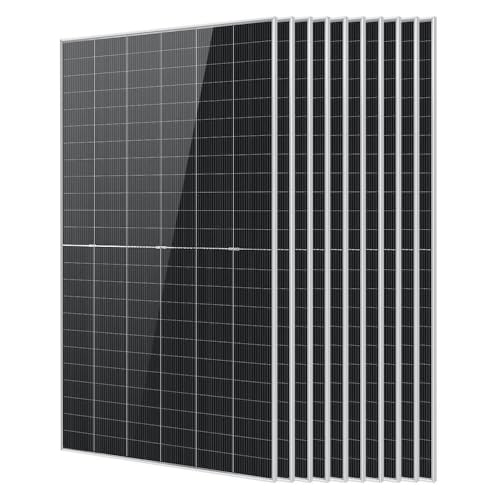
The 590W bifacial panel from SUNGOLDPOWER uses advanced N-Type 16BB cells and achieves up to 30% more energy from the rear side, which helps with faster payback in sunny climates and reduces the required footprint for a given output. It is a versatile option for rooftop or ground-mounted systems, offering flexibility for various commercial layouts. Limitations include sensitivity to high heat and shading, which can affect the rear-face gain optimization if not properly designed.
Callsun N-Type 16BB 400W Bifacial, 2 Panels

Callsun’s 400W bifacial modules use N-Type 16BB cells and a dual-module parallel design to improve shading resilience. The bifacial backsheet design captures extra energy, which is beneficial for commercial rooftops with reflective surfaces or partial shading. This option is best for operators prioritizing redundancy and shading tolerance. Caution: total system output can depend on how well the dual-module setup is wired and balanced in the array, which may require careful electrical design.
JJN Bifacial 425 Watt Panels, 2-Pack

The 425W bifacial modules use 16BB N-type cells and feature a robust aluminum frame designed to withstand outdoor exposure. Bifacial technology provides potential gains from rear illumination, supporting mid-size projects where space efficiency matters. This option is best for buyers who want strong uptime in varied weather and prefer a compact footprint. Limitation: the 425W rating is lower than the 550W or 860W options, which may affect total system sizing for larger installations.
Buying Guide
What to consider when budgeting for commercial solar panels
Power rating, efficiency, and space requirements directly impact cost per watt. Higher wattage modules reduce the number of panels and mounting hardware needed, potentially lowering installation labor. Bifacial designs often increase energy output but require optimal siting to realize gains. Consider site shading, reflective surfaces, and roof or ground layout when estimating costs and energy yield.
How to evaluate installation needs
Rooftop projects benefit from higher panel density and structural assessment. Ground-mounted systems allow easier orientation and maintenance but may incur more space and fencing costs. For off-grid or remote sites, ensure the system includes adequate energy storage or backup power compatibility. Ask for installation plans that clearly show mounting hardware, wiring routes, and any required inverters or combiner boxes.
Choosing between bifacial and standard panels
Bifacial panels can deliver more energy per watt in favorable conditions, especially with bright ground or snow reflectivity. If your site has strong reflective surfaces and adequate sun exposure, bifacial options may offer faster payback. If space is plentiful but shade is a concern, consider shading-tolerant designs or anti-reflective coatings to maximize real-world gains.
Durability and warranty considerations
Look for frames rated for wind and snow loads, IP ratings for connectors, and long-term reliability under outdoor conditions. A longer warranty and proven field performance reduce long-term risk in commercial deployments. Certification to safety standards helps ensure compliance with local regulations and marketplace requirements.
System sizing and future expansion
Plan for modular expansion: a higher-wattage panel now may pair with future microinverters or optimizers if you anticipate capacity growth. Consider string sizing, maximum input ratings of inverters, and potential need for monitoring or remote management. A clearly documented expansion path improves long-term cost efficiency.
Frequently Asked Questions
- What affects commercial solar panel costs? Module wattage, bifacial technology, efficiency, mounting hardware, and installation complexity all influence overall costs and payback times.
- Are bifacial panels worth it for most businesses? They can be, especially in bright, reflective environments, but gains depend on site conditions and system design.
- How important is panel spacing in limited spaces? Very important. Higher power-density panels reduce the number of units needed and simplify wiring and mounting.
- Should I prioritize efficiency or wattage? Prioritize wattage per panel for space-constrained sites; efficiency matters when shading, orientation, or limited roof area limits total capacity.
- What maintenance do these panels require? Regular inspection for debris, seal integrity, and wiring connections; ensure inverters and batteries (if used) are serviced per plan.
- How does shading affect performance? Shading reduces output; bifacial designs and anti-shade features mitigate loss but still benefit from strategic placement.