Best Inline Water Pumps With Pressure Switch for Reliable Water Pressure
When you need steady water pressure on demand, an inline water pump with a pressure switch is the right choice. This guide highlights five dependable options suited for RVs, homes, boats, and off-grid setups. Each product is chosen for clear automatic on/off operation, self-priming ability, and a practical pressure range. Best for: RV users needing reliable on-demand water flow, home water systems seeking automatic pressure control, and marine setups needing compact, self-contained pumps. The quick-reference table below helps compare key specs at a glance.
| Product | Voltage | Flow | Pressure | Best For |
|---|---|---|---|---|
| ECO-WORTHY 110V Fresh Transfer | 110V AC | 5.5 GPM | 70 PSI | Home, RV, garden irrigation |
| CRESTWAVE 7GPM 70PSI | 110V AC | 7.0 GPM | 70 PSI | Fresh water systems, RVs |
| ECO-WORTHY RV Fresh Water Pump | 12V DC | 3.5 GPM | 45 PSI | RV, yacht, camper |
| TDRFORCE 12V DC 4GPM | 12V DC | 4.0 GPM | 45 PSI | RV, marine, boats |
| WASSERMANN 115V AC 4GPM | 115V AC | 4.0 GPM | 45 PSI | Home, RV, marine |
ECO-WORTHY 110V Fresh Transfer Diaphragm Pump

Product: ECO-WORTHY 110V AC Fresh Transfer Diaphragm Water Pump On Demand 5.5GPM 70PSI. This unit runs on 110V and includes a pressure switch set to 70 PSI, enabling water on demand with faucet opening and automatic shutdown when closed. Self-priming to 9.8 ft and lift to 131 ft. Thermal overload protection protects the motor. Best for: homes, irrigation systems, and RVs needing a strong, automatic pressure boost. Limitation: 110V operation requires a fixed power source; portability is limited compared to 12V options.
Key features:
– 5.5 GPM at 70 PSI
– Self-priming up to 9.8 ft
– Thermal overload protection
– Adjustable pressure via built-in switch
Best for: users needing a high-pressure 110V inline booster for fixed installations like gardens or homes with reliable AC power.
ECO-WORTHY 33-Series Industrial Pump 4GPM 50PSI
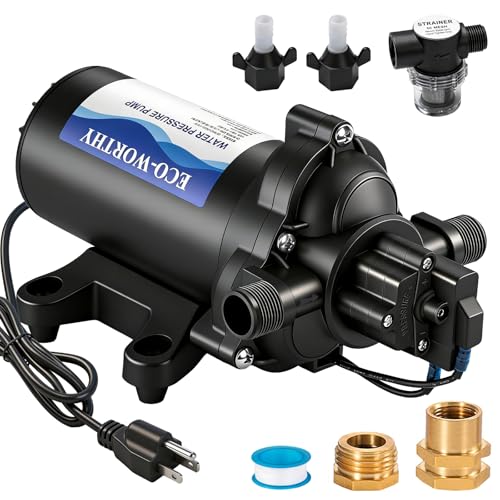
Product: ECO-WORTHY 33-Series Industrial Water Pressure Pump, 110V AC, 4.0 GPM at 50 PSI. On-demand operation with a smart pressure switch, quiet operation, and adjustable range (45-70 PSI). Self-priming to 9.8 ft, lift to 131 ft. Thermal overload protection adds safety. Best for: RVs, small homes, and marine setups where AC power is available but space is limited. Caution: 50 PSI baseline may be lower than some high-demand showers; confirm your required pressure before purchasing.
Key features:
– 4.0 GPM, 50 PSI (adjustable 45-70 PSI)
– Self-priming up to 9.8 ft
– Quiet operation and overload protection
Best for: on-demand pressure boost in RVs or small households with AC power access.
CRESTWAVE Fresh Water Pump 7GPM 70PSI

Product: CRESTWAVE Fresh Water Pump, 7 GPM, 70 PSI, 110V AC with a five-chamber diaphragm design. Features a self-priming lift of up to 10 ft and a max head of 157 ft, suitable for RVs, homes, marine, and industrial settings. Built-in pressure switch enables automatic on/off based on water demand. Best for: larger flow needs in RVs or home water systems. Limitation: 7 GPM may exceed minimal needs in very small fixtures, potentially wasting energy in low-demand applications.
Key features:
– 5-chamber design for stable flow
– 4-7 GPM, 70 PSI
– 10 ft self-priming, 157 ft max head
Best for: users needing higher flow with automatic pressure control in RVs or small homes.
ECO-WORTHY RV Fresh Water Pump 12V DC

Product: ECO-WORTHY RV Fresh Water Pump, 12V DC, 3.5 GPM at 45 PSI. On-demand 12V pressure switch with self-priming up to 9.8 ft and lift up to 98 ft. Thermal overload protection guards the motor. Best for: RVs, yachts, and campers that rely on battery power. Limitation: 12V operation depends on battery availability and voltage stability; may experience voltage drop under heavy load.
Key features:
– 3.5 GPM, 45 PSI
– 12V DC, self-priming
– On-demand pressure switch
Best for: off-grid or mobile water systems powered by a 12V source.
TDRFORCE 12V DC RV Fresh Water Pump 4GPM

Product: TDRFORCE 12V DC RV Fresh Water Pump, 4 GPM at 45 PSI, inline diaphragm with self-priming. Designed for RVs, marine, and boats, with 3/4″ inlet/outlet compatibility and 1/2″ adapters for easy installation. Best for: compact, on-demand pressure boosts where 12V power is available. Limitation: 4 GPM may be lower for high-demand showers or multiple fixtures simultaneously.
Key features:
– 4.0 GPM, 45 PSI
– 12V DC, on-demand operation
– Easy installation with standard fittings
Best for: RVs or boats needing reliable on-demand pressure from a 12V source.
Buying Guide
What should you consider when choosing an inline pump with a pressure switch?
- Voltage and power source: Do you have reliable AC power at the installation site, or do you rely on 12V battery power? AC models typically offer higher flow; DC models suit mobile setups.
- Flow rate vs. pressure needs: Assess your fixtures. If you need strong showers, a higher GPM with 50–70 PSI is beneficial. For simple sinks, 3–4 GPM at 45 PSI may suffice.
- Self-priming capability: A good inline pump should self-prime from near-dry conditions and lift water from a low tank; verify the maximum self-prime height.
- Pressure switch range: An adjustable or on-demand switch helps tailor performance to your water usage pattern and avoid rapid cycling.
- Safety features: Look for thermal overload protection and dry-run protection to prevent motor damage during operation anomalies.
- Installation compatibility: Check inlet/outlet sizes and available adapters; ensure the unit can be mounted in the intended orientation (vertical/horizontal).
- Noise and vibration: Quieter models use better diaphragms and motor bearings; consider mounting options to minimize noise.
- Reliability and service: Prefer brands with accessible after-sales support and predictable maintenance needs.
How to choose between AC and DC pumps
Choose AC when you have a fixed power source and want higher flow in a stationary setup. Choose DC when you need portability, battery-powered operation, or integration with solar panels. For RVs, boats, or off-grid uses, a DC pump minimizes the need for shore power.
Installation tips
- Place the pump as close as possible to the water source to reduce suction losses.
- Install a filter to prevent debris from clogging the diaphragm.
- Use compatible fittings and ensure leak-free connections to maintain pressure stability.
- Test the system by opening fixtures gradually and observing the pressure switch cycling.
FAQ
- Q: Do inline water pumps require priming? A: Most diaphragm pumps offer self-priming capabilities up to a certain vertical lift.
- Q: What PSI is typical for RV systems? A: 40–70 PSI is common, depending on fixtures and length of piping.
- Q: Can these pumps run dry safely? A: Some models include dry-run protection; verify in the product specs.
- Q: Are 12V pumps suitable for homes? A: They can be used for small, off-grid homes or auxiliary fixtures, but expect lower maximum flow than some AC models.
- Q: Do these pumps require maintenance? A: Regularly check seals, strainers, and electrical connections for longevity.