Best High Temperature Multi-Conductor Cables for Harsh Environments
Looking for high temperature multi-conductor cables that perform under extreme heat and demanding conditions? This guide highlights five practical options, chosen for different needs—from compact 14 AWG to rugged 11 AWG builds and shielded multi-conductor options. Each entry notes who it’s best for and why, plus a key caution. Whether you’re wiring kilns, ovens, or industrial equipment, these selections help balance temperature tolerance, flexibility, and conductivity for reliable performance.
| Product | Conductor Size | Length | Notable Feature |
|---|---|---|---|
| 14 AWG | 16.4 ft | Mica fiberglass insulation, wide temp range | |
| 11 AWG | 16.4 ft | Lower resistance, high temp tolerance | |
| 11 AWG | 25 ft | Longer run, robust insulation | |
| 20 AWG | 30 ft | EMI shielding, control-friendly | |
| 14 AWG | 20 ft | Silicone, flexible and high temp |
KToyeang 14 Gauge 2 Conductor High Temp Wire

Best for compact high-temperature applications requiring a compact profile. This 14 AWG, mica fiberglass insulated two-core cable supports -76℉ to 932℉ operation with a 300V/500V rating and a 16.4 ft length. It is ideal for lamp, boiler, heater, or kiln circuits where space is limited and heat resistance is critical. The multi-layer insulation, including mica and glass fiber braid, provides reliable heat endurance and fire resistance for short to moderate runs. Caution: check diameter (OD 7.9 x 4.7 mm) to ensure a proper fit in conduit or terminal blocks.
Who it’s best for: hobbyists and small industrial installations needing a compact, high-temp solution. Why selected: strong heat tolerance, robust insulation, and a flexible 16.4 ft length for shorter runs.
KToyeang 11 Gauge 2 Conductor High Temp Wire 16.4Ft
This entry uses 11 AWG conductors for higher current capability with the same mica fiberglass insulation, rated to -76℉ to 932℉ and 752℉ rated temperature. The 16.4 ft length makes it suitable for medium-distance runs in electrical heating, ovens, or kilns. It shares the same layered insulation design for heat and wear resistance. Caution: larger diameter may require more space in wire trays or conduits.
Who it’s best for: professionals needing higher current capacity in a moderate run. Why selected: superior current capacity without sacrificing heat resistance or flexibility.
KToyeang 11 Gauge 2 Conductor High Temp Wire 25Ft
Best for longer runs where consistent high-temperature performance is needed. The 11 AWG construction and 25 ft length provide a balance of current capability and reach for installations in kilns, heaters, or industrial machinery. This version emphasizes ultra-low eccentricity and tight glass fiber braiding for fire resistance and conductivity. Caution: verify routing to avoid sharp bends that could stress the insulation.
Who it’s best for: installers needing more length without compromising heat tolerance. Why selected: longer run with robust insulation and reliable high-temperature performance.
20/6 Shielded Wire 30Ft
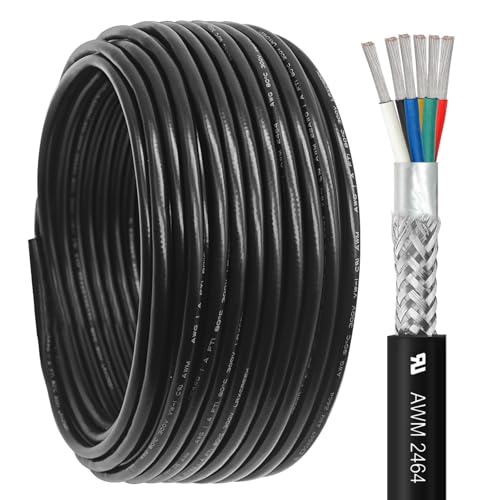
Better for applications where EMI shielding is important. This 20 AWG, 6-conductor shielded cable features a tinned copper braid for 85% shielding and a foil shield, along with PVC insulation. It suits CNC machines, spindles, microphones, and 3D printers where stable signal and interference protection matter. Caution: it’s a smaller conductor size, so current capacity is lower than thicker wires; plan accordingly for power needs.
Who it’s best for: electronics and automation setups requiring EMI protection and flexibility. Why selected: combines shielding with a practical 30 ft length for easy routing.
Haerkn 14 AWG Silicone Wire Dual Color

Choose this for flexible, high-temperature applications requiring a two-wire hookup. The 14 AWG silicone insulation supports -60 to 200 degrees Celsius with two conductors included (10 ft black, 10 ft red). It’s suited for lamp wiring, heating elements, and control circuits where low impedance and silicone flexibility matter. Caution: silicone coatings can be sensitive to certain solvents and outdoor exposure; plan for environment.
Who it’s best for: builders needing a straightforward, flexible high-temperature hookup wire. Why selected: proven silicone insulation with dual-color coding for simple polarity identification.
Buying Guide: Key Considerations for High Temperature Multi-Conductor Cables
- Temperature range and rating: Match the operating and peak temperatures to your equipment’s needs. Note working temperature vs. peak rating where applicable.
- Conductor gauge and current: Higher AWG (smaller number) supports more current but may be stiffer. Choose according to load and distance.
- Insulation composition: Mica, fiberglass, silicone, and fluoroglovite tapes influence heat resistance, fire resistance, and flexibility. Multi-layer insulation improves durability in harsh environments.
- Shielding and EMI considerations: For noisy environments or sensitive electronics, shielded options reduce interference.
- Length and routing: Longer runs increase resistance and potential signal loss; confirm conduit fit and bend radius to avoid insulation damage.
- Voltage rating: Ensure the wire voltage rating aligns with circuit design and safety standards of the installation.
- Durability and environment: Look for UV resistance, chemical resistance, and abrasion resistance if exposed to harsh environments.
- Compatibility with devices: Verify connector types, terminal blocks, and enclosure space to avoid fit issues.
Frequently Asked Questions
- What is the main difference between 14 AWG and 11 AWG high-temperature cables?
Answer: 11 AWG has thicker conductors, allowing higher current capacity and lower resistance, which is beneficial for longer runs or higher loads. - When should I choose shielded versus unshielded high-temperature cables?
Answer: Choose shielded cables when EMI or interference could affect performance, such as around motors or RF equipment. - Can mica fiberglass insulation withstand kiln or furnace environments?
Answer: Yes, mica fiberglass insulation is designed for high-temperature and fire-resistant applications, suitable for kilns and heating elements. - What should I check before purchasing long-length high-temperature cable?
Answer: Check conductor gauge, insulation type, temperature rating, shield presence, flexibility, and bend radius to ensure proper installation. - Is there a risk in using silicone-insulated wire for high-temperature service?
Answer: Silicone insulation offers excellent flexibility but may degrade with certain solvents or outdoor exposure; ensure the environment matches its rated conditions.