Best 80 Amp MPPT Solar Charge Controller for Home and RV Systems
If you are looking to maximize solar charging efficiency while supporting a variety of battery chemistries, an 80 amp MPPT solar charge controller is a solid choice. These controllers handle higher current, adapt to 12V–48V battery banks, and optimize power harvest from solar panels. This guide profiles five reliable options, explaining who each is best for, key strengths, and any notable limitations. Ideal buyers include off-grid homeowners, RV and boat setups, and small to mid-size solar installations seeking robust performance and future-proof features.
Summary of top picks:
| Product | Best For | Key Advantage |
|---|---|---|
| Ampinvt 80 Amp MPPT | General 12–48V systems | Wide voltage range and LCD data |
| POWLAND 80A MPPT | Remote monitoring fans | RS485/USB ports and high efficiency |
| HQST 80 Amp MPPT | Bluetooth monitoring | Low-temp cut-off and app control |
| PowMr 80A MPPT | Expandable systems | Parallel connection capable up to 12 units |
| POWLAND 80A MPPT (second listing) | Versatile battery types | 3/4-stage charging with safety protections |
Ampinvt 80 Amp MPPT Solar Charge Controller
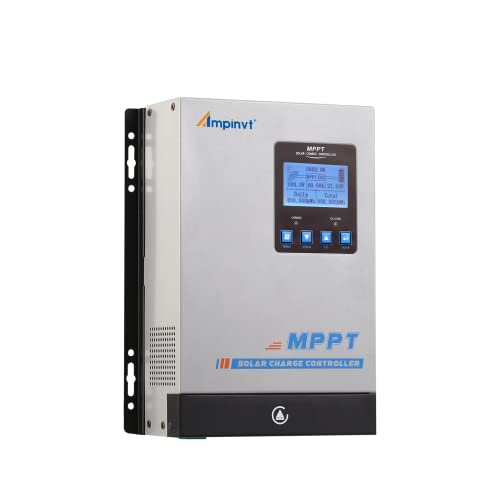
The Ampinvt model supports auto-identification for 12V, 24V, and 48V systems with a maximum input power capable of handling multiple voltage configurations. It features an LCD display for real-time data and a memory-friendly energy statistics function. Best for: small to mid-size off-grid setups where straightforward monitoring helps track daily generation. Limitation: while versatile, it may not include advanced remote monitoring as standard in some competing models.
POWLAND 80A MPPT Solar Charge Controller

Best for: RVs, cabins, and mobile setups that require flexible voltage sensing (12V–48V) with enhanced monitoring via RS485/USB and robust protection features. This controller emphasizes high efficiency (up to 99% real-time tracking) and compatibility with LiFePO4, AGM, GEL, and flooded batteries. It’s especially useful where future-proofing and remote monitoring are priorities. Caution: some users may prefer a dedicated app if Bluetooth is their only monitoring method.
HQST 80 Amp MPPT Solar Charge Controller
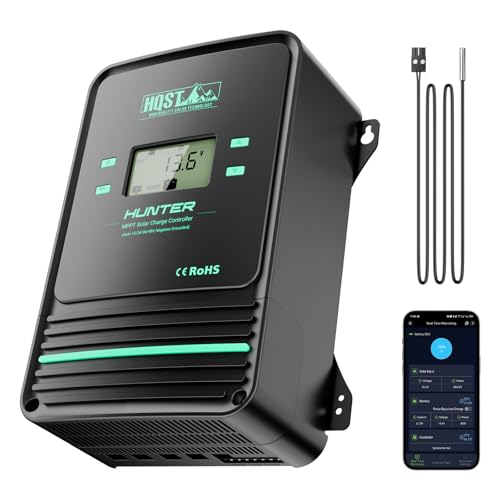
This model emphasizes Bluetooth app control and an LCD display, with low-temp cut-off protection suitable for LiFePO4 batteries and broad compatibility with LiFePO4, sealed, AGM, GEL, and flooded types. Best for: users who want convenient remote or on-device monitoring and a clear interface for parameter adjustments. Limitation: Bluetooth range is limited to about 10 meters in unobstructed conditions, so remote data requires proximity or additional connectivity options.
PowMr 80A MPPT solar Charge Controller

Best for: larger or expandable systems thanks to parallel connection support up to 12 units, enabling bigger storage capacities. It uses a three-stage charging algorithm (bulk, boost, float) to optimize battery health and charging efficiency, with MPPT efficiency up to 99%. Caution: ensure proper wiring and fuse protection when expanding beyond a single unit to avoid complex configuration challenges.
POWLAND 80A MPPT Solar Charge Controller (Second Listing)

Best for: users needing versatile battery compatibility with intelligent three- or four-stage charging and solid protection (short circuit, reverse polarity, overload). This model supports sealed, gel, flooded, and lithium battery formats, making it a flexible choice for mixed-system environments. Limitation: some configurations may require careful setup to optimize the multi-stage charging across different battery chemistries.
Buying Guide: Key Purchase Considerations
- System voltage and battery types: Confirm that the controller auto-detects 12V–48V and supports your battery chemistry (LiFePO4, AGM, GEL, flooded, etc.).
- Maximum PV input and efficiency: Look for up to 150V PV input and MPPT efficiency near 99% for maximum harvest in varied light conditions.
- Protection features: Short-circuit, reverse polarity, overload, and temperature protections help extend battery life and system safety.
- Monitoring options: LCD displays, Bluetooth, USB or RS485 connections determine how you track performance and adjust settings.
- Expandability: If you anticipate growing your system, prefer models that allow parallel unit operation or easy scaling.
- Battery compatibility: Ensure compatibility with your preferred battery types and charging profiles (bulk/absorption/float/equalization).
- Outdoor environment considerations: Temperature range, low-temp cut-off, and enclosure requirements influence long-term reliability.
Frequently Asked Questions
- What is an MPPT solar charge controller?
The MPPT (Maximum Power Point Tracking) controller optimizes solar panel performance by dynamically tracking the best voltage/current point, improving charging efficiency compared with PWM controllers. - Can I use an 80A MPPT with different battery chemistries?
Yes, most 80A MPPT controllers support multiple chemistries like LiFePO4, AGM, GEL, and flooded lead-acid. Check each model’s supported charging profiles. - Is Bluetooth monitoring necessary?
Bluetooth offers convenient on-site monitoring. If you need remote monitoring, choose a model with RS485/USB or Wi-Fi options. - Can these controllers be used in parallel for larger systems?
Some models support parallel connections (up to 12 units). Verify the specific model’s parallel-capable features before purchasing. - What is a typical 80A MPPT controller best for?
Medium to large off-grid setups, RV solar systems, and cabin installations where higher current and flexible battery compatibility are beneficial. - Do these controllers require special wiring or fuses?
Yes. Follow the manufacturer’s wiring diagrams, use appropriate gauge cables, and install fuses or circuit breakers near the battery bank.