Best Digital Phase Angle Meters for Precise Angles and Levels
Whether you’re a professional tradesperson or a DIY enthusiast, digital phase angle meters help you measure angles and orientations with high precision. This guide highlights top-rated models that combine accurate readings, easy-to-read displays, and versatile features like magnetic bases and angle alerts. Explore five reliable options that cover general angle finding, phase sequence checks, and digital level functionality.
Summary of Selected Products
- Klein Tools 935DAG Digital Electronic Level and Angle Gauge — 0–90° and 0–180° Ranges; Magnetic Base
- Klein Tools 935DAA Digital Electronic Level and Angle Gauge with LED Angle Alert
- Sanliang Digital Level Angle Gauge Meter Magnetic Electronic Level — IP54, 0.05° Resolution
- Klein Tools 935DGGP Angle Finder with Magnetic Base — Degrees, Percent Grade, mm/m, In/ft
- ETCR ETCR1000D Non-Contact Phase Sequence Tester — AC Voltage Range 70–1000V
Klein Tools 935DAG Digital Electronic Level and Angle Gauge

The 935DAG offers versatile digital angle measurement with zero calibration and a digital level function. It supports 0–90° and 0–180° ranges and includes a high-visibility auto-rotating display for convenient viewing in various orientations. A strong magnetic base enables hands-free operation by attaching to ferromagnetic surfaces such as pipes and saw blades, making it practical for construction, electrical, and woodworking tasks.
Klein Tools 935DAA Digital Electronic Level and Angle Gauge

The 935DAA emphasizes angle alert functionality with LED indicators and audio cues that simplify reaching a target angle quickly. It measures and sets angles, supports relative angle checks, and functions as a digital level. The model features an easy-to-read reverse contrast screen, ideal for job sites, workshops, and home projects where quick visual confirmation is essential.
Sanliang Digital Level Angle Gauge Meter with Magnet

This model combines durability with accuracy, boasting IP54 dust and water resistance and an ABS body for rugged use. It delivers a measurement range of 4×90°, a 0.05° resolution, and ±0.2° accuracy with 0.1° repeatability. The backlit LCD display adapts automatically when the device is inverted, and auto power-off helps conserve battery life during long jobs.
Klein Tools 935DGGP Angle Finder

The 935DGGP provides flexible unit conversion between degrees, percent grade, mm/m, and in/ft, supporting a broad set of applications from framing to slope finding. It functions as a digital gauge for measuring angles, checking relative angles, and acting as a digital level. A high-contrast display enhances visibility in dim work environments, ensuring accurate readings and efficient workflows.
ATOPLEE 3 Phase Sequence Presence Rotation Tester Indicator
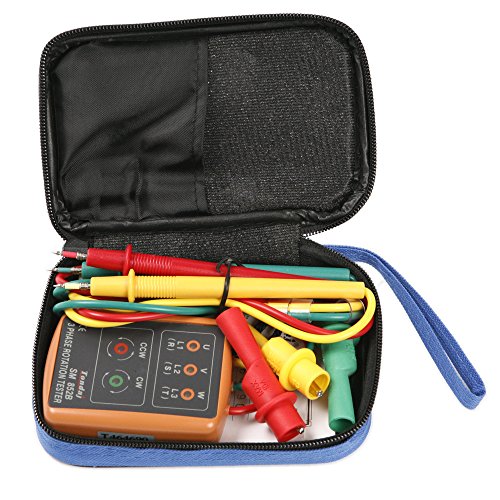
This tester is designed for 3-phase systems, providing presence and rotation checks with LED indicators and a buzzer. It operates over a wide voltage range for field applications and helps identify phase orientation quickly. While not a traditional handheld angle gauge, it complements phase verification tasks in electrical installations and maintenance scenarios where phase sequence matters.
ETCR1000D Non-Contact Phase Sequence Tester

The ETCR1000D is a non-contact tester that detects phase sequence and live status through LEDs and a buzzer. It supports a wide test range from AC 70V to 1000V and is suitable for identifying clockwise versus counter-clockwise rotation, as well as locating faults in wiring. Its versatility makes it a useful companion tool for electrical diagnostics in residential, commercial, and industrial settings.
Buying Guide: Key Considerations for Digital Phase Angle Meters
- Measurement range and resolution — Look for devices that cover common angle ranges (0–180°) and offer fine resolution (0.05° to 0.1°) for precise alignment in woodworking, electrical work, and construction.
- Display readability — Reverse-contrast or high-visibility displays are important on job sites with variable lighting. Auto-rotate functionality helps you read the display from different orientations.
- Calibration and accuracy — Meters with easy zero-calibration and stable relative angle readings improve consistency across tasks. Check stated accuracy and repeatability.
- Magnetic base and mounting — A strong magnetic base enables hands-free operation on metal surfaces, pipes, or saw blades, enhancing efficiency in tight spaces.
- Measurement modes — Absolute angle, relative angle, and level mode expand versatility. Some models also support angle hold, unit conversions, and tilt percentage readings for slope work.
- Durability and protection — IP ratings (like IP54) indicate dust and water resistance, which matters for field use. A rugged ABS body helps with long-term durability.
- Phase sequence capabilities — For electrical installations, consider whether the tool includes phase sequence testing and audible/visual indicators to confirm proper wiring orientation.
- Power management — Auto shutoff features and battery life impact reliability during extended projects. Rechargeable vs. replaceable batteries can influence maintenance.
- Portability and weight — Compact, lightweight meters with magnetic bases are easier to carry and maneuver in tight spaces without sacrificing accuracy.
- Included accessories — Carrying cases, calibration aids, and test leads add value and reduce setup time on site.
Considerations for Choosing the Right Tool
Choosing a digital phase angle meter depends on your primary use case. If you frequently work with metal hardware or piping, a model with a strong magnetic base and a clear, auto-rotating display will improve accuracy and efficiency. For electrical installations, prioritize units that provide clear phase indicators, wide voltage compatibility, and a reliable relative angle function to align components precisely. For general woodworking and construction tasks, a meter with flexible unit conversions and a durable build can simplify slope measurements and layout work. Non-contact phase testers are valuable for safety-conscious checks of live lines, though they serve a different role than traditional angle gauges. By balancing measurement needs, display readability, and durability, you can select a tool that delivers consistent results across projects.
All five highlighted products offer distinct strengths: the Klein Tools models deliver robust angle measurement with magnetic bases and alert features, the Sanliang unit emphasizes durability and high-contrast display, the ETCR and ATOPLEE devices cover phase sequence and non-contact testing, and the Klein 935DGGP provides versatile unit conversion for varied applications. Together, they form a practical toolkit for both professional environments and serious home projects.