Best Surge Protectors for Cable Modems and Coaxial Lines
For households relying on cable modems, keeping data lines and equipment safe from electrical surges is essential. The following selections focus on in-line coaxial surge protectors designed to protect cable modems, TV tuners, and related gear without impairing signal quality. This guide compares features, installation ease, and suitability for home networks to help you choose the right protector for in-line use on coaxial connections.
Summary of chosen products:
| Product | Key Benefit | Compatibility |
|---|---|---|
| Parts Express Cable TV In-Line Coaxial Surge Protector | Patented gas-tube surge protection, transparent signal | HFC or FTTC broadband networks |
| VCE Coaxial Surge Protector (2-Pack) | Low insertion loss, high return loss, CE & RoHS | Cable TV, MATV, SATV systems |
| Proxicast ANT-272-002 Coax Protector | F-type connectors, outdoor-rated | TV, satellite, cable Internet |
| groword Coaxial Surge Protector (4 Pack) | Cost-effective protection for multiple lines | Coaxial TV, cable boxes, distribution amps |
| Proxicast ANT-271-002 Coax Protector | F Female connectors, bi-directional protection | TV, satellite, cable Internet |
Parts Express In-Line Coaxial Surge Protector

Parts Express offers a patented in-line coaxial gas tube surge protector designed for HFC or FTTC broadband networks. The device is structured to remain transparent to both analog and digital bi-directional signal transmission, ensuring your modem and related equipment avoid unnecessary signal distortion while receiving surge protection. Its inline design makes installation straightforward on existing coax runs, and the system focuses on minimizing insertion loss. This protector is suited for network setups where protecting the cable modem from lightning and power surges is a priority without compromising data throughput.
VCE Coaxial Surge Protector (2-Pack)
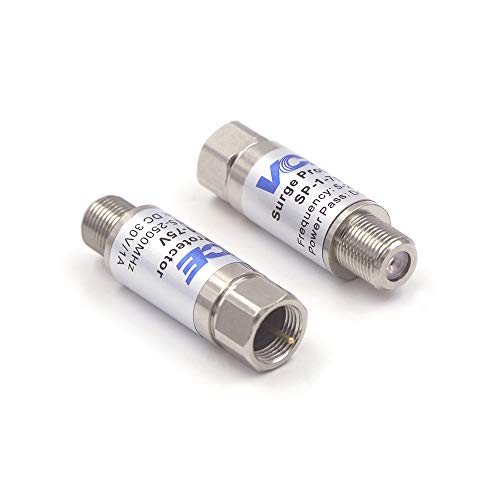
The VCE two-pack provides robust protection for coaxial lines with a focus on low insertion loss and high return loss. It is CE and RoHS compliant, making it suitable for CATV, MATV, SATV, and other cable networks. The device is designed for in-line installation, allowing it to fit into existing coax runs without requiring significant reconfiguration. A DC outlet supports remote power while keeping the signal path clear for high-frequency transmissions. This option is especially helpful for protecting modems and set-top boxes in multi-device environments.
Proxicast ANT-272-002 Coax Protector

Proxicast’s Pro-Grade protector uses F-type male and female connectors and is designed for TV, satellite, AM/FM antennas, and cable Internet use. It is compatible with 4G/5G signal boosters that use 75 Ohm outdoor antennas, and provides bi-directional protection for inline use. The unit is outdoor-rated, making it suitable for weather-exposed installs while safeguarding sensitive coax-connected equipment such as a cable modem and receiver from surge events.
groword Coaxial Surge Protector (4 Pack)

groword offers a cost-conscious option with a 4-pack of coaxial surge lightning protectors designed for inline use on satellite, distribution amps, and cable box setups. The protector claims to shield common home coaxial lines used by cable Internet services and TV, while maintaining compatibility with licensed spectrum services. Typical usage includes protecting modem-involved coax lines from lightning surges, with straightforward F-type connectors for easy installation in existing coax networks.
Proxicast ANT-271-002 Coax Protector

Proxicast ANT-271-002 focuses on F female connectors and provides bi-directional protection for TV, satellite, AM/FM, and cable Internet use. It is compatible with 4G/5G boosters employing 75 Ohm outdoor antennas and supports inline installation. This unit is designed for versatile protection across multiple coax-connected devices in a home theater or home network environment, with durability for outdoor-rated applications.
Buying Guide
- Coaxial compatibility: Ensure the surge protector uses 75 Ohm F-type connectors and supports frequencies in your service range (often 5-2400 MHz for modern cable Internet and TV systems).
- Bi-directional protection: Look for devices that safeguard both directions of signal flow, protecting equipment without blocking legitimate transmissions.
- Installation style: Inline/coaxial protectors should fit into existing runs without requiring re-wiring. Outdoor-rated units are preferred if the coax line runs outside or through exposed areas.
- Insertion loss and return loss: Opt for protectors that advertise low insertion loss and high return loss to preserve data signals while offering surge protection.
- Regulatory compliance: CE and RoHS compliance can indicate adherence to safety and environmental standards, especially for devices in shared or multi-room networks.
- Remote power options: Some models include a DC outlet for remote power supply; consider whether your installation benefits from this feature for enhanced protection reliability.
- Quantity versus coverage: If you have multiple coax lines (modem, TV, satellite, distribution amps), a multi-pack may reduce total cost and simplify installation.
- Outdoor versus indoor use: For exterior coax runs, outdoor-rated models resist weather-related wear, reducing the risk of degradation or failure over time.
- Impact on signal quality: While surge protectors add protection, verify that the chosen model explicitly states compatibility with high-frequency signals to avoid degradation of Internet speeds.
- Warranty and support: Consider products with documented warranties and clear customer support pathways to address installation or performance questions.