Best NEMA 14-50 Switches for EV and Dryer Power Sharing
Choosing the right NEMA 14-50 switch can simplify home EV charging and dryer use by sharing a single 240V outlet safely. This guide highlights five top options, detailing compatibility, features, and safety considerations to help American homeowners compare quickly. Each product is selected for reliability, ease of use, and clear power management capabilities.
Summary of chosen products
| Product | Brand | Key Benefit | URL |
|---|---|---|---|
| Sekelo Manual EV Charging Switch | Sekelo | Simple, manual power sharing for 24A / 5.76 kW max | Link |
| Smart NEMA Socket Splitter 240V EV | islewire | Auto power switching with LCD readout | Link |
| Briidea Automatic Power Switch | briidea | Smart auto switching, up to 5.76 kW | Link |
| Exqutoo Manual Splitter Switch | Exqutoo | NEMA 14-30P to 14-30R & 14-50R with knob control | Link |
| VEVOR NEMA Splitter | VEVOR | Smart distribution with two 14-50 outlets | Link |
Note: All links in this table point to the respective product pages on Amazon for quick reference. Details such as current compatibility and safety features should be verified before purchase.
Sekelo Manual EV Charging Switch

The Sekelo manual EV charging switch is designed for controlled power sharing between a dryer and an EV charger. It targets homes with limited circuit capacity by allowing a simple dial-based switch to direct power to either the dryer or the EV charger. Compatibility notes emphasize use with 24A/5.76 kW max chargers and manual 24A mode to prevent overload shutdowns. The device operates with straightforward plug-and-play installation and no complex electronics.
Key features include a manual switching mechanism, a safety-oriented power management approach, and a compact design suitable for retrofit scenarios. Users should confirm their charger’s ability to operate at 24A and ensure the 24A setting is engaged before operation to maintain safe performance.
islewire Smart NEMA Socket Splitter

This smart NEMA 14-50 splitter enables dual Level 2 charging without rewiring. It automatically prioritizes the left outlet (Dryer) and transfers power to the right outlet (EV) when the left finishes, delivering hands-free operation. A 3.4-inch LCD display provides real-time current, voltage, power, charging time, and temperature data, while a 3-color LED ring communicates charging status at a glance. ETL certification reinforces safety and reliability for home use.
Considerations include ensuring the left outlet is capable of drying duties and that the automatic transfer logic aligns with household patterns. The LCD readout helps monitor ongoing draws to prevent overloading and to plan charging windows around appliance cycles.
Briidea Automatic Power Switch

The Briidea automatic power switch focuses on safe, automatic sharing of power between a dryer and an EV charger. It supports up to 5.76 kW and emphasizes an improved switching algorithm to better identify the dryer’s action, reducing unnecessary switching. The design aims to minimize noise during operation and maintains a compact footprint. Auto switching prioritizes the dryer, then hands over power to the EV when the dryer cycle ends.
Potential considerations include verifying that the connected EV and dryer support the 24A/5.76 kW limit and understanding the device’s switching cadence to ensure it aligns with user needs for uninterrupted charging and drying cycles.
Exqutoo Manual Splitter Switch

Exqutoo’s manual split features NEMA 14-30R and 14-50R dual sockets, with a rotary knob controlling which outlet is active. The device displays real-time voltage and current, enabling users to monitor power usage as it switches between different outlets. It emphasizes safety through current limiting to keep charging current below 24A to prevent overheating or damage, and it provides a flexible power management solution for devices charging at different rates.
Users should assess compatibility with their specific dryer and EV charging equipment, ensuring the combined load does not exceed the 24A threshold and that the knob provides precise, reliable selection during operation.
VEVOR NEMA Splitter
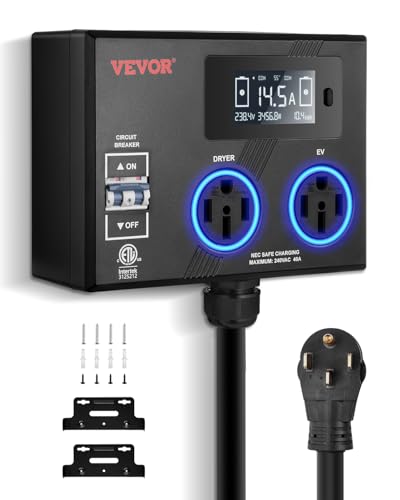
VEVOR’s splitter offers smart 240V power sharing with a NEMA 14-50 plug and two 14-50 outlets, accompanied by a 3.4-inch LCD and a 3-color LED indicator. The design aims to deliver efficient Level 2 EV charging while protecting against overload via ETL-certified safety features. The left outlet is prioritized to maintain consistent dryer operation, while the system can auto-switch to the right outlet for EV charging when needed.
Key considerations include ensuring the vehicle and dryer control systems are compatible with the auto-switching logic and confirming the overall load remains within 40A when required by the dryer’s cycle. ETL certification supports a confidence in safety and compliance for household use.
Buying Guide: Key Purchase Considerations
- Load compatibility: Confirm the charger’s maximum current (often 24A or 32A) and ensure the device supports 24A/5.76 kW operation to avoid overload shutdowns.
- Auto vs. manual switching: Decide between manual dial controls and automatic power switching. Auto-switching offers hands-free operation but requires clear prioritization rules to match home usage patterns.
- Outlets and plugs: Check whether the device supports NEMA 14-30 and NEMA 14-50 configurations, and ensure the outlets align with your dryer and EV charger plugs.
- Safety certifications: Look for ETL or cETLus certifications and current protection features to minimize fire risk and ensure compliance with local electrical codes.
- Monitoring capabilities: LCD screens and LED indicators help track current, voltage, and temperature, empowering proactive management of charging windows.
- Installation considerations: Some units are plug-and-play, while others may require minor wiring or professional assessment. Verify installation instructions and regional electrical standards.
- Future-proofing: If planning two EVs or upgrading chargers later, consider a splitter with higher amperage allowances or dual-outlet arrangements to avoid frequent hardware changes.
Depth and perspective matter: Evaluate how each option handles peak loads, the expected duration of dryer cycles, and whether you need continuous charging during dryer operation. Compare safety features, ease of use, and the potential for future electrical upgrades in your home.