Best 120 Volt Heat Trace Cable for Pipe Freeze Protection and Water Flow in Winter
Keeping water systems thawed and functioning during freezing temperatures is crucial for homes and small businesses. This guide highlights top 120-volt heat trace cables designed for pipe freeze protection, featuring self-regulating technology, varied lengths, and safe certifications. Each product section below includes practical considerations, installation notes, and key benefits to help you choose the right solution for your pipes, gutters, roofs, or water hoses.
| Product | ||||
|---|---|---|---|---|
| MAXKOSKO 12 Ft. | Self-Regulating | 12 ft | -40°F | Compact for tight spaces |
| SZFY 120FT | Self-Regulating | 120 ft | -40°F | Versatile long-run coverage |
| DEWENWILS 6FT | Thermostat Included | 6 ft | -40°F | Ready-to-use with thermostat |
| MAXKOSKO 24 Ft. | Self-Regulating | 24 ft | -40°F | Moderate extension, energy-friendly |
| HEATIT 60ft | Self-Regulating, ETL | 60 ft | -40°F | High-certification, broad reach |
Note: The products listed here are representative choices for 120V heat cable needs. Always verify installation compatibility with your pipe material and local electrical codes before purchase. The selections emphasize reliability, safety certifications, and practical installation options for American homes and facilities.
MAXKOSKO 12 Ft. 120 V Heating Cable

The MAXKOSKO 12-foot heat trace cable is designed for both metal and plastic pipes, providing rapid freeze protection with a 5 W/ft rating. It includes a 3-foot power cord, allowing straightforward placement away from the plug while still enabling effective heat transfer to the pipe. Self-regulating technology adjusts heat output to prevent overheating, making it a practical choice for small-scale installations, including under-sink connections or short pipe runs. It operates to maintain water flow even in subfreezing conditions down to -40°F. For those who plan to run the cord along a wall or through a snug space, the 12-foot length covers a majority of typical residential pipe segments without excessive slack.
Key installation considerations: ensure the cable is placed along the exterior of the pipe for best contact, avoid wrapping around sharp bends, and maintain clearances away from flammable materials. The self-regulating core reduces energy usage by turning on only when needed. This makes it suitable for occasional snow events or as a preventive measure for exposed pipes in unheated spaces.
SZFY 120FT Heat Tape For Water Pipes
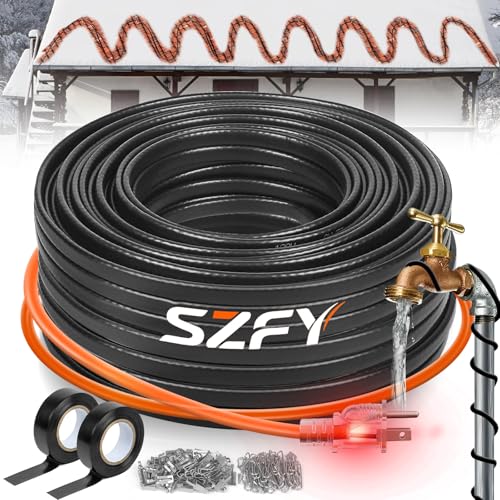
The SZFY 120 ft heat tape is designed for extensive coverage, ideal for long runs along roofs, gutters, or large water lines. It features a thickened copper wire core, which enhances heat conduction and energy efficiency, backed by multi-layer rubber and a robust outer jacket for durability. The system is self-regulating, automatically adjusting heat output to the surrounding temperature, helping to prevent overheating while providing reliable protection down to -40°F. A user-friendly kit length range (3-50 ft) makes it adaptable for smaller segments or longer installations, and it is widely used in agricultural and farm settings where extended coverage is beneficial.
Practical notes: this model is well-suited for roof-edge de-icing or long gutter lines where a uniform heat distribution is important. Proper anchoring and masking where necessary ensure consistent contact with pipes. The built-in regulation capability supports energy savings by heating only when necessary, even across extended runs.
DEWENWILS 6FT Heat Cable With Thermostat

The DEWENWILS heat cable pairs a 6-foot length with a built-in thermostat, providing a simple, plug-and-go solution for pipe freeze protection. The 21 W total wattage supports reliable heating for a range of pipe materials, including copper, galvanized steel, ABS, and PVC. The thermostat monitors pipe temperature and activates below roughly 37°F, turning off around 50°F to conserve energy. The 2-foot cold lead plus the 6-foot length offers flexibility for routing and placement, reducing heat loss along long runs. This setup is particularly convenient for homeowners who want a straightforward installation without separate external controllers.
Key considerations: ensure the thermostat location is accessible for adjustments and that the cable is secured away from sharp edges or moving parts. While appropriate for most residential pipes, avoid use on gutters or hoses, which require different configurations for heat protection.
MAXKOSKO 24 Ft. 120 V Heating Cable

This 24-foot version from MAXKOSKO expands the coverage to longer pipe sections, maintaining a 5 W/ft rating and the same self-regulating technology that prevents overheating. The included 3-foot power cord keeps the thermostat distant from the plug, enabling more flexible routing. Like the 12-foot variant, it activates at around 38°F and automatically adjusts heat output to ensure energy efficiency while preventing frozen pipes. It is suitable for mid-length runs along exterior walls or across longer sections of plumbing that require continuous protection.
Important installation tips: lay the cable along the pipe surface with even contact, avoid overlapping tightly, and consider securing with appropriate tape or clips to maintain steady heat transfer. This length is a good compromise for fencing pipes or garages with extended cold exposure.
HEATIT 60ft Pipe Heat Cables

HEATIT 60ft represents a comprehensive solution with ETL certification for the entire heating cable system, with 3 W/ft performance and a continuous self-regulating design. Its 60-foot length supports large-scale pipe protection across multiple segments or longer runs on roofs and gutters. The product includes a two-foot power lead and options ranging from 3 to 160 feet. Full certification and robust insurance backing provide strong safety assurances, which is valuable for both residential and commercial installations. This model is ideal when long installation runs are required, and when users want the confidence of full-system certification across the entire cable.
Usage guidance: plan routing to minimize thermal variations along long runs. Keep the cable away from potential abrasion points and ensure proper insulation around exposed sections to maximize efficiency. The ETL listing helps ensure compliance with North American electrical safety standards, contributing to safer winter operations.
Buying Guide: Key Purchase Considerations And Comparisons
- Length and coverage: Determine pipe length and whether you need short, medium, or extended coverage. Longer cables offer flexibility but may require more careful routing and insulation to maximize efficiency.
- Wattage and heating power: Common ratings range around 3–5 W per foot. Higher wattage provides faster response but can consume more energy; balance with expected exposure and pipe size.
- Self-regulating technology: Self-regulating cables automatically adjust heat output with temperature changes, reducing the risk of overheating and saving energy. This is a top feature for safety and efficiency.
- Thermostat and controls: Some models include built-in thermostats or external controllers. Decide if you prefer plug-and-go simplicity or configurable control for larger systems.
- Certifications: Look for ETL/UL certifications for the entire cable. Full-system certification (not just a plug) provides higher safety guarantees, especially for drinking water or exposed outdoor installations.
- Pipe compatibility: Most cables work with metal and plastic pipes (copper, PVC, galvanized, ABS). Confirm compatibility with your pipe material and installation conditions (indoor, outdoor, roof, gutter, or underground).
- Installation considerations: Plan whether the cable will be straight, spiraled, or overlapped to reach all critical points. Use appropriate clips or tape to maintain contact and avoid damage from movement or freezing expansion.
- Safety and insurance: Choose products backed by product liability insurance or manufacturer assurances if used in critical water systems or commercial settings.
- Environmental exposure: Outdoor and roof installations require weather-resistant jackets and UV protection. UV-stable materials extend lifespan in sun-exposed locations.
- Maintenance and longevity: Self-regulating cables typically have durable jackets and long service lives, often achieving 5–10 years with proper installation. Consider warranties when comparing options.
In choosing among the featured products, consider your specific scenario: a short run in a cold basement or crawlspace may benefit from the DEWENWILS or MAXKOSKO 12 ft options, while longer exterior roofs or gutters may be better served by SZFY’s long 120 ft length or HEATIT’s high-certification 60 ft model. For in-pipe installations or underground lines, select models that explicitly advertise internal self-regulation and safety certifications to ensure reliability and compliance with safety standards.