Best 24V AC Relays for HVAC and Automation
Choosing a reliable 24V AC relay is essential for HVAC systems, home automation, and industrial control. This guide spotlights five relevant products with different coil voltages, contact forms, and mounting options to fit DIN rail installations and general control circuits. The selection emphasizes durability, switching capacity, and compatibility with 24V control signals to ensure safe, efficient operation in American applications.
| Product | Brand | Coil Voltage | Contacts | Key Feature |
|---|---|---|---|---|
| Electromagnetic Power Relay, MY4NJ | VAMRONE | 24 VAC | DPDT (2NO 2NC) | DIN rail friendly, LED indicator |
| SUNLEE 2 Poles Contactor | SUNLEE | 24 VAC | 2P, 40 FLA / 50 A | UL Recognized, Class F insulation |
| Briidea DPST Relay Module | briidea | 24 VAC/DC | DPST 1NO 1NC | Compact control module |
| 90370 General Purpose Relay | LVACODV | 24 VAC | SPDT | Fan control friendly |
| mxuteuk JQX-13FL Relay | mxuteuk | AC 24V | DPDT (2NO 2NC) | DIN rail ready, LED indicator |
Below are detailed product sections with specifications and practical use cases to help match the right relay to your 24V control needs.
Electromagnetic Power Relay, MY4NJ—VAMRONE

The MY4NJ relay uses a DPDT configuration with eight terminals and a 24VAC coil. With a 10A contact rating at 240VAC/28VDC, it supports common HVAC and electronics loads and is designed for DIN rail mounting with self-tapping screws. An LED indicator helps visualize coil activation, aiding diagnostics in panel installations and control circuits.
SUNLEE 2 Poles Contactor, 24 VAC

This heavy-duty 2-pole contactor handles 40 FLA and up to 50A resistive load, with a 24 VAC coil. Silver contacts minimize arcing and pitting, and the Class F insulation increases thermal headroom. UL Recognized and A2L compliant, it is suitable for demanding HVAC and compressor control applications in the U.S. market.
Briidea DPST 1NO 1NC Relay Module

The Briidea module provides a DPST arrangement with one normally open and one normally closed contact. It supports AC or DC 24V input, drawing about 17mA, and can switch up to 8A at 250VAC or 30VDC. This compact module is practical for simple control tasks and easily integrates into existing low-voltage control circuits.
90370 General Purpose Relay, LVACODV
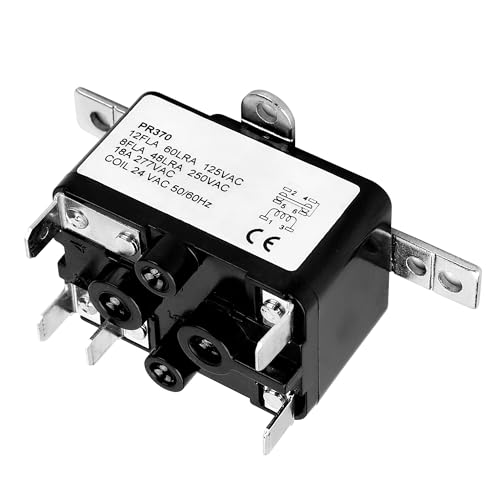
This 24V AC relay features SPDT contacts and a 12A load capacity, suitable for flexible fan control and electromechanical applications. The SPDT form offers versatile wiring options, enabling both simple on/off and changeover configurations in HVAC controls and light duty automation tasks.
mxuteuk JQX-13FL 24V DPDT Relay

The mxuteuk JQX-13FL is a DPDT relay with eight terminals and a 24V coil, compatible with 10A at 250VAC/10A at 28VDC. It includes a DIN rail mount and a DIN-Rail slotted aluminum base, making it ideal for panel installations in automation setups and 24V control circuits where DIN rail mounting is preferred.
Buying Guide: Key Considerations When Selecting a 24V AC Relay
- Coil voltage and type: Confirm 24V AC operation and compatibility with your control circuitry. Decide between AC or DC coil if mixed signals are used in the system.
- Contact configuration: Choose DPDT for two isolated circuits or SPDT/DPST based on required switching behavior (NO/NC, isolation, and load type).
- Contact rating: Ensure the relay can safely switch the expected current and voltage of the load (AC or DC, resistive vs. inductive). Consider inrush and peak loads for motors or compressors.
- Mounting and form factor: DIN rail mounting is common in control panels; verify rail type, length, and available space in the enclosure.
- Insulation and temperature rating: Look for Class F insulation (or better) for higher temperature tolerance and reduced risk in hot environments.
- Isolation and safety certifications: UL Recognized, A2L compliance, and other safety approvals enhance reliability in American installations.
- Indicators and diagnostics: LED indicators or test features help with quick fault finding and verification during maintenance.
- Environmental considerations: Choose relays with corrosion resistance and appropriate housing if exposed to moisture, dust, or vibration.
- Compatibility with HVAC systems: For fans, condensers, and heat sequencers, ensure the relay’s contact form and rating match the system’s switching needs.
- Cost versus longevity: Higher-rated relays may incur higher upfront costs but provide longer service life in demanding environments.