Best 3-Phase Generator Motors for DIY Projects and Learning
Three-phase generators and motors offer efficient, smooth power for education, hobby projects, and lightweight power generation. This article highlights five relevant models that demonstrate how 3-phase technology can be used in teaching kits, wind-powered experiments, and compact generators. Each entry includes a brief overview of specifications, practical applications, and what to consider when choosing a unit for learning or small-scale use.
| Product | Brand | Key Feature | Ideal For |
|---|---|---|---|
| CrocSee Micro 3 Phase AC Mini Hand Brushless Motor Generator | CrocSee | Voltage 3–24V; Brushless design | Classroom experiments and small DIY projects |
| Klanata 6000W 3 Phase Alternator | Klanata | 750 RPM, 12 magnets, aluminum shell | Wind or hybrid energy demonstrations |
| ECSiNG 2PCS 3-24V 3 Phase | ECSiNG | Wide 3–24V range; brushless design | Educational kits and model experiments |
| 6000W Three Phase Alternator (Hyuduo) | Hyuduo | Gearless, low-speed operation; high efficiency | Home wind, marine, and general demonstrations |
| 3 Phase AVAN-300W Permanent Magnet Generator | Garosa | NdFeB magnets; direct-drive potential | Compact learning setups |
Below are five selected products that demonstrate a range of 3-phase generator motors suitable for education, experiments, and small-scale power generation. Each section provides a concise overview, usage ideas, and key considerations to help you choose the best option for your needs.
CrocSee Micro 3 Phase Brushless Generator Kit
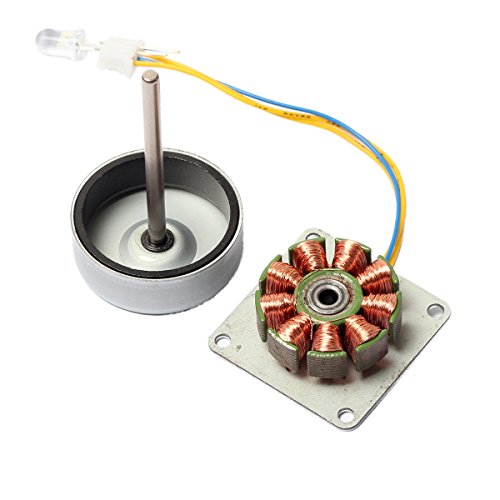
This micro 3-phase brushless AC generator model is designed for teaching electricity generation concepts and for initial practical experiments. It provides an adjustable output range and a simple, compact platform to demonstrate three-phase principles in a hands-on setting. The device supports low to moderate voltage and current, making it suitable for classroom demonstrations or small DIY projects that require stable phase relationships and smooth operation.
Considerations: Ideal for demonstrations and learning projects; consider the required power level and compatibility with your measurement gear. Ensure you have appropriate safety measures when running experiments at higher voltages within the 3–24V window.
Klanata 6000W 3 Phase Alternator

This 3-phase permanent magnet generator emphasizes high output potential with a robust aluminum shell and 12 magnetic poles. Aimed at wind or hybrid energy demonstrations, it delivers stable power with good heat dissipation thanks to its rotor design. It is suited for experiments needing a higher wattage without gears, offering direct-drive-style simplicity in some setups.
Considerations: Evaluate cooling and mounting requirements for your project, plus the need for external rectification or regulation depending on your load. The unit’s performance hinges on wind or mechanical input matching your testing scenario.
ECSiNG 2PCS 3-24V 3 Phase Mini Generator

Two compact, brushless three-phase generators operate within a broad 3–24V range, balancing versatility with a straightforward learning curve. The 3-phase design supports smooth operation, low maintenance, and compatibility with a range of educational kits and DIY experiments. This is well-suited for classroom demonstrations, model builds, and hobbyist projects that require reliable three-phase output.
Considerations: Good for teaching multiple voltage scenarios; verify magnet and winding configurations to ensure it aligns with your intended experiments and safety expectations.
Hyuduo 6000W Three Phase Alternator

This 3-phase permanent magnet generator emphasizes gearless operation, easy direct-drive capability, and strong heat dissipation for reliable, long-term use. Its low-speed design makes it suitable for demonstrations of wind energy concepts, marine power systems, and general power generation experiments that require substantial wattage with energy-saving potential.
Considerations: Check compatibility with your load and voltage/current requirements. Determine how you’ll regulate and store energy if you’re pairing the unit with batteries or electronic loads.
AVAN-300W 3-Phase Permanent Magnet Generator

The AVAN-300W model highlights a compact, efficient three-phase permanent magnet approach with NdFeB magnets aiding higher power density. It supports direct-drive operation in suitable setups and is often used for educational kits that illustrate fundamental three-phase generation, rectification, and power conversion concepts. This unit can serve as a core component in small-scale wind or micro-grid demonstrations.
Considerations: Assess how you’ll integrate rectification, regulation, and load matching. The magnets and copper windings imply good efficiency, but ensure your circuit design accommodates three-phase outputs safely for your learning goals.
Buying Guide: Key Purchase Considerations And Comparisons
- Power capability and voltage range: Choose a unit with a voltage window that aligns with your experiments or teaching objectives (commonly 3–24V for hobby scales). Higher wattage units suit large demonstrations or wind/tower experiments, while smaller kits better fit classroom settings.
- Design type: Brushless versus brushed. Brushless designs generally offer longer life and lower maintenance, which is beneficial for frequent use in classrooms or labs.
- Rotor and magnet configuration: Permanent magnet generators (NdFeB) provide high efficiency and compact size, but may require careful cooling and protection. Consider rotor design and how it dissipates heat during operation.
- Cooling and enclosure: Look for units with adequate heat dissipation and corrosion-resistant housings if you plan to operate in humid or outdoor environments or near salt air (e.g., marine testing).
- Drive and load compatibility: If your project involves direct coupling, gearless designs can simplify integration. For wind or turbine applications, ensure the input drive characteristics match your rotor speed and torque conditions.
- Safety and handling: Three-phase systems introduce more complex electrical behavior. Ensure you have proper protective equipment, training, and safe testing practices for students and hobbyists.
- Expandability and kit compatibility: Some options come in pairs or with accessories designed for teaching tools. If building a multi-unit demonstration, consider models that scale well or integrate with common educational hardware.
- Replacement parts and support: Check for readily available windings, magnets, or housing components and whether the brand provides documentation, schematics, or replacement parts for ongoing use.
- Measurement and instrumentation: Plan to measure phase voltages, currents, and power factors. A compatible multimeter or oscilloscope can help visualize three-phase behavior and confirm proper phasing.
Across these options, the best choice depends on your intended application: classroom demonstrations, wind-energy experiments, or compact DIY power generation. Students and hobbyists should prioritize safety, measurement capability, and the ability to observe three-phase relationships in a tangible way. For more advanced setups, consider how you will implement rectification, voltage regulation, and load matching to convert the generated AC into usable DC or stable AC for specific experiments.