Best BMS for LiFePO4 Battery: Top 5 Models for Safe, Efficient Power
Choosing the right Battery Management System (BMS) for LiFePO4 setups is essential for safety, longevity, and performance. This guide highlights five strong options, each with features that support protection, balancing, and remote monitoring. Whether you’re building an RV solar system, a DIY power pack, or a backup battery, the right BMS can simplify management and extend pack life.
The following quick comparison summarizes key specs of the featured products. Use it to narrow choices before diving into individual sections.
| Product | Brand | Voltage Range | Max Current | Notable Features |
|---|---|---|---|---|
| 4S 100A DC14.6V BMS | Cywhrvzsf | DC 14.6V | 100A | Discharge protection; lightweight aluminum; fast heat dissipation |
| JKBMS Smart BMS | JKBMS | 4S-8S (12V-24V) | 200A | Active balance; Bluetooth app; broad battery compatibility |
| Bisida 15S BMS | Bisida | 3.2V Lifepo4 up to 70V | 50A | Multiple protections; voltage and temperature safeguards |
| WSDMAVIS 4S 20A | WSDMAVIS | 4S | 20A | Balance, over/under protection, compact PCB |
| 4S 12V 800A BMS | GODIYMODULES | 12V | 800A peak | High instantaneous current; suitable for power-hungry loads |
These options emphasize safety, ease of use, and compatibility with LiFePO4 chemistry. Each entry below provides a concise overview, a quick look at protection features, and notes on typical applications.
DALY Smart BMS 4S 12V 100A With WiFi

The DALY 4S 12V BMS includes Bluetooth and Wi-Fi connectivity for remote monitoring and parameter adjustments. It provides protection against overcharging, overdischarging, overcurrent, short circuits, and temperature extremes, helping to preserve LiFePO4 packs in stationary or mobile setups. Its dual connectivity supports monitoring via apps on mobile devices, making it suitable for RVs, solar-powered systems, or battery backups where remote oversight is desirable.
Bisida 15S BMS 48V 50A Lifepo4

Bisida’s 15S BMS provides extensive protection: overcharge, overdischarge, overcurrent, short-circuit, and temperature safeguards, plus voltage balance functionality. It supports Lifepo4 cells with a safe operating window from about 2.3V to 3.65V per cell. A key note is matching voltage, capacity, and internal resistance for optimal charging. This model suits larger LiFePO4 packs used in off-grid and energy storage projects where rigorous protection is essential.
JKBMS Smart BMS With CAN RS485
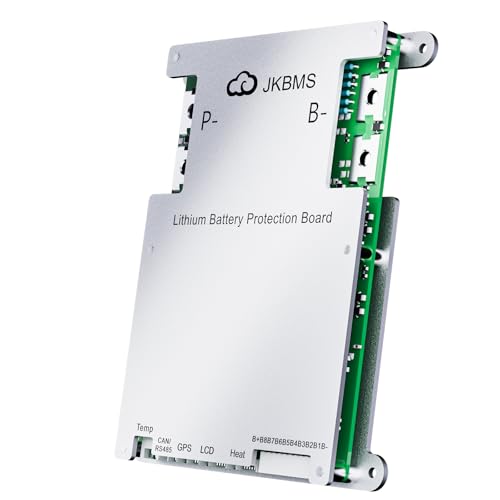
JKBMS offers an active balance feature and broad compatibility across LiFePO4, Li-ion, and other chemistries. The system supports CAN and RS485 for integration with monitoring hardware and third-party controllers, and its mobile app enables real-time status checks and parameter adjustments via Bluetooth. The flexible 4S-8S range makes it suitable for compact to mid-sized packs in RVs, solar setups, or portable power banks requiring easy monitoring and robust protection.
WSDMAVIS 4S 20A LiFePO4 BMS

This WSDMAVIS board focuses on 4S LiFePO4 protection with a balance function and over/under voltage safeguards. The stated continuous current is 18A with peak discharge up to 20A and a 20A charge limit. It’s designed for compact packs and projects needing a simple, affordable BMS with essential protection and basic balancing to extend pack life in small to mid-size LiFePO4 applications.
GODIYMODULES 4S 12V 800A BMS

The GODIYMODULES 4S BMS is built to handle high instantaneous current—up to 800A peak—making it suitable for demanding loads or motors in LiFePO4 systems. It provides standard 4S pack protection and a robust output stage, ideal for projects where peak current events are common, such as electric tools, small electric vehicles, or high-drain battery packs used in power tools or backup systems.
Buying Guide
- Battery chemistry compatibility: Ensure the BMS supports LiFePO4 cells and the exact configuration (4S, 8S, 15S, etc.) you plan to use. Mismatches can prevent charging or cause safety risks.
- Protection features: Look for overcharge/overdischarge protection, overcurrent/short-circuit protection, temperature monitoring, and balance function. Active balancing can improve longevity for larger packs; passive balancing is common for smaller packs.
- Current ratings: Choose a BMS with a continuous discharge/charge rating that meets or exceeds your system’s requirements. If you expect high surge current (motors, inverters), prefer models with higher peaks.
- Communication and monitoring: Bluetooth, Wi‑Fi, CAN, or RS485 enable remote monitoring. Consider whether you need app-based controls, PC software, or integration with a second monitoring system.
- Cell matching: Some BMS units require matching cell voltages and impedances across the pack. Following manufacturer guidelines ensures reliable charging and balancing.
- Physical and thermal considerations: Aluminum housings and good heat dissipation help with high-current use. Ensure packaging fits your enclosure and has adequate cooling.
- Ease of installation: Look for clear wiring diagrams, accessible balance ports, and whether the BMS uses a common negative or separate B- lines. Some models require additional fuses or protection components.
- Future scalability: If you anticipate expanding your pack, choose a BMS with a compatible voltage range or flexible balancing options to minimize replacement needs later.
In sum, the best BMS for your LiFePO4 battery depends on pack size, current demands, and how you intend to monitor and control the system. The five models highlighted above cover a range of configurations—from compact 4S packs with straightforward protection to larger, feature-rich systems with remote connectivity. When selecting, weigh protection depth, current capability, and ease of integration against your specific application needs.