Best Commercial Reverse Osmosis System Options for Businesses
When selecting a commercial reverse osmosis system, reliability, capacity, and filtration quality are vital. This guide highlights five solid options suitable for restaurants, offices, labs, and light industrial use. Each product showcases high output, efficient filtration, and practical features like pressure monitoring and low waste ratios. Read through to compare capacities, filtration stages, and system design to fit your water quality needs and space constraints.
| Product | Brand | Capacity | System Type | Key Benefit |
|---|---|---|---|---|
| iSpring CRO1000 | iSpring | 1000 GPD | Tankless Commercial RO | High flow with on-demand filtration |
| iSpring RCS5T | iSpring | 500 GPD | Tankless Commercial RO | Low waste ratio with booster option |
| iSpring RCC7AK | iSpring | 75 GPD | Under-Sink RO | Mineral boost and easy top-mounted faucet |
| Waterdrop G3P600 | Waterdrop | 600 GPD | Tankless Under-Sink RO | 8-stage filtration with smart faucet |
| APEC ROES-50 | APEC WATER | 50 GPD | Under-Sink RO | Reliable 5-stage filtration |
iSpring CRO1000 1000 GPD Tankless Commercial RO System

The CRO1000 delivers true commercial-grade performance with a 1,000 GPD output and a tankless design for on-demand filtered water at 0.7 GPM. Built-in inlet and outlet gauges enable easy pressure monitoring. An optional PMP1000 booster pump can boost performance when feed pressure is below 80 psi, expanding operating range to 80–130 psi. It uses a high-efficiency, commercial-size RO membrane that removes up to 99% of contaminants, including lead, chlorine, fluoride, and arsenic. The 4-stage filtration includes a transparent 20” x 4.5” PP sediment filter, two carbon block filters, and a stainless-steel 1,000 GPD membrane for durability.
iSpring RCS5T Commercial Tankless RO System
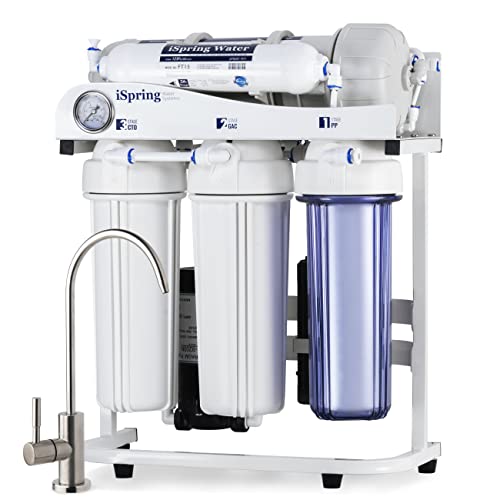
The RCS5T features a 5-stage filtration lineup, including stages that address PFAS, rust, chlorine, and disinfection byproducts. It boasts a 500 GPD membrane and a low-waste ratio of 1.5:1 pure to drain, making it suitable for light commercial settings like restaurants, salons, labs, and small offices. A built-in booster pump enhances water pressure, maximizing RO production and ensuring steady supply of purified water even when feed pressure is uneven.
iSpring RCC7AK Alkaline 6-Stage Under-Sink RO

The RCC7AK combines a patented top-mounted design for easy installation with a mineral boost in the AK stage, delivering filtered water with balanced pH and added minerals. A transparent first-stage housing makes it simple to monitor filter life and contaminant buildup, helping maintenance departments schedule replacements proactively. This system is best suited for under-sink applications where compact footprint and mineral remineralization are priorities.
Waterdrop G3P600 Tankless RO System

The G3P600 is an 8-stage tankless RO system with certifications for NSF/ANSI standards 58, 42, and 372. It features a 2:1 pure to drain ratio and a smart LED faucet that displays real-time water quality and filter life. Its compact, tankless design reduces under-sink space usage by up to 70%, making it well-suited for modern kitchens or commercial spaces with limited room. The system reduces a broad range of contaminants and includes a smart display for ongoing monitoring.
Waterdrop G5P500A Alkaline 8-Stage RO System
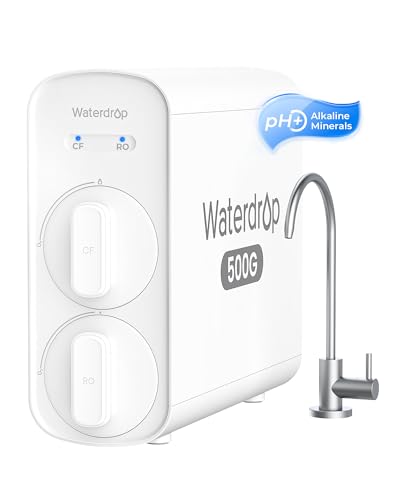
The G5P500A uses an eight-stage filtration sequence with an RO membrane and alkaline remineralization to deliver mineral-rich water. It features a compact tankless design and a higher stage filtration array designed to reduce PFAS, lead, chlorine, and other contaminants while enriching water with minerals like calcium and magnesium. Its modern, space-saving design is ideal for small to mid-size kitchens and office spaces seeking both purity and mineral balance.
Buying Guide: Key Purchase Considerations
- Capacity and demand: Match system output to daily water usage. Commercial systems range from tens to thousands of gallons per day; select a model that sustains peak demand without excessive waste.
- Tank vs. tankless: Tankless systems save space and provide on-demand water but may require more robust feed water pressure and periodic maintenance. Tank-based designs may offer simpler installation in some setups.
- Filtration stages: More stages typically improve contaminant removal and taste. Consider whether mineral remineralization is desired for drinking water quality.
- Efficiency and waste: Check the pure-to-drain ratio. Lower waste ratios (closer to 1:1 or 1.5:1) help reduce water usage, especially in municipalities with high water costs.
- Water pressure and booster options: Some systems include boosters or require external pumps to maintain optimal production, particularly at low inlet pressures.
- Certifications and safety: Look for NSF/ANSI certifications for contaminant reduction, material safety, and overall system reliability.
- Installation footprint: Space constraints matter. Tankless designs are compact but may require additional space for filtration panels and routing.
- Maintenance and replacement parts: Consider availability of replacement membranes and filters, ease of service, and clear monitoring indicators.
- Application fit: For restaurants and labs, prioritize filtration efficiency and regulatory compliance. For offices, consider ease of use and water quality consistency for staff.