Best 50 Amp Solar System Kits for Home and Outdoor Power
Exploring reliable 50 amp solar system kits helps homeowners and outdoor enthusiasts ensure steady, off-grid or backup power. This guide highlights five top options, detailing inverter power, panel capacity, battery compatibility, and ease of installation. Each selection prioritizes robust performance, scalability, and practical everyday use, from cabins and RVs to boats and farms.
Summary of chosen products
- Product 1: ZXDZTZ 100W Panel Kit with 50A Controller and 4000W/6000W Inverter
- Product 2: ECO-WORTHY 9.36KWH Off-Grid Kit with 2340W Panels and 5000W Inverter
- Product 3: ZXDZTZ Complete Solar Inverter Kit 4000W/6000W with 100W Panels
- Product 4: ECO-WORTHY Home Off-Grid System with 10KW Inverter and 12x410W Panels
- Product 5: Victron SmartSolar MPPT Controller (50A) for 12/24V systems
- Load assessment: Build a load profile to match inverter capacity and battery storage. For example, a 50A system can support essential appliances, lighting, and small HVAC if sized appropriately, but higher power tools or HVAC may require larger kits or multi-unit configurations.
- Inverter type and surge: Consider the difference between pure sine wave versus modified sine wave inverters. Pure sine wave inverters deliver cleaner power for sensitive electronics and motors. Check surge ratings to handle motor starts and peak loads without tripping.
- Battery compatibility: Determine if you will use lead-acid, AGM, or LiFePO4 batteries. LiFePO4 offers longer life and stability but at higher upfront cost. Ensure controller and inverter are compatible with your chosen chemistry, voltage (12V, 24V, 48V), and wiring.
- Charge controller technology: MPPT controllers optimize harvest in variable sun, especially when panels are not perfectly aligned. PWM controllers are simpler and cheaper but less efficient under high voltage or partial shading.
- System expansion: If you anticipate growing energy needs, select modular kits that allow adding more panels, controllers, or larger battery banks. Look for compatibility with multiple inverters and controllers for easier scalability.
- Monitoring and maintenance: Solar systems benefit from remote monitoring apps, Bluetooth/WiFi connections, and device-level protections. Plan for routine checks of battery voltage, temperature, wiring, and connector integrity.
- Installation considerations: Roof space, shade-free exposure, and mounting considerations affect panel output. Ground mounts may be suitable for larger arrays; ensure weatherproofing and safety clearances, especially in coastal or extreme climates.
- Durability and warranty: Review IP ratings for panels, enclosure protection, and inverter heat management. Confirm warranty terms for panels, batteries, and electronics, and understand what is covered in case of failures.
ZXDZTZ 100W Solar Panel Kit With 50A Controller

This complete solar system combines a 100W solar panel with a 50A charge controller and an inverter capable of 4000W/6000W surge, with continuous output options of 300W/500W. It converts 12V DC to 110V/220V AC, enabling straightforward powering of small to mid-range devices. The kit is marketed as compact and portable, suitable for outdoor adventures or emergency power at home, and explicitly notes compatibility with a range of vehicles and outdoor gear, including motorcycles, boats, RVs, and trailers. Users should consider the core output limits (≤300W/500W continuous) when sizing appliances and plan for more robust loads if needed.
Key features include surge handling for short-term high-demand devices, a complete turnkey solution, and portability. The included cigarette lighter adapter and battery clips provide flexible connection options, though it remains best suited to light to moderate loads rather than extensive off-grid living. For backup power or mobility-focused applications, this kit provides a compact entry point into 50A charging and conversion capabilities.
ECO-WORTHY 9.36KWH Off-Grid Solar Power System
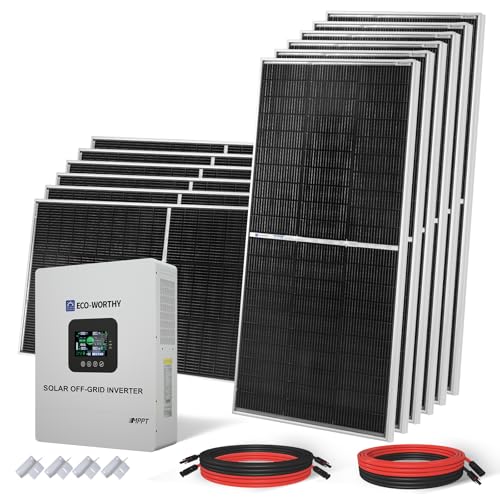
This system targets higher daily energy needs, promising an ideal 9.36 kWh per day under four hours of sun with a 2340W solar panel array. The off-grid setup uses a 5000W 48V DC-110V AC pure sine wave inverter paired with a 100A MPPT controller, delivering 99.9% efficiency with multiple charging modes and a 5500W PV input, 5000W output configuration. It emphasizes uninterrupted power to appliances like air conditioners, TVs, refrigerators, and common kitchen devices, making it suitable for homes, sheds, cabins, farms, or remote locations seeking reliable energy backup. The 18BB high-efficiency solar cells and double-sided generation boost daily energy harvest, while IP68 protection and a 30-year lifespan underline durability.
The system supports hybrid charging (solar and mains) and emphasizes seamless compatibility with lithium and lead-acid batteries. With a plug-and-play philosophy and robust weatherproofing, it aims to reduce downtime and simplify installation for DIY enthusiasts and small off-grid setups.
ZXDZTZ Complete Solar Inverter Kit 4000W/6000W

This kit mirrors many features of the first ZXDZTZ option, emphasizing a 4000W/6000W surge-capable inverter, 12V DC to 110V/220V AC conversion, and a 100W solar panel with a 50A PWM controller. The highlights are portable, making it appealing for emergency backup or outdoor expeditions. A notable feature is the 30A PWM solar charge controller in the listing, with automatic system recognition for 12V/24V configurations and protections against overcharging, shorts, and overheating. It supports both lead-acid and certain lithium batteries, depending on the system design and ensure battery compatibility. As a single-panel entry, it’s best for lighter loads or as a starter kit to test off-grid capabilities before expanding.
Owners should assess their planned load carefully and consider expanding with additional panels or a larger battery bank to maximize reliability during extended outages or off-grid living scenarios.
ECO-WORTHY Home Off-Grid Solar Power System

This comprehensive off-grid system targets substantial power needs with a 10KW inverter capable of 20KW peak power and split-phase output. It includes 15.36kWh UL-certified lithium batteries and 4920W of solar panels, aiming to deliver dependable energy for entire homes or cabins. The kit supports multiple charging modes and can operate in solar-only, grid-tallback, or hybrid modes to maximize energy capture and use. A notable advantage is the server-rack-style lithium battery pack, designed for compact storage with a durable enclosure, improving safety and space efficiency in tight installations.
The system emphasizes cloud-based monitoring and app-based status checks, along with the flexibility to split-phase output for more balanced residential loads. It suits users seeking a robust, scalable off-grid solution with battery storage, though it requires careful planning for panel orientation and space to deploy the full array.
Victron Energy SmartSolar MPPT Controller (Bluetooth) 50A

The Victron Energy SmartSolar MPPT Controller is designed to maximize solar power conversion with rapid optimization of charging, preserving battery life through intelligent algorithms. It includes Bluetooth connectivity for easy monitoring via mobile devices, enabling synchronized charging across multiple controllers when deployed in larger systems. The 100V, 50A rating supports a wide range of panel configurations, while the MPPT approach improves efficiency, especially under partial shading or variable weather conditions. It emphasizes system-wide energy optimization when multiple controllers operate in concert, a key advantage for scalable setups that prioritize longevity and reliable battery health.
Ideal for larger installations or where precise battery management is critical, this controller pairs well with high-capacity solar arrays and robust batteries. Users should ensure compatibility with their chosen inverters and battery types, and plan for appropriate cooling and wiring best practices to avoid voltage drops and thermal issues.
SUNGOLDPOWER 10KW Inverter With MPPTs

The SUNGOLDPOWER SPH10048P is an all-in-one solar charge inverter featuring built-in MPPTs, dual MPPTs, and up to 200A of battery charging. It supports split-phase 120V/240V or single-phase 120V output, with a WiFi module for remote monitoring. The device presents a robust option for high-demand loads, offering protective features for voltage and current discrepancies and multiple operation modes to align with different power strategies, including solar-priority and hybrid configurations. It’s targeted at households seeking substantial power in a compact, integrated package with connectivity for ongoing performance tracking.
When planning a large off-grid footprint, consider ventilation, battery health, and appropriate wire sizing to accommodate high current. The inclusion of WiFi monitoring supports proactive maintenance and performance reviews.
MOES Dual Power Controller 50A Automatic Transfer Switch
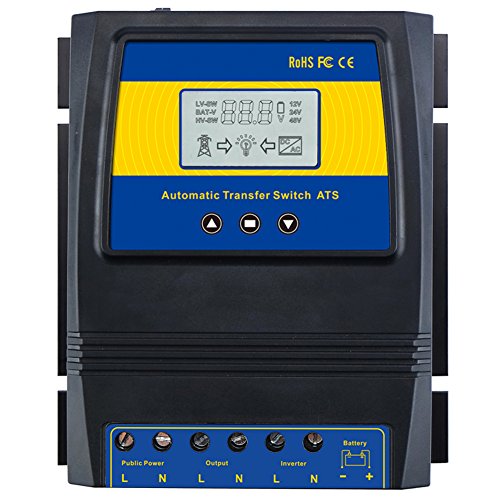
The MOES Dual Power Controller is an automatic transfer switch designed for off-grid solar and wind systems. It switches to grid power when battery voltage is low and reverts to battery when voltage recovers, effectively acting as an uninterruptible power supply (UPS) for essential loads. It detects DC voltages at 12/24/48V and AC at 100–120V or 220–240V with auto-distinguishing capabilities. Users can set cut-off and recovery voltages to tailor performance for their battery chemistry, making it adaptable for sealed, gel, lead-acid, and certain lithium configurations. This device helps protect batteries from deep discharge and preserves critical loads during fluctuating solar conditions.
While beneficial for backup scenarios, it’s important to pair this switch with appropriate battery management and a well-planned load schedule to avoid unintended power interruptions. Its compatibility with multiple voltages makes it a flexible addition to larger systems seeking reliable automatic power transitions.
ECO-WORTHY 10000W Complete Off-Grid Kit with 20.48kWh Battery
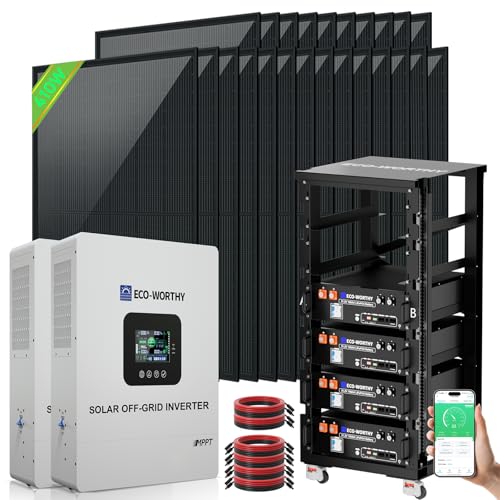
This expansive off-grid kit is designed for substantial, reliable power, featuring a 40 kWh daily-approximation, a 10 kW inverter with split-phase capability, and a sizable 20.48 kWh lithium battery bank. It aims to support extended outages and higher energy demand, including multiple 110V appliances. The system is described as expandable, with potential to integrate more solar panels and additional battery capacity as needed. Like other ECO-WORTHY offerings, it emphasizes plug-and-play integration with their multi-brand inverter solutions and a comfortable user-monitoring interface via an app. This kit is well-suited for larger homesteads, cabins, or remote facilities that require durable, long-duration electricity storage.
Potential buyers should verify space for panel installation, battery rack configuration, and local permitting requirements for large off-grid installations. It’s recommended to ensure proper ventilation, fire safety compliance, and battery maintenance planning for a system of this scale.
Buying Guide: 50 Amp Solar System Purchase Considerations
Overall, a 50 amp solar system kit can serve as a capable base for emergency power, off-grid living, or remote site operation. When evaluating options, balance initial costs with long-term reliability, maintenance needs, and how the components integrate with existing electrical infrastructure. Prioritize safety, proper sizing, and future-proofing through scalable configurations to maximize return on investment and energy resilience.