Best Outdoor Post Light Dusk-to-Dawn Sensors for Lamp Posts
Choosing the right dusk-to-dawn sensor for outdoor lamp posts can enhance security, save energy, and ensure reliable lighting after dark. This guide highlights five top options, comparing installation, compatibility, durability, and performance. Each product is evaluated on ease of use, sensor reliability, and suitability for residential or commercial lighting setups.
Product Overview
| Product | Brand | Type | Key Benefit |
| Solus Dusk-to-Dawn Sensor with Ezee Change Plug | Solus | Plug-in post light sensor | Quick replacement without rewiring |
| J.LUMI YCA1030 Hard-Wired Post Eye Light Control | J.LUMI | Hard-wired sensor | Reliable triggering and time delay prevention |
| ALAMSCN Photocell Sensor 120V AC | ALAMSCN | Outdoor photocell sensor | Weatherproof with broad load support |
| Design House Replacement Dusk to Dawn Sensor | Design House | Pole-light sensor | Easy installation with broad fixture compatibility |
| Mighmia Photoelectric Switch for Outdoor Pole Light | Mighmia | Post light sensor | Durable, plug-and-play replacement |
Across these selections, the common goal is to switch outdoor lighting automatically based on ambient light, reducing manual operation and energy use while maintaining consistent visibility for security and ambiance after sunset.
Solus Dusk-to-Dawn Sensor with Ezee Change Plug
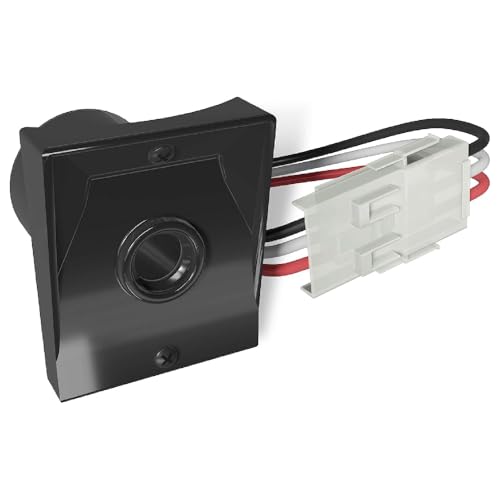
The Solus dusk-to-dawn sensor features a built-in photocell that automatically turns a post light on at dusk and off at dawn, removing the need for manual operation. The Ezee Change Plug enables fast, tool-free replacement after installation, minimizing downtime and rewiring requirements. It supports a wide wattage range, handling up to 300W incandescent, 60W LED, 39W fluorescent, and 100W HID, making it suitable for many residential and small to mid-size commercial applications. The UL-listed unit provides reliability and safety assurances for outdoor use.
Installation and compatibility are straightforward, especially for owners transitioning from older sensors. The plug-in design reduces installation time and makes maintenance accessible for property managers seeking to minimize labor costs. The sensor’s broad wattage tolerance helps future-proof updates as lighting fixtures evolve. In areas with variable daylight, the adjustable dusk-to-dawn timing can accommodate different seasonal daylight changes, ensuring consistent nighttime illumination.
J.LUMI YCA1030 Hard-Wired Post Eye Light Control

The J.LUMI post eye light control is a hard-wired dusk-to-dawn sensor designed for reliability in both residential and commercial outdoor lighting. It carries UL listing, indicating adherence to safety and performance standards. The latest generation electronics aim to provide a stable trigger response, reducing false activations from passing vehicles or stray lights. A built-in time delay helps prevent rapid cycling when encountering brief light disturbances. Its standard fit accommodates typical residential outlet boxes and pole installations.
Key advantages include dependable performance in varied weather, a compact form factor, and compatibility with standard fixtures. The device’s hard-wired design ensures a permanent installation that won’t rely on plug-and-play connections exposed to the elements. The sensor’s robust construction supports long-term outdoor use, contributing to energy savings by ensuring lights operate only when necessary after sunset.
ALAMSCN Photocell Sensor 120V AC

The ALAMSCN photocell sensor converts manual lighting to automatic operation, turning outdoor lights on at dusk and off at dawn. It is built for compatibility with 120V AC circuits and supports a substantial load range, ideal for parking lots, landscapes, or signage lighting. The device relies on a 16AWG wired connection with a weather-resistant design, rated for up to 150°C, ensuring reliable performance in diverse climates. This unit suits applications requiring broad outdoor lighting control without complex rewiring.
With easy integration into existing outdoor lighting systems, the ALAMSCN sensor provides durable sealing and weather resistance. Its straightforward operation focuses on dependable dawn-dusk transitions, which helps reduce energy waste while maintaining safety and visibility around properties. Users should verify fixture compatibility and ensure proper mounting to avoid misreads from nearby artificial lighting or reflective surfaces.
Design House Replacement Dusk to Dawn Sensor

The Design House dusk-to-dawn sensor is designed for easy installation with most fixtures and bulbs used in outdoor pole lights. It helps automate outdoor lighting, providing security benefits and energy savings by ensuring lights turn on after dark and off at daylight. Compatibility with a wide range of pole lights makes it a versatile choice for homeowners and facility managers managing multiple fixtures.
Durability is aided by a weather-resistant construction intended to withstand outdoor conditions. The design emphasizes straightforward mounting and reliable sensor performance, reducing maintenance efforts. As with any dusk-to-dawn device, proper calibration is essential to avoid nuisance triggers from artificial lighting or shadows near the fixture. This makes it a practical option for improving nighttime outdoor illumination without extensive installation work.
Mighmia Photoelectric Switch for Outdoor Pole Light

The Mighmia post light sensor offers automatic dusk-to-dawn operation, functioning without manual intervention. It features a weatherproof PC housing that resists rain, snow, dust, and abrasion, supporting outdoor use in extreme temperatures from -30°C to +65°C. The plug-and-play design simplifies replacement for existing post lights, aided by a 1-3/8″ mounting hole compatible with many lampposts. This makes it a practical upgrade for aging sensors or DIY outdoor lighting projects.
Durability and reliability are emphasized with a robust waterproof construction, making it suitable for exposed locations. The sensor’s quick replacement capability reduces downtime during maintenance cycles. Users should confirm mounting hole compatibility and ensure the electrical supply matches the device rating to maximize performance and longevity.
Buying Guide
Key purchase considerations for dusk-to-dawn sensors on lamp posts include:
- Compatibility: Ensure the sensor supports your fixture type, mounting method, and voltage (commonly 120V in the U.S.).
- Sensor reliability: Look for UL or equivalent safety listings and weatherproof ratings (IP65 or higher) for outdoor use.
- Wattage and load: Verify the sensor can handle the fixture’s total wattage and type (LED, incandescent, HID, etc.).
- Install method: Decide between plug-in (easier replacement) and hard-wired (permanent, permanent installation).
- Calibration and timing: Check whether the unit offers adjustable dusk/dawn thresholds, time delays, and light shield options to avoid false activations.
- Durability: Choose materials and housings designed to resist rain, dust, temperature swings, and UV exposure.
- Maintenance and replacement: Consider ease of access for routine checks and whether replacement parts are readily available.
- Security and energy savings: Assess how the sensor contributes to security lighting and reduces energy consumption over time.
- Future-proofing: A sensor with broad compatibility can accommodate evolving lighting technologies, including newer LEDs and smart fixtures.
In summary, the best dusk-to-dawn sensor for your lamp posts balances ease of installation, reliable daylight sensing, weather resistance, and compatibility with current and future lighting fixtures. For properties with multiple fixtures, a hard-wired option may provide lasting stability, while plug-in designs offer flexibility for quick upgrades or temporary setups. Consider the environment, typical weather conditions, and the type of lighting you rely on after dark to guide the optimal choice.