Best Constant Current Power Supplies for Lab and DIY Projects
Finding a reliable constant current power supply is essential for current-limited testing, LED driving, and precision electronics work. The following selections emphasize adjustable voltage and current, clear readouts, and built-in protections. Each option is suitable for hobbyists and professionals seeking stable CC behavior across varying loads. Below you’ll find five top picks with practical features, safety safeguards, and easy-to-use controls to help you choose the right unit for your projects.
The table below summarizes five selected products to compare key specs at a glance.
| Product | Brand | Output Range | Display | Special Feature |
|---|---|---|---|---|
| Jesverty SPS-3010 | Jesverty | 0–30V / 0–10A | 4-Digit LED | CV/CC auto-switching, USB port |
| NICE-POWER 30V 10A | NICE-POWER | 0–30V / 0–10A | 4-Digit LED | Output switch, precise readouts, multiple protections |
| Jesverty SPS-6005 | Jesverty | 0–60V / 0–5A | 4-Digit LED | CV/CC auto-switch, USB port |
| NICE-POWER 0–30V 0–10A | NICE-POWER | 0–30V / 0–10A | 3-Digit/Encoder readouts | High power, encoder precision, compact |
| Amtake Universal Power Supply | Amtake | 3–36V / up to 4A | 14 tips and LCD | Wide compatibility, multiple safety cutoffs |
Jesverty SPS-3010: 0–30V, 0–10A With Auto CV/CC

The Jesverty SPS-3010 provides a broad 0–30V and 0–10A output with a high-visibility 4-digit display. Real-time readouts show voltage, current, and power, with a resolution as precise as 0.01V, 0.001A, and 0.1W. It automatically switches between constant-voltage (CV) and constant-current (CC) modes as the load changes, ensuring safe operation for both resistive and LED loads. A USB 5V/2A port adds charging convenience for small projects or firmware updates. This model suits bench testing, lab experiments, and educational setups that require stable CC behavior under changing loads.
Protection features help prevent damage from overloads and shorts, and the coarse/fine adjustment dials provide precise control. Note that the user-set voltage and current thresholds define the crossover where CV transitions to CC, making it important to calibrate for your specific load. Overall, SPS-3010 balances versatility with straightforward operation for everyday CC tasks.
NICE-POWER DC Power Supply: 30V 10A

The NICE-POWER unit delivers a robust 0–30V and up to 10A with a high-contrast 4-digit display that reports voltage, current, and power in real time. It emphasizes user safety with an OUTPUT switch to quickly enable or disable power to the load, reducing risk during setup changes. The device uses a switching regulation design for efficiency, while the internal protections guard against over-voltage, over-current, over-temperature, and short circuits. It’s designed for reliability in lab benches, electronics workbenches, and educational labs where stable CC behavior is essential for test accuracy.
Security is complemented by certified construction and a 110V US standard input. The unit’s readouts stay legible in low-light environments thanks to the backlit display. For users needing repeatable CC performance across various loads, this model offers solid performance with practical safeguards and a professional feature set.
Jesverty SPS-6005: 0–60V, 0–5A
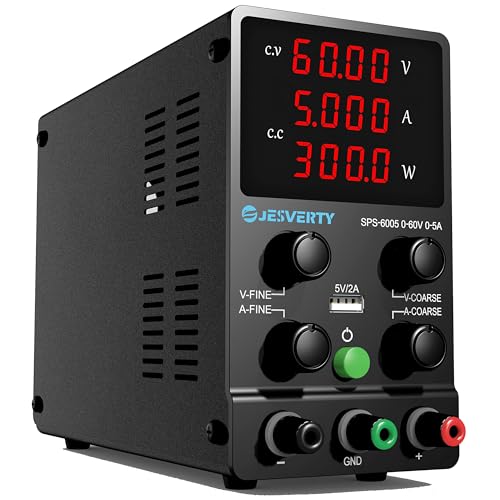
The SPS-6005 extends the voltage range to 0–60V while maintaining a 0–5A current ceiling, making it suitable for higher-voltage experiments or LED driving that requires precise control. Its 4-digit LED readout shows V, A, and W in real time, with similar CV/CC automatic switching as the 3010 model. The device is designed with coarse and fine adjustment to help users dial in exact settings, plus a USB port for charging or powering small devices during testing. This unit is ideal for labs or workshops needing more voltage headroom without sacrificing current control.
Operational safeguards include protection against over-voltage, over-current, short circuits, and thermal issues. The combination of CV/CC versatility with a wide voltage range makes the SPS-6005 a practical option for multi-scenario use—from charging, LED drivers, to bench experiments where variable voltage is important.
NICE-POWER 0–30V 0–10A: Compact, Accurate

This NICE-POWER model emphasizes precision in a compact footprint. It offers a narrow voltage and current range that covers common bench tasks, with a real-time readout of voltage, current, and power at a three-digit or encoder-assisted display. The encoder-based adjustment enables fine tuning, which is especially helpful when you need exact values for LED drives or sensor calibration without overshoot. An integrated encoder knob design provides tactile, repeatable control for critical experiments where stable CC behavior matters, and the device remains robust under continuous operation.
Key protections guard against overloads and faults, while its efficiency and cooling design help maintain performance during longer test sessions. If space is at a premium but you still require reliable CC behavior, this NICE-POWER unit is a sensible choice for the desktop lab or educational settings.
Amtake Universal Power Supply: 3–36V, 4A
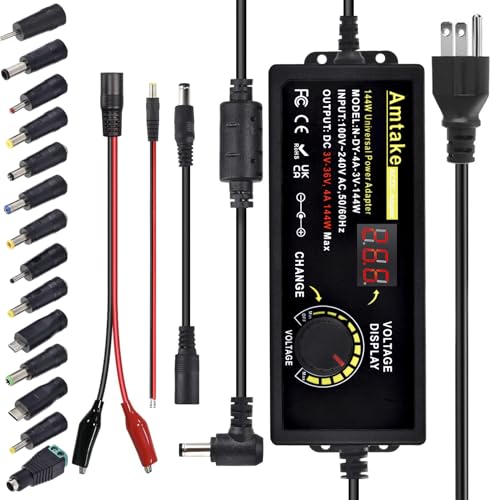
The Amtake universal power supply offers broad compatibility with adjustable DC output from 3V to 36V and up to 4A. It ships with a wide set of DC tips to support various devices and configurations, making it a versatile option for projects that require flexibility in input and output connectors. Built-in safety protections, automatic shutdown features for over-voltage, over-current, and temperature, add a layer of security for long-running tests or experiments. A 14-tip accessory kit helps accommodate different devices and ensures you can connect the correct load without adapters. The compact form-factor supports portable bench use and space-constrained setups.
For makers who frequently switch between projects, the Amtake unit offers a practical combination of adjustability, safety, and compatibility. It is particularly useful for LED drivers, sensor benches, or small electronics assemblies where a wide voltage range and solid CC behavior are advantageous, even though it may not reach the higher current levels of some dedicated CC power supplies.
Buying Guide: Key Considerations For Choosing A Constant Current Power Supply
- Current and voltage range: Match the device under test. If you drive LEDs or motors, ensure the CC limit fits your load’s requirements and that the CV range covers any voltage you’ll need.
- Readout clarity: A 4-digit display with real-time V/A/W readouts helps you monitor performance precisely. Backlit displays assist in low-light work areas.
- CV/CC auto-switching: Automatic mode switching reduces operator error and protects loads during changes in resistance or load conditions.
- Protection features: Look for over-voltage, over-current, over-temperature, short-circuit protection, and optional leakage or grounding safeguards to safeguard both equipment and personnel.
- Controls and ergonomics: Coarse and fine knobs, or encoder-based adjustments, allow precise value setting. An output on/off switch can prevent accidental power application.
- Safety and compliance: Ensure the unit meets local electrical standards (US-appropriate input voltage) and features tested protection circuits for safe bench use.
- Portability vs. power: Compact models save space, but higher current capacity may be necessary for demanding applications. Consider a model with a USB port if charging small devices is beneficial.
- Accessories and expandability: Multiple tip configurations or supplementary ports can improve versatility for experimental setups and testing rigs.
When selecting a constant current power supply, weigh the balance between current headroom, voltage swing, and the presence of practical safeguards. For educational labs, hobbyists, and professionals who require reliable CV/CC transitions with clear readings, the five models reviewed here offer solid baselines and dependable performance across common bench tasks.