Best 30 Hp Phase Converter Solutions for American Workshops
When outfitting a shop with three-phase power, choosing the right phase converter is critical for performance and reliability. This guide highlights five strong options that align with a 30 HP objective, including high-capacity American Rotary converters and versatile VFD-based approaches. Each entry notes performance sweet spots, typical loads, and practical use considerations to help you compare effectively.
| Product | Brand | HP Range | Type |
|---|---|---|---|
| AR20-20 HP 1 to 3 Three PH | American Rotary | 20 HP | Rotary Phase Converter |
| AD20 – 20 HP Digital Controls Heavy Duty | American Rotary | 20 HP | Digital Rotary Phase Converter |
| AR10-10HP 1 to 3 Three PH | American Rotary | 10 HP | Rotary Phase Converter |
| AR5 5 HP 1 to 3 Three PH | American Rotary | 5 HP | Rotary Phase Converter |
| ATO 10hp VFD Single to 3 Phase | ATO | 10 HP | VFD Inverter |
Note: The 30 HP target often means pairing a higher-capacity converter with one or more auxiliary drives to handle peak loads. Review the load profile of your tools (CNCs, lathes, mills, saws, and drills) to determine whether multiple machines will operate simultaneously or if occasional peaks are expected. The following sections present five carefully selected products that are well-suited for many American shops seeking robust 3-phase power options.
AR10-10HP Rotary Phase Converter

Brand: American Rotary. This AR10 model is designed for light to moderate loads with a 10 HP rating, suitable for applications like general-purpose motors and mixed loads. The unit is advertised as capable of starting up to a 5 HP/14 Amp 208-240V load, making it a practical option for smaller workshops looking to expand to three-phase capability without oversized equipment. When paired with other loads, it can help smooth transitions for CNCs or other equipment that require a stable three-phase supply.
Key considerations: For users planning to run a handful of smaller machines simultaneously, ensure that the total connected load remains within the converter’s continuous operating range. Consider the starting surge of connected motors and plan for adequate starter capability to avoid nuisance tripping.
AD20 – 20 HP Digital Controls Heavy Duty
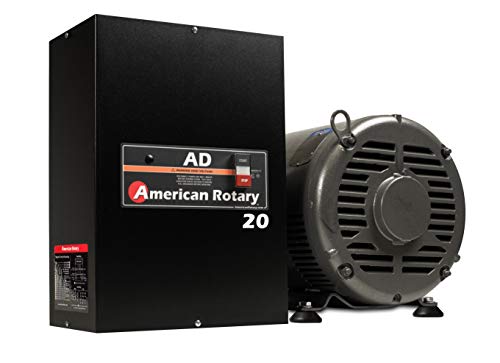
Brand: American Rotary. The AD20 is a digital-controlled 20 HP rotary phase converter designed to handle heavy-duty CNC, VFD, EDM, and other demanding loads. It is positioned for users who need reliable three-phase power for heavier industrial tools while maintaining adaptable controls for start-up sequencing and load balancing. This option is suitable for shops that regularly operate high-demand equipment, offering a robust solution for 10–20 HP loads in a single-machine or mixed-load environment.
Key considerations: Confirm that your peak load aligns with 20 HP capacity and assess how many machines will operate together. Digital controls can assist with smoother starts, reducing voltage dips that could affect precision equipment.
AR20-20 HP 1 to 3 Three PHASE

Brand: American Rotary. The AR20 extends the 10 HP family into a 20 HP range, enabling larger on-site loads with a single converter. It is described as capable of starting up to a 10 HP load with a continuous 28 Amp rating at 208-240V. This makes it a strong candidate for shops with multiple medium-sized machines or alternating high-demand drives. Efficiency and run capability are important factors when matching this unit to your anticipated load profile.
Key considerations: Evaluate whether your operations include substantial peak loads that may approach the 20 HP mark. Ensure wiring, circuit protection, and cooling are appropriate for sustained 20 HP operation to avoid overheating or tripping.
ATO 10hp VFD Single to 3 Phase

Brand: ATO. This model uses a single-phase input to generate three-phase output via a variable frequency drive (VFD). It is suitable for precise speed control and broad motor compatibility across fans, pumps, and power tools. The VFD approach can offer smooth speed modulation and energy efficiency, with a 10 HP output capacity and RS485 communication for integration with control systems.
Key considerations: VFDs introduce the option of speed control, but check compatibility with your motors (enclosure type, cooling, and duty cycle). Ensure proper cooling and electrical protections to prevent nuisance faults during high-load operation.
QNK 7.5KW 10HP VFD 3-Phase Inverter

Brand: QNK. The QNK VFD provides 10 HP equivalent performance through three-phase output from a single-phase input, featuring digital control, low-noise operation, and interference mitigation. It supports a wide frequency range and includes RS485 for integration with CNC or automation systems. It’s well-suited for CNC spindles and other speed-critical loads where precise control is essential.
Key considerations: VFD-based solutions can offer substantial control benefits but require correct motor and drive matching, including torque characteristics and cooling needs. Ensure the drive’s protection settings align with your application to maintain reliable operation under varying loads.
Buying Guide: Key Purchase Considerations and Comparisons
- Load profile: Determine whether your shop runs one high-demand machine at a time or several smaller loads concurrently. Rotary phase converters excel at handling multiple motors with modest starting surges, while VFDs provide precise speed control and can be more energy-efficient for variable-speed applications.
- Starting and running amperage: Check the converter’s continuous and peak ratings against the combined horsepower and current draw of your equipment. Oversizing can add cost, but undersizing risks tripping breakers and motor overheating.
- Control and start-up behavior: Digital controls and soft-start features in higher-end units reduce voltage dips during motor start-up. If your tools require precise ramping or synchronized starts, consider a model with advanced control options.
- Voltage and phase compatibility: Most units operate at 208-240V and convert single-phase input to three-phase output. Confirm your facility voltage, the number of phases, and motor compatibility (some CNCs and VFDs can require specific control signals).
- Cooling and enclosure: Heavier loads demand sufficient cooling and robust enclosures. Ensure adequate airflow or dedicated cooling to prevent overheating during extended operation.
- Maintenance and service: Look for units with accessible components, good documentation, and a track record of reliable service in the U.S. market. Consider the availability of replacement parts and local support.
- Cost versus performance: Rotary converters generally offer rugged, long-term value for steady loads, while VFDs may justify their cost through speed control, energy savings, and compatibility with variable workloads.
- Installation considerations: Ensure correct wiring, circuit protection, and clearances per electrical codes. It may be prudent to consult a qualified electrician when integrating a phase converter into an existing shop electrical system.