Best Solar Exhaust Fan With Thermostat: Efficient Ventilation for Homes, Sheds, and Greenhouses
Solar-powered exhaust fans with thermostats offer a reliable, energy-saving way to regulate temperature and improve air quality in spaces that lack easy access to electrical wiring. This guide highlights five top options, explaining how each model uses solar power, batteries, and adjustable thermostats to maintain comfortable conditions in greenhouses, attics, chicken coops, and sheds. Read on to compare performance, battery capacity, panel configuration, and control features to find the right fit for your ventilation needs.
Summary Of Selected Products
| Product | Brand | Key Benefit |
|---|---|---|
| GROWNEER Solar Powered Exhaust Fan | GROWNEER | High airflow with solar priority and 3200mAh battery |
| Lewisia 10W Solar Powered Fan | Lewisia | Dual fans with timer and temperature control |
| ecoCalm 10″ Solar Exhaust Fan | ecoCalm | Battery-backed, adjustable thermostat, bifacial panels |
| VEVOR Gable Mount Fan | VEVOR | 1300 CFM with adjustable thermostat for large spaces |
| ecoCalm 8″ Solar Exhaust Fan | ecoCalm | Battery-assisted, bifacial panels, auto temperature control |
GROWNEER Solar Powered Exhaust Fan
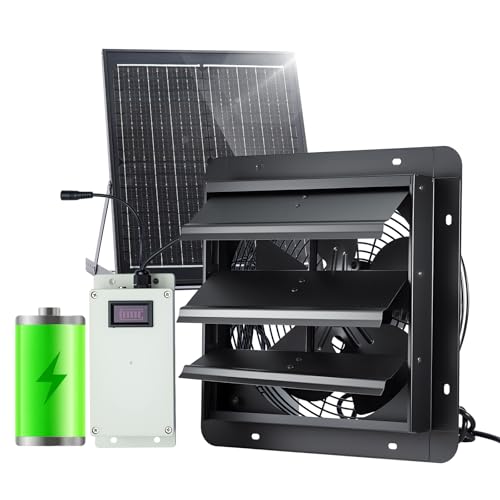
The GROWNEER unit combines a 12-inch high-speed solar exhaust fan with a 30W solar panel and a built-in 3200mAh battery. Its solar-priority system powers the fan directly when sunlight is available while charging the battery for use when light fades. This design supports continuous operation on cloudy days or at night, ensuring sustained ventilation in spaces up to about 1400 square feet, such as greenhouses, attics, or barns. The fan can run at three speeds, offering flexibility from gentle ventilation to strong airflow, with a tested 1200 CFM and 1200 RPM for rapid air exchange. A rugged metal body resists rust and corrosion, and the louvers automatically close when the fan stops to minimize dust and backdraft.
Key details:
- Solar priority mode with battery backup
- Three speed settings
- 1200 CFM airflow, 1200 RPM
- Durable metal housing; low-noise operation (40–60 dBA)
- Automatic louver closure to prevent backdraft
Lewisia 10W Solar Powered Fan

The Lewisia system features a dual-fan configuration that supports both exhaust and intake functions, providing balanced ventilation for enclosed spaces such as chicken coops, greenhouses, sheds, and garages. It offers three installation methods to optimize airflow: both fans exhaust, both fans intake, or one fan for intake and the other for exhaust. A digital controller with a temperature sensor and timer enables precise operation, with two working modes: TIME and TEMP. The 10W solar panel charges a 4400mAh battery, giving several hours of nighttime or cloudy-day performance for steady ventilation.
Key details:
- Dual fan system (exhaust and intake)
- Three installation configurations for airflow optimization
- Digital controller with temperature and timer
- 10W solar panel; ~3 hours of battery-backed performance
ecoCalm 10″ Solar Exhaust Fan

The ecoCalm 10″ model uses two 15W bifacial solar panels and a 5000mAh battery to deliver nighttime or low-light operation. The battery automatically switches its power source based on sun exposure, helping to maintain airflow in greenhouses or sheds. The product includes an adjustable thermostat, enabling automatic on/off control according to ambient temperatures. With bifacial panels that can capture sunlight from both sides, power generation can increase efficiency up to around 130%, though performance varies with weather and sun conditions.
Key details:
- 5000mAh battery; nighttime performance
- Two 15W bifacial panels for higher efficiency
- Adjustable thermostat for automatic control
- Auto power-mode switching based on sunlight
VEVOR Gable Mount 14 Inch Solar Fan

The VEVOR gable mount fan is designed for attic or roof installations, delivering up to 1300 CFM to cool large areas up to 1850 square feet. It includes an adjustable thermostat to minimize energy use by turning the fan on or off according to ambient temperature. A robust steel housing and corrosion-resistant construction ensure durability, while aluminum blades help maintain efficiency over the long term. This model provides strong, targeted ventilation for hot spaces like attics and workshops and emphasizes energy-conscious operation via its thermostat controls.
Key details:
- 1300 CFM for large spaces
- Adjustable thermostat; automatic temperature-based operation
- Durable steel housing and corrosion resistance
- Suitable for roof or gable mounting
ecoCalm 8″ Solar Exhaust Fan
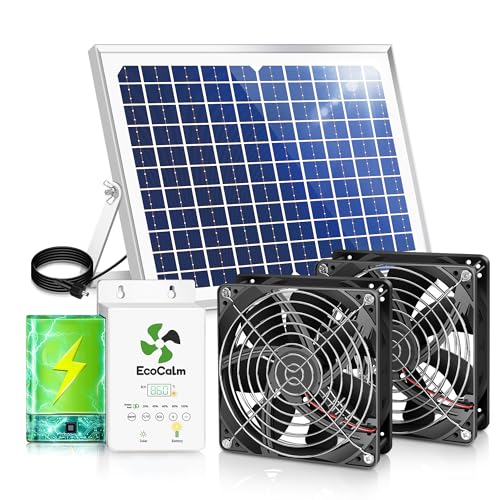
The ecoCalm 8″ model uses bifacial solar panels and a 4400mAh battery to provide evening ventilation for sheds, greenhouses, and outdoor enclosures. The battery supports operation during night or cloudy conditions, with automatic switching based on sunlight exposure. A bifacial 16W panel (on the rear) helps optimize energy generation, potentially delivering up to 41W under ideal conditions. As with other ecoCalm units, the thermostat enables automatic temperature-based control, promoting consistent indoor air quality without manual supervision.
Key details:
- 8″ exhaust fan with bifacial solar panel
- 4400mAh battery for extended nighttime use
- Automatic thermostat control
- Rear panel contributes to higher power generation
Buying Guide: Key Purchase Considerations For Solar Exhaust Fans With Thermostats
- Space and airflow requirements: Measure the area to be ventilated and choose a unit with adequate CFM. Larger spaces like attics or greenhouses benefit from higher airflow (>1000 CFM), while smaller sheds can manage with lower-CFM models.
- Power source and autonomy: Look for solar priority systems with built-in batteries to ensure ventilation during cloudy days or at night. Battery capacity (mAh or Ah) indicates how long the fan can operate without sun.
- Thermostat and control options: Adjustable thermostats help automate operation, reducing energy use. Some models offer timer or temperature modes for precise control.
- Panel configuration: Bifacial panels can increase power generation by capturing light from both sides, improving performance in sunny conditions. Consider panel wattage and whether two-panel setups are included or upgradeable.
- Durability and noise: Metal housings offer corrosion resistance and longer lifespans in dusty or humid environments. Noise levels vary; look for models with dBA ranges that fit the location’s tolerance for sound.
- Installation flexibility: Some products are designed for attic or roof mounting, while others are suitable for shed walls or ground installations. Check mounting hardware and required clearances.
- Weather resistance: For outdoor or greenhouse use, ensure IP ratings or water resistance are appropriate to protect motors and electronics from moisture.
- Maintenance requirements: Consider ease of access for battery replacement or panel cleaning. Durable seals and simple hardware can reduce long-term upkeep.
- Energy savings vs. upfront cost: While solar-powered units reduce electricity bills, higher initial costs may reflect better efficiency or solar panel configurations. Evaluate total cost of ownership over several seasons.
- Warranty and support: A longer warranty signals confidence in durability. Confirm coverage for motor, thermostat, and battery components.
Choosing the right solar exhaust fan with a thermostat involves balancing space requirements, energy savings, and automation features. By comparing airflow, battery life, panel efficiency, and mounting options, you can select a system that maintains comfortable temperatures while reducing dependence on grid electricity.