Best Sun Tracker Solar Panels for Efficient Solar Power
The following selections highlight top sun tracker solar panel systems that maximize energy capture with single- or dual-axis tracking. These kits integrate trackers, controllers, and wind-safety features to help homeowners, farms, and off-grid setups boost daily output. Each product below draws from robust tracking technology designed to align panels with the sun throughout the day, reducing shade loss and increasing overall efficiency.
Summary of chosen products:
| Product | Brand | Type | Key Benefit |
|---|---|---|---|
| ECO-WORTHY Dual Axis Tracking System (Expanded) | ECO-WORTHY | Dual Axis | Up to 40% more power; intelligent light sensing |
| 1200W Solar Tracker System | ECO-WORTHY | Dual Axis | High daily output; 270° rotation |
| 1600W Solar Tracker System | ECO-WORTHY | Dual Axis | High efficiency with compact footprint |
| Solar Panel Single Axis Tracking System | ECO-WORTHY | Single Axis | Increases power by ~30%; space-saving |
| Portable Solar Panel With Tracker | REDIGOO | Dual Axis | Portable, travel-friendly with 360° tracking |
ECO-WORTHY Solar Panel Dual Axis Tracking System (Expanded Version)

Features emphasize intelligent light sensing and 270° tracking for maximum sun exposure. The system increases efficiency by up to 40% over standard brackets, due to real-time orientation adjustments. It supports 10P/100W or 8P/200W and 4P/400W configurations, making it adaptable to various panel arrays found in residential or small-farm settings. The design includes an automatic wind response for high-wind events, with the controller enabling manual override to optimize snow clearing and positioning during winter months.
ECO-WORTHY 1200W Solar Tracker System

This 1200W kit pairs six 195W panels with a dual-axis tracker and a tracker controller, enabling up to 270° rotation. A sensitive sunshine sensor drives alignment to maximize daily irradiance, with an expected daily output around several kilowatt-hours under typical sun conditions. The wind-speed feature allows the base to reset to a horizon position in windy days, and expansion screws secure the base for stable setups in more exposed locations. Quick after-sales support is highlighted to address any product issues.
ECO-WORTHY 1600W Solar Tracker System

Designed for higher-capacity needs, this 1600W system uses eight 195W panels with a dual-axis tracker and controller. The setup emphasizes daily output around 8.6 kilowatt-hours under four hours of optimal sunlight. It also notes a compact footprint, occupying roughly 0.0484 square meters for space-conscious installations. The package is built to withstand varied weather with a robust tracking mechanism and sensor-assisted adjustments to keep the array aligned with the sun for extended periods.
ECO-WORTHY Solar Panel Single Axis Tracking System

Single-axis tracking serves as a cost-effective upgrade to fixed mounts, increasing power generation by at least 30% by following the sun’s arc across the sky. This kit supports multiple panel sizes and configurations, with installation options varying by panel width. The included tracker controller and mounting hardware enable straightforward setup for yards, farms, or field installations. After-sales support is described as responsive, emphasizing diagnostics by engineers and hassle-free replacements when defects are confirmed.
ECO-WORTHY 2 Sets Solar Panel Single Axis Tracking System
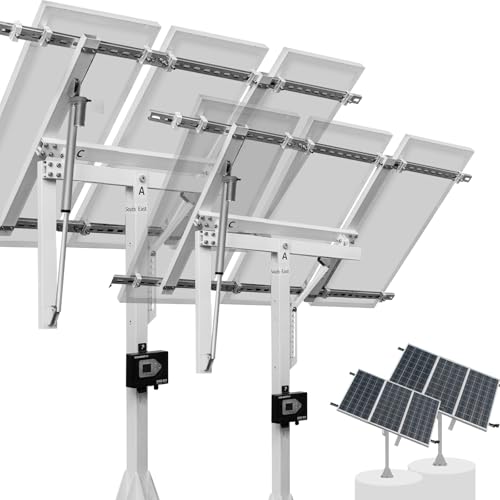
This option includes two tracking bracket sets, enough to hold 2–8 panels depending on size, with space-saving advantages versus traditional tripods. It emphasizes a 30% power increase over fixed mounts and a 270° tracking range, which allows the system to capture sun from multiple directions—southeast to northwest—throughout the day. The design prioritizes safety and aesthetics for family-friendly installations, helping keep outdoor spaces clear and organized while maximizing energy capture.
Portable Solar Panel with Solar Tracker, 200W

Designed for travel and outdoor adventures, this 200W portable kit folds to a compact 80 × 60 cm and weighs about 16 pounds. Its dual-axis, 360° automatic sun tracking ensures higher daily yields compared with fixed portable panels. Setup takes 5–10 minutes without tools, making it suitable for campsites, RV trips, or emergency off-grid scenarios. While highly portable, the system remains a fully functional sun-tracking solution that maximizes energy harvest on the go.
Buying Guide: Key Considerations And Comparisons
When choosing a sun tracker solar panel system, several factors determine long-term value and performance:
- Tracking Type: Dual-axis trackers maximize sun exposure throughout the day and across seasons, but single-axis models offer lower cost and simpler maintenance. Consider your energy goals and budget.
- Wind Resilience: Look for wind sensors and automatic safe-mode features that reorient or lock the frame in high wind. This protects hardware and improves reliability in exposed locations.
- Control And Sensors: High-quality trackers use precise light sensors and responsive controllers to maintain optimal angles. Evaluate response time, sensor quality, and ease of manual override if needed.
- Space And Footprint: Some kits save space with compact bases, which is valuable for yards or limited installations. Compare the required footprint against available space.
- Maintenance And Support: Robust after-sales support reduces downtime and ensures diagnostics by engineers when issues arise. Check warranty terms and replacement policies.
- Compatibility: Ensure the tracker kit matches the panel sizes and configurations you plan to deploy. Some kits specify maximum panel counts and widths for best results.
- Portability: If you need mobility, portable tracking solutions offer foldable designs and lighter weights, though they may have lower capacity than fixed installations.
- Cost of Installation: Install complexity varies. Some kits require drilling and ground anchors, while others are plug-and-play with simple mounting brackets. Factor in hardware and potential professional installation time.
In sum, dual-axis systems generally deliver higher daily outputs, particularly for off-grid or high-energy applications, while single-axis options provide a cost-effective upgrade for expanding existing arrays. Weather resilience, sensor accuracy, and after-sales support are decisive for year-round reliability. Consumers should balance initial investment with projected energy gains, space constraints, and long-term maintenance needs.