Best Electric Generator Motor Kit for DIY Projects and Learning
For students, hobbyists, and educators, a reliable generator motor kit can illuminate the principles of electricity, magnetism, and energy conversion. The following hand-picked products span beginner-friendly sets to more advanced kits, offering hands-on experiments with motors, generators, and related components. Each item highlights practical applications—from powering LEDs to demonstrating how motion becomes electricity. Use these kits to spark curiosity, support STEM curricula, and build functional demos that illustrate core physics concepts in action.
| Product | Brand | Key Focus | Voltage Range |
|---|---|---|---|
| EUDAX 6 Set Mini Generator Motors | EUDAX | Multi-volt generator motors, wind/solar/battery demonstrations | 3V – 12V |
| Thames & Kosmos Motors & Generators Science Kit | Thames & Kosmos | Electric motor to generator concepts, structured lessons | Various (educational kit) |
| Dowling Magnets Science Discovery Kit: Electric Motor Generator | Dowling Magnets | Motor-generator projects with magnetic studies | Includes various voltages |
| CrocSee Micro 3 Phase AC Mini Hand Brushless Motor Generator | CrocSee | Micro 3-phase brushless generator model | 3V–24V, 0.1–1A |
| Hand Crank Generator Dc Electric Motor Kit (SAFIGLE) | SAFIGLE | Hands-on energy conversion with crank power | 3V–6V (motor tested) |
EUDAX 6 Set Mini Generator Motors

The EUDAX kit provides six compact generator motors along with mounting brackets, propellers, LEDs, and quick connectors. It supports multiple voltage levels—3V, 4.5V, and 12V—with distinct rated speeds (1500, 2500, and 6500 RPM, respectively). This multi-functional kit is designed for beginners and can be driven by wind, gears, pulleys, solar panels, or batteries, enabling a wide range of educational demonstrations and DIY projects. The included English manual helps guide setup, experimentation, and safe handling of small electrical components.
Thames & Kosmos Motors & Generators Science Kit

This science kit outlines how an electric motor converts electricity into motion and how a generator reverses that process. It includes a transparent plastic component to observe inner workings, encouraging students to analyze gear trains, commutators, and windings. With guided activities, learners explore energy conversion, efficiency, and the relationship between current, voltage, and speed. The kit is aligned to classroom-style experiments, making it suitable for elementary to middle school STEM programs and for independent home projects.
Dowling Magnets Science Discovery Kit: Electric Motor Generator

Dowling Magnets’ kit focuses on magnetism fundamentals while assembling motor and generator configurations. It offers a guided approach that introduces conceptually how magnets influence current and motion. The included comprehensive guide frames magnetism concepts before delving into practical projects, which align with Next Generation Science Standards. Hands-on experiments cover topics such as earth magnets, attraction, repulsion, and the flow of electricity, providing a broad framework for magnetism-centric physics exploration.
CrocSee Micro 3 Phase AC Mini Hand Brushless Motor Generator
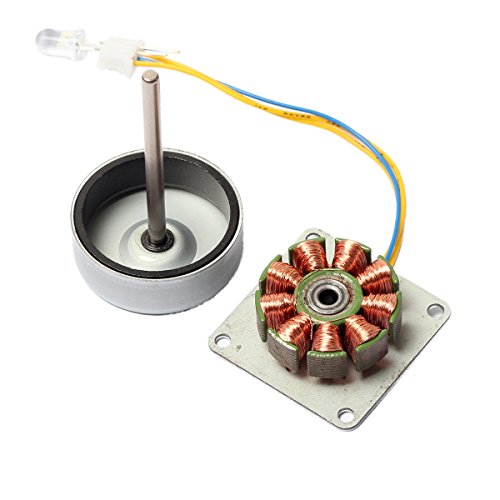
Designed as an educational micro-generator, the CrocSee kit uses a 3-phase brushless motor concept to demonstrate AC generation. It provides a practical platform to study phase relationships, electrical output, and the differences between DC and AC generation. The kit supports learning through hands-on assembly and testing, making it a useful starter for students and hobbyists exploring small-scale power generation and motor design.
Hand Crank Generator Dc Electric Motor Kit (SAFIGLE)

The SAFIGLE hand crank kit demonstrates energy conversion through manual cranking. It emphasizes electromagnetic principles and circuit relationships while delivering a compact, portable experience suitable for classroom demonstrations or at-home experiments. The kit’s design prioritizes durability and ease of assembly, making it appropriate for sustained classroom use and STEM activities that involve voltage generation, circuit testing, and energy transfer concepts.
Buying Guide
Key considerations when selecting an electric generator motor kit include scope, complexity, and learning goals. For beginners, starter kits like the EUDAX set or the SAFIGLE hand-crank kit emphasize core concepts through simple builds and safe components. Intermediate learners benefit from kits that reveal inner workings, such as the Thames & Kosmos Motors & Generators kit, which provides guided experiments and transparent parts for observation. Advanced students may explore more technical micro-generators, like the CrocSee 3-phase model, to study AC generation, phase relationships, and performance under varied loads.
Important features to assess:
- Voltage range and RPM: Ensure the kit matches your intended experiments (low voltages for LED lighting, higher for motors and measurement practice).
- Components included: Look for LEDs, gears, propellers, magnets, and wiring that support diverse demonstrations.
- Educational value: Kits with guided lesson plans and manuals can shorten setup time and improve learning outcomes.
- Durability and safety: Metal gear components and rugged housings support repeated classroom use and student handling.
- Expansion potential: Kits that allow reconfiguration into motor-generator pairs or integration with solar or wind modules offer broader experimentation.
When comparing kits, consider your audience. For younger learners, a visually transparent design helps observations of motion and electricity. For high school or informal education contexts, more complex configurations and measurable outputs (voltage, current) support deeper scientific inquiry. Finally, verify whether the kit aligns with your curriculum standards or learning objectives to maximize educational value and hands-on engagement.