Best 24 Volt Solar Battery Solutions for RVs and Off-Grid
Finding the right 24 volt solar battery setup involves balancing panel efficiency, durability, and a robust BMS. This guide highlights five solid 24V options, spanning compact panel kits to high-capacity LiFePO4 batteries. Each entry includes key features to help you compare performance, installation ease, and reliability for RVs, boats, and off-grid systems. Use the buying guide to navigate charge controllers, weather resistance, and future expandability so you can choose a system that fits your energy needs and space constraints.
Summary of chosen products:
| Product | Brand | Type | Key Benefit |
|---|---|---|---|
| SOLPERK Solar Panel Kit 50W 24V | SOLPERK | Solar Panel Kit | High efficiency with intelligent controller |
| Voltset 30W 24V Solar Panel Kit | Voltset | Solar Panel Kit | Durable build with MPPT controller |
| TechCella 24V 100Ah LiFePO4 Battery | TechCella | LiFePO4 Battery | High surge capability and long life |
| Dyness 24V 100Ah LiFePO4 Battery | Dyness | LiFePO4 Battery | Expandable and resilient cold protection |
| 24V 100Ah LiFePO4 Battery (yeagulch) | yeagulch | LiFePO4 Battery | Compact, protected 100A BMS |
SOLPERK 24V Solar Panel Kit

The SOLPERK kit combines a 50W 24V mono panel with a smart 10A PWM controller. It features a weather-ready aluminum frame, toughened glass, and IP67 rating for exposure to outdoor conditions. The system is designed for RVs, cars, boats, and camping setups, with a listed 25-year lifespan. The 10A controller offers safeguards against overcharging and other faults, helping protect connected batteries while maintaining efficient charging. Pre-drilled frame holes and adjustable mounts simplify installation on rooftops, walls, or poles, with edge protection to mitigate damage from impacts.
Voltset 30W 24V Solar Panel Kit

The Voltset 30W kit delivers up to 30% faster charging with an IP67-rated charge controller and 3 LED indicators to show charging status. The panel uses tempered glass and a corrosion-resistant frame designed to withstand harsh weather, with a 25-year panel lifespan. It’s engineered for 24V battery banks in RVs, boats, and camping vehicles, and the built-in controller provides clear status signals and simple troubleshooting when solar power is insufficient.
TechCella 24V 100Ah LiFePO4 Battery

The TechCella 24V LiFePO4 battery provides strong, consistent power for trolling motors, RVs, and solar systems. It weighs about 41.5 lbs and offers a compact footprint. A smart 100A BMS supports large surge currents for motor starts and endurance for extended use, delivering up to 300A surge and 120A continuous discharge. Rated for up to thousands of cycles, it includes automatic recovery from overload conditions to maintain system uptime.
Dyness 24V 100Ah LiFePO4 Battery
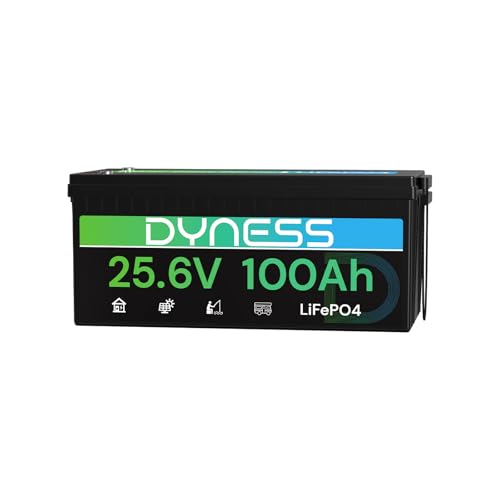
Dyness offers a 24V 100Ah LiFePO4 battery with A+ grade cells and a built-in 100A BMS. It supports over 4,000 cycles at 100% depth of discharge and includes protection for overcharge, discharge, short circuits, and overheating, plus a low-temperature cut-off for cold-weather operation. The battery is expandable via series or parallel connections, enabling larger banks (up to 51.2V and about 400Ah) for higher solar storage capacity and scalable off-grid power.
24V 100Ah LiFePO4 Battery (yeagulch)

This 24V 100Ah LiFePO4 battery uses thermally stable LiFePO4 cells with a built-in 100A BMS to guard against overcharging, over-discharging, overcurrent, and overheating. The unit is designed for RVs, boats, and off-grid systems, with a wide operating temperature range (-20°C to 60°C) and a lightweight profile (around 41.66 lbs). Its compact size makes it well-suited for space-constrained installations while maintaining reliable power delivery and protection.
Buying Guide
- Battery chemistry and lifecycle: LiFePO4 (LFP) offers long cycle life, good tolerances in cold weather, and safer chemistry compared with other Li-ion variants. Consider cells with a high cycle count (thousands) and a smart BMS for protection against overcharge, over-discharge, and short circuits.
- System voltage and compatibility: Ensure the panel kit and the battery bank align with a 24V system. Some kits target 24V specifically, while others are rated for 12V or 24V or support expansion to multiple series/parallel configurations.
- Charge controller features: Look for IP67 or IP65 ratings for weather resistance, MPPT or PWM efficiency, and clear status indicators. MPPT controllers generally extract more energy in variable sunlight, especially in off-grid setups.
- Durability and weather resistance: For outdoor installations, panels with tempered glass, corrosion-resistant frames, and protective coatings last longer in sun, wind, and salt-air environments. IP ratings provide a quick gauge of weather sealing.
- Physical footprint and installability: Compare weight, dimensions, and mounting options. Some kits include adjustable brackets and easy pre-drilled frames, reducing installation time on rooftops, poles, or walls.
- Expandability and future-proofing: If you plan to scale, choose systems that support adding more panels or larger LiFePO4 banks (e.g., 2P, 4P configurations or higher voltage banks) to meet growing power demands.
- Safety and certifications: Look for products with FCC/CE certifications for electrical safety and performance, and verify any required safety features in the BMS and charging circuitry.