Best Deep Cycle Marine Batteries for Solar Power on Boats
The right deep cycle battery can power solar systems on boats for days. This guide compares top AGM and LiFePO4 options, highlighting efficiency, durability, and suitability for marine use. Below, you’ll find five carefully chosen models with reliable performance, long life, and compatibility with trolling motors and off-grid marine setups.
| Product | Brand | Chemistry | Key Benefit |
|---|---|---|---|
| Weize Deep Cycle AGM 12V 100Ah | WEIZE | AGM Lead-Acid | Maintenance-free, low self-discharge |
| Renogy Deep Cycle AGM 12V 100Ah | Renogy | AGM Lead-Acid | Strong safety features, versatile connections |
| GRNOE 2-Pack 12V 100Ah LiFePO4 | GRNOE | LiFePO4 | Lightweight, long cycle life, built-in BMS |
| HRBEENERGY 12V 100Ah LiFePO4 | HRBEENERGY | LiFePO4 | High cycle life, built-in 100A BMS, efficient |
| Rvpozwer 12V 100Ah LiFePO4 | Rvpozwer | LiFePO4 | Long lifespan, expandable, Group 31 |
Note: Each product section provides a concise overview based on listed features, with focus on marine suitability, solar compatibility, and maintenance considerations. All links point to official Amazon product pages for convenience and accuracy.
Weize 12V 100Ah AGM Deep Cycle Battery
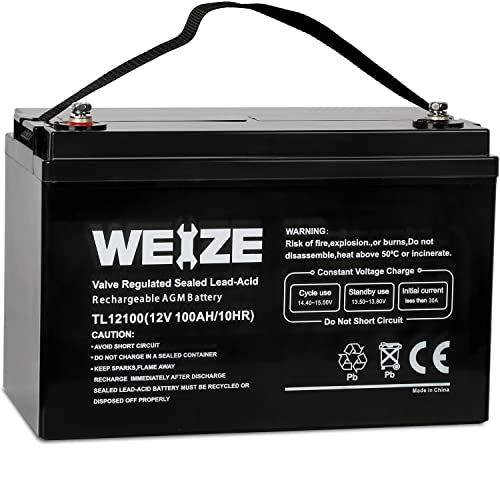
WEIZE’s AGM 12V 100Ah battery is maintenance-free with a compact 12.99 x 6.73 x 8.43 inch footprint. Its AGM technology limits acid leakage and minimizes maintenance. The battery supports a 1100A max discharge current for short bursts and offers a very low self-discharge rate, aiding long storage between charges. It operates effectively across a wide temperature range, making it suitable for varied marine environments. With a sealed design, this unit reduces the risk of spills, which is advantageous on boats with tight spaces.
Renogy Deep Cycle AGM 12V 100Ah Battery

Renogy’s AGM 12V 100Ah battery is a globally trusted option with strong safety and performance credentials. Its sealed design and robust internal construction reduce maintenance overhead. The battery supports series and parallel configurations (up to four in parallel), enabling scalable power for larger boat electrical systems. Renogy emphasizes safety and reliability, which is valuable for RVs, cabins, marine vessels, and off-grid setups where consistent power is essential.
GRNOE 2-Pack 12V 100Ah LiFePO4 Battery

This GRNOE LiFePO4 package includes two 12V 100Ah batteries with a built-in BMS, temperature protection, and advanced over-current and short-circuit safeguards. Weighing around 22.5 pounds each, these batteries offer significantly lighter weight than traditional lead-acid counterparts while delivering high energy density. The BMS protects against common LiFePO4 risks, and the compact footprint makes them a practical upgrade for marine solar systems. They’re suitable for RVs, cabins, and off-grid boat setups where weight and safety matter.
HRBEENERGY 12V 100Ah LiFePO4 Battery

HRBEENERGY offers a 12V 100Ah LiFePO4 battery with a built-in 100A BMS and low-temperature protection. The system emphasizes safe charging and discharging with high stability across cycles. It is lighter and more energy-dense than traditional lead-acid options, and it supports long cycle life—well-suited for continuous use in solar-powered marine applications. The recommended charging voltage is around 14.6V, and the BMS provides auto protection and recovery to minimize maintenance needs on boats.
Rvpozwer 12V 100Ah LiFePO4 Battery

Rvpozwer’s LiFePO4 unit provides extensive cycle life with a 12.8V nominal voltage. The built-in 120A BMS guards against typical LiFePO4 issues, including overcharge, over-discharge, and short circuits. Its 15000-cycle potential at 60% DOD makes it a strong option for long-term solar-powered marine setups. The battery is Group 31 compatible and supports series and parallel expansions for larger grid configurations, offering scalable marine power along with excellent safety features.
Buying Guide
- Battery chemistry: AGM batteries are maintenance-free and robust in marine environments, while LiFePO4 offers longer cycle life, lighter weight, and deeper discharges. For solar-heavy use, LiFePO4 often provides superior long-term value.
- Cycle life and depth of discharge: LiFePO4 cells typically deliver thousands of cycles with manageable depth of discharge, while AGM batteries have shorter lifespans and higher weight for similar capacities.
- Weight and space: LiFePO4 packs are noticeably lighter per Ah and more compact, which matters for boat installations with space constraints and weight limits.
- Thermal performance: Look for batteries with wide operating temperatures or built-in thermal protections. Marine environments can experience temperature swings that affect performance and longevity.
- BMS protections: A strong BMS protects against overcharge, over-discharge, short circuits, and overheating. This is especially important when batteries are used across multiple devices and in harsh marine conditions.
- Expandability: If your boat’s solar setup may scale, choose options that support series/parallel configurations to reach higher voltages or capacities without replacing the entire bank.
- Maintenance and safety: Sealed or AGM systems reduce acid leakage risk in wet environments. LiFePO4 batteries are inherently safer and less prone to leaking liquids compared with traditional lead-acid.
- Compatibility with trolling motors and inverters: Ensure the chosen battery can deliver peak currents required by trolling motors and power inverters used on boats.
- Warranty and service: Consider brands with solid warranties and easily accessible support, given the outdoor and vehicle-based use case.
When selecting a deep cycle marine battery for solar, compare total system requirements—including daily energy use, solar array size, and anticipated storage days—against battery chemistry, weight, and cycle life. For many marine solar systems, LiFePO4 options provide longer life, lower weight, and safer operation, though high-quality AGM choices still offer reliable performance with straightforward integration.