Best Home Solar Panels and Off-Grid Kits for House Power
Investing in home solar panels and off-grid kits can provide dependable energy, reduce bills, and increase resilience during outages. This guide features five highly relevant options that fit residential needs—from complete off-grid kits to high-efficiency solar panels with plug-and-play inverters. Each selection emphasizes ease of installation, longevity, and compatibility with typical American homes. Explore practical, reliable choices to power essentials like refrigerators, lighting, and small appliances even when the grid isn’t available.
| Product | Brand | Key Benefit | Link |
|---|---|---|---|
| ECO-WORTHY 9.36KWH 2400W 48V System Kit | ECO-WORTHY | High daily output with hybrid inverter | https://www.amazon.com/dp/B0BQV4YG1T?tag=infinitepower06-20 |
| Jackery HomePower 3000 | Jackery | Robust portable home backup with solar panels | https://www.amazon.com/dp/B0FFSDCNR4?tag=infinitepower06-20 |
| ECO-WORTHY 200W Panel Kit | ECO-WORTHY | Compact, durable off-grid solution | https://www.amazon.com/dp/B09RZZHHHM?tag=infinitepower06-20 |
| ECO-WORTHY 10KW Off-Grid System | ECO-WORTHY | Large-scale residential off-grid capability | https://www.amazon.com/dp/B0D6GNN255?tag=infinitepower06-20 |
| ECO-WORTHY 5KW Off Grid Complete Kit | ECO-WORTHY | Balanced kit for whole-house backup | https://www.amazon.com/dp/B0DKP24MKD?tag=infinitepower06-20 |
ECO-WORTHY 9.36KWH 2400W 48V System Kit

The ECO-WORTHY 9.36KWH kit delivers an approximate 9.36 kWh daily output under four hours of full sun, making it suitable for houses, sheds, cabins, and other energy backup needs. It includes a 5000W 48V all-in-one inverter and a 12-piece 195W solar panel array. The system is designed for plug-and-play installation, with pre-drilled panels and durable mounting hardware. Ideal for powering appliances like air conditioners, refrigerators, TVs, and microwaves, this kit emphasizes reliability and straightforward setup for residential use.
Key features include a 195W monocrystalline panel with corrosion-resistant framing, and a hybrid inverter that combines solar input with mains backup. It supports multiple charging modes and provides high efficiency with low EMI. The package targets homeowners who want a robust, ready-to-install solution for continuous power during outages or remote locations.
Considerations: installation space, roof or ground mounting availability, and electrical compatibility with your home’s service panel. Also assess local sunshine patterns to estimate daily output accurately. This kit is well-suited for households seeking a substantial, all-in-one off-grid solution with a strong emphasis on reliability.
Jackery HomePower 3000 Portable Power Station

Jackery’s HomePower 3000 combines a substantial 3,072Wh lithium battery with a 3,600W continuous output and 7,200W surge, offering reliable home backup for essential devices during outages. The unit features up to 20 ms UPS switching to keep critical items—like routers, fridges, and medical devices—operational with minimal interruption. It’s compatible with solar charging, and the 30% federal tax credit reference highlights potential cost-saving incentives for solar property owners.
This option is particularly relevant for homeowners seeking portable backup that can be deployed around the house or on the go, rather than a permanent, fixed-install system. Its modular nature, rapid charging, and solid lifespan—thanks to an efficient LiFePO4 battery—make it a practical supplement to fixed solar arrays, especially in regions with frequent weather-related outages or RV use.
Considerations: while highly portable and versatile, it is not a fixed-structure installation. It pairs well with a home solar array for rapid emergency power, but it may require careful placement and regular recharging during low-sun periods to maintain readiness.
ECO-WORTHY 200 Watts Solar Panel Kit

This ECO-WORTHY panel-only kit centers on high-efficiency monocrystalline cells with a 21.5% improvement in performance under optimal light. A compact footprint and corrosion-resistant aluminum frame support prolonged outdoor use, including on RVs or cabins. The kit’s 35.2 x 23.1 x 1.37-inch panels are designed to withstand wind and snow loads, making them a practical choice for housing backup or partial-grid-tallbacks.
Key advantages include a low-maintenance design, integrated mounting hardware, and strong resilience against environmental exposure. It’s suitable for homeowners who want to expand an existing system or outfit smaller structures with a dependable solar power source. The focus is on long-term durability and straightforward integration with compatible charge controllers and inverters.
Considerations: ensure you have an appropriate charge controller and mounting system for your roof or ground installation. Total system capacity depends on the number of panels deployed and your home’s energy needs, so plan for future expansion if you anticipate higher loads.
ECO-WORTHY 10KW Off-Grid System

This expansive off-grid system features a 10 kW rating with 20 kW peak power, designed for whole-house resilience in remote locations. The kit includes a 12 x 410W solar panel array, a 48V 100Ah LiFePO4 battery in a server rack form factor, and a 10 kW hybrid inverter capable of single-phase and split-phase outputs. The plug-and-play design minimizes wiring complexity, making it a practical option for modern homes seeking independence from the grid.
Considerations: large upfront investment and significant space requirements for solar panels and battery storage. The server-rack battery configuration is space-efficient but demands proper mounting and ventilation. This set is best for homeowners planning long-term energy independence with the capacity to power a wide range of home loads, including HVAC, appliances, and electronics during outages.
ECO-WORTHY 5KW Off Grid Complete Kit
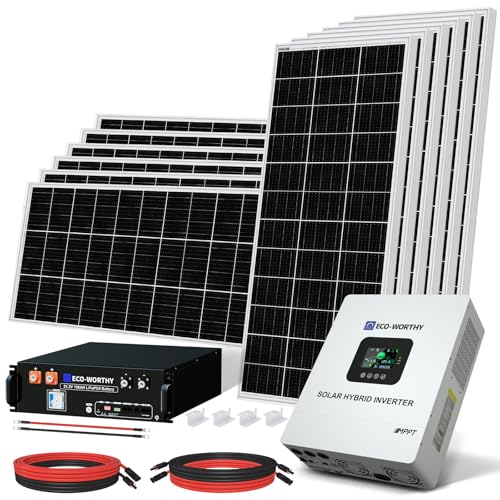
This complete off-grid kit provides a balanced solution with 12 x 195W mono solar panels (totaling 2,340W) and a 5 kW hybrid inverter with 120V/240V output, enabling parallel operation for higher power. The set includes a 51.2V 100Ah LiFePO4 battery, designed to be stacked in a server rack for efficient storage. The integrated wiring simplifies installation, making it a practical path to home energy independence while maintaining manageable scale for many households.
Considerations: assess your roof or yard space to accommodate 2340W of solar panels and ensure electrical capacity for the inverter. The kit’s UL 9540A-tested battery adds safety and regulatory compliance, but local permitting and electrical code adherence are essential for a smooth setup. This option suits homeowners seeking a mid-size, self-contained energy system with reliable performance and modular expansion potential.
Buying Guide: Key Purchase Considerations
- Energy needs and scale: Evaluate daily usage patterns, essential loads, and desired autonomy. Larger homes may justify 5–10 kW+ systems with substantial storage, while smaller spaces can rely on compact panels and portable units.
- System type: Decide between a full fixed-grid-tied setup with battery storage, a hybrid system, or a portable backup solution. Fixed systems offer continuous power through outages, while portable units provide flexibility for emergencies and off-grid travel.
- Storage capacity: Battery capacity (Wh and Ah) and chemistry (LiFePO4 is common) affect runtime and durability. A larger battery bank improves resilience during long outages but increases upfront cost and space needs.
- Inverter and controller: An efficient pure sine wave inverter protects appliances. MPPT controllers optimize charging under changing sunlight, boosting overall efficiency.
- Durability and warranty: Look for corrosion-resistant panels, robust mounting options, and a long warranty on modules, inverters, and batteries. This protects against performance loss and weather exposure.
- Installation considerations: Roof orientation, shading, and roof condition influence output. Ground mounting may offer more flexibility but requires space and permitting.
- Regulatory incentives: Federal and state tax credits and rebates can significantly reduce net costs. Verify eligibility and documentation requirements for your location.
- Maintenance and expansion: Consider modular kits that can be expanded later as energy needs grow or as budgets allow. A plug-and-play approach reduces complexity for DIY installation.
Across these options, the emphasis for housing remains on reliability, safety, and ease of integration with existing electrical systems. Homeowners should align system capacity with energy goals, available space, and local climate to ensure that the installed solar solution delivers consistent power year after year.