Best Solar Panel and Deep Cycle Battery Pairings for Reliable Off‑Grid Power
Choosing the right deep cycle battery to pair with a solar panel system can maximize efficiency and lifespan for off‑grid living, RVs, boats, and cabins. This guide reviews five top options that balance energy density, safety, and durability with solar charging compatibility. The selections cover lithium iron phosphate (LiFePO4) and AGM lead‑acid chemistries, along with compact solar panel kits designed for 12V systems. Use the comparisons below to identify batteries and panels that best fit your climate, charging setup, and maintenance preferences.
| Product | Brand |
|---|---|
| 2-Pack 12V 100Ah LiFePO4 Battery Group 31 | GRNOE |
| Weize Deep Cycle AGM 12V 100Ah | WEIZE |
| Renogy Deep Cycle AGM 12V 100Ah | Renogy |
| Solperk Solar Panel Kit 20W 12V | SOLPERK |
| 12V 300Ah LiFePO4 Battery | yeagulch |
GRNOE 12V 100Ah LiFePO4 Battery With Built‑In BMS

The GRNOE 12V 100Ah LiFePO4 battery combines high energy density with a rugged BMS that protects against overheating, overcharge, over-discharge, and short circuits. A built‑in low‑temperature cutoff enables safe charging in cold environments, with the BMS cutting charging below 32°F to prevent damage. Its compact dimensions (12.9 x 6.7 x 8.6 inches) and 22.48‑pound weight offer up to a 57 Wh/Lb energy density, making it a viable replacement for SLA/AGM batteries in RVs, cabins, and off‑grid solar setups. For optimal charging, use a 14.6V ± 0.2V adapter rather than a standard 12V charger.
WEIZE 12V 100Ah Deep Cycle AGM Battery
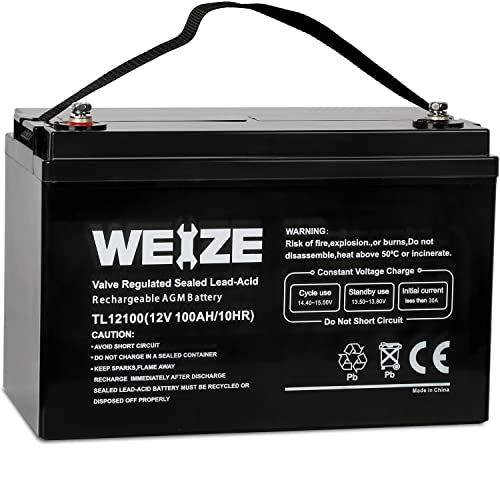
The WEIZE 12V 100Ah AGM battery provides maintenance‑free operation with a sealed design that reduces acid leakage risk. Its lower self‑discharge (1–3% per month) supports long storage between solar cycles. It handles a broad operating temperature range and can sustain up to 1100A for short bursts, making it suitable for RVs, solar storage, trolling motors, and off‑grid installations. This battery is best paired with a capable MPPT or PWM solar charge controller to optimize constant 12V charging from a 12V solar panel array.
Renogy Deep Cycle AGM 12V 100Ah Battery

Renogy’s 12V 100Ah AGM battery emphasizes safety and stability, designed for series or parallel connections without voltage limitations. Its sealed construction minimizes maintenance, while a low internal resistance supports higher discharge currents when appliances demand surge power. Renogy emphasizes a long shelf life and controlled self‑discharge, which helps preserve stored energy between cloudy days. This makes it ideal for RVs, cabins, and off‑grid systems where reliability and low maintenance are priorities.
Solperk Solar Panel Kit 20W 12V
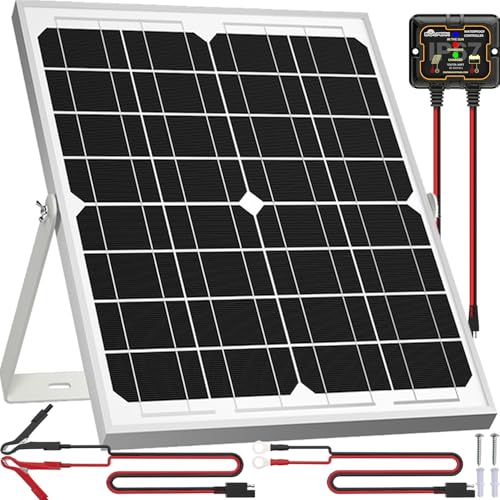
This 20W Solperk solar panel kit is designed for charging and maintaining 12V batteries, including LiFePO4, AGM, and SLA chemistries. It features a monocrystalline A+ cell with high efficiency (21%–30%) and a robust, weatherproof build. The included 8A controller uses a smart three‑stage charging design to prevent overcharging and optimize solar input. A durable frame and waterproof construction support outdoor use on boats, RVs, and cars, while indicators keep users informed of charging status.
YEAGULCH 12V 300Ah LiFePO4 Battery

The YEAGULCH 12V 300Ah LiFePO4 battery offers a significantly larger energy capacity with a robust BMS that provides over‑charge, over‑discharge, and short‑circuit protection. It supports balancing when charging voltage exceeds 14.1V to maintain uniform state of charge across parallel cells. With a focus on safety and high cycle life (up to 6000+ cycles at 80% DoD), it suits large energy storage needs for RVs, marine applications, and off‑grid homes seeking extended runtimes between charges.
Buying Guide: Key Purchase Considerations
Chemistry And Safety
LiFePO4 batteries offer high cycle life and stable chemistry with strong thermal safety, making them ideal for solar storage where longevity matters. AGM batteries are solid, maintenance‑free, and budget‑friendly for smaller systems. Evaluate BMS features such as overcharge/overdischarge protection, short‑circuit protection, and temperature management to protect both battery and connected electronics.
Capacity, Weight, And Footprint
For off‑grid or mobile use, energy density matters. LiFePO4 packs deliver more usable energy per kilogram, while AGM packs tend to be heavier for the same Ah rating. Consider space constraints, mounting options, and whether you’ll frequently discharge deeply or prefer moderate DoD to extend battery life.
Charging Compatibility
Ensure your solar panel array, charge controller (PWM or MPPT), and battery chemistry align with recommended charging voltages. LiFePO4 typically uses a charge voltage around 14.4–14.6V, while AGM often accepts similar ranges but with different charging curves. A reliable MPPT controller can improve efficiency, especially in variable sunlight.
Durability And Weather Resistance
Outdoor solar setups demand weatherproof enclosures, corrosion resistance, and solid mounting hardware. Panels with tempered glass and sturdy frames withstand wind and hail. For batteries, sealed designs reduce maintenance needs in humid or salty environments, while robust BMS adds a layer of safety for portable or marine systems.
Lifecycle And Warranty
LiFePO4 batteries commonly boast thousands of cycles under proper use, paying off in long‑term savings, while AGM options offer proven performance with shorter cycle expectations. Review manufacturer warranties, return policies, and replacement terms to assess long‑term risk and total cost of ownership.
System Scale And Budget
Match your solar kit with your energy demands. If you plan to power appliances with a higher startup surge, prioritize batteries with higher discharge currents and reliable BMS protection. Budget constraints may steer you toward a mix of smaller solar panels paired with a dependable 12V battery bank rather than oversized packs configured for future expansion.